Humor is a tightrope walk. One person's brilliant subversive joke is another person's reason to leave the party. The "offensive funny t-shirt" market is flooded with low-effort, mean-spirited designs that mistake cruelty for comedy — but there's also a real craft to edgy humor that lands. The difference between a shirt that's hilariously provocative and one that's just awful comes down to mechanics, not luck.
This guide is about those mechanics: why some edgy shirts get laughs and others get glares, the difference between punching up and punching down, and how to read the room before you wear the joke. No slurs, no hate — just an honest breakdown of where the line is and how to stay on the funny side of it.
Table of Contents
The Mechanics: Why Edgy Jokes Land (or Don't)
There's an actual theory for this. The Benign Violation Theory, developed by researchers Peter McGraw and Caleb Warren, proposes that humor happens when three conditions are met: something violates how the world "ought" to be, the violation is perceived as benign (safe), and both perceptions happen at once. A shirt with a dark joke about existential dread registers as a violation — but because it's just ink on cotton, your brain files it as safe. Result: a laugh.
This is why the exact same joke can kill in one room and bomb in another. The "benign" part is entirely contextual. A joke about Monday mornings is benign almost everywhere. A joke that targets a real person's real suffering isn't benign to anyone who recognizes themselves in it — the violation stays a violation, and nobody laughs except people who enjoy the cruelty. That's the entire game: edgy humor works when the audience can see the safety net. Remove the net, and it's not comedy anymore.
The other half of the mechanics is intelligence signaling. Edgy humor that requires the reader to get a reference, spot the irony, or complete the thought flatters the audience — "you're smart enough to get this." Edgy humor that's just a crude word in big letters insults the audience's intelligence instead. One earns respect; the other earns an eye-roll.
There's one more layer worth understanding: the audience completes the joke. An edgy shirt isn't a finished comedy bit — it's half a bit, and the reader's brain supplies the other half. That's why the smartest edgy designs leave room for interpretation rather than spelling everything out. A shirt that hands you the entire joke is just a statement; a shirt that makes you connect two dots yourself gives you a tiny hit of satisfaction for getting it. This is also why edgy humor fails so badly when it misjudges its audience — if the reader can't or won't complete the thought the way you intended, the half-bit collapses into just the offensive half.
Punching Up vs. Punching Down
This is the single most useful rule in edgy comedy, and it applies perfectly to shirts:
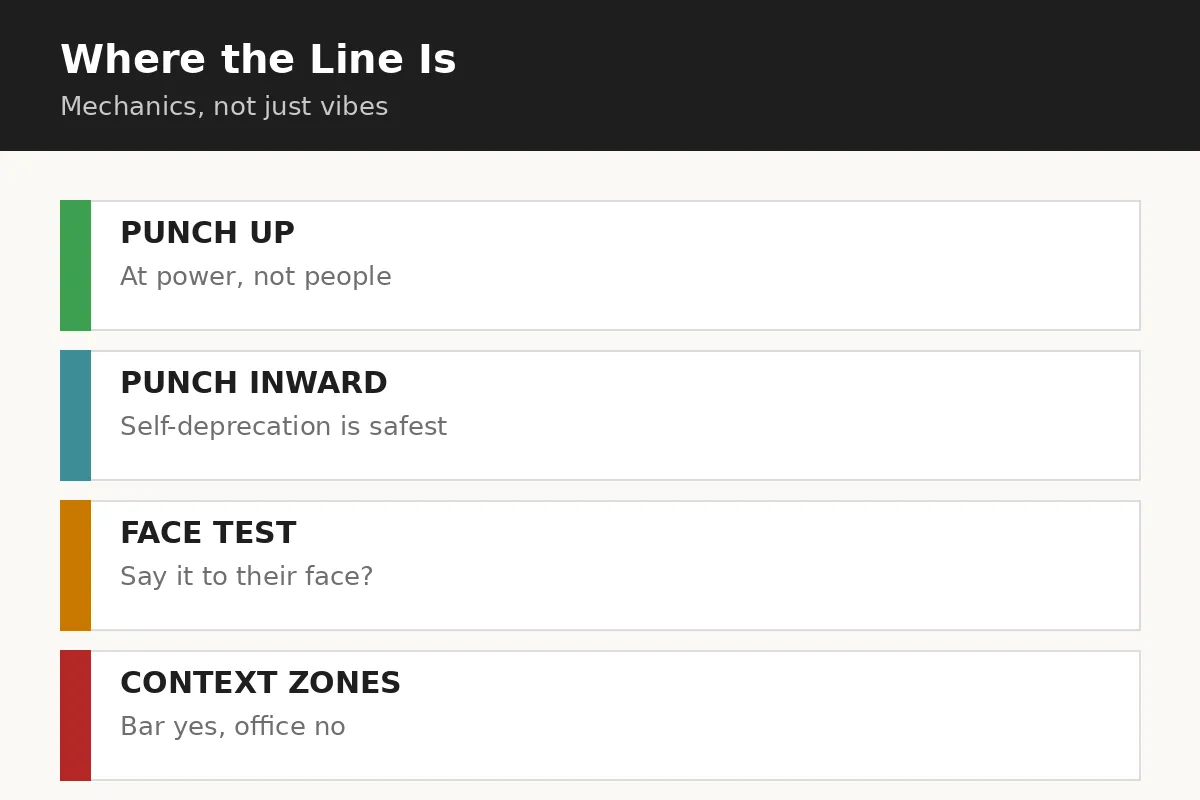
- Punching up — mocking the powerful, the pompous, or the absurd systems we all live under. Billionaires, bureaucracy, corporate jargon, the performative nature of social media. The target can take it, and the audience enjoys watching.
- Punching inward — mocking yourself. "I'm the reason we can't have nice things." Self-deprecation is the safest edgy lane because the only person who can be offended is you, and you signed up for it.
- Punching down — mocking people with less power, or targeting someone's identity, appearance, or circumstances they didn't choose. This is where "offensive funny" curdles into just offensive. It's also the laziest form of humor — it requires zero wit to mock someone who can't mock back.
A useful test before buying or wearing: would you be comfortable explaining the joke to the exact group it references, face to face? If the answer is no, the shirt isn't brave — it's just mean with extra steps.
Three Lanes of Edgy Humor That Work
Within the safe zone, three approaches consistently land:
1. The Absurdist Pivot
The shirt sets up like it's going somewhere provocative, then veers into total nonsense — a design styled like a political manifesto that turns out to be a recipe for mediocre lasagna. It borrows the aesthetic of offense to deliver a punchline of pure triviality. The edge is in the format, not the target, so nobody gets hurt and everybody gets the joke.
2. Self-Deprecating Nihilism
"Disappointing my parents since 1994." "My life is a blooper reel." Technically negative, but the wearer is the target, which makes it socially bulletproof. In an era of relentless self-optimization content, wearing your anxiety on your chest reads as honesty — and honesty is inherently funny when it's well-phrased.
3. The Wordplay Trap
Linguistic subversion: a phrase that sounds provocative until you parse it, then resolves into something clever or wholesome. The humor comes from the reader's own double-take — they caught themselves assuming the worst, and the shirt rewards them for reading carefully. This lane ages the best because it relies on craft, not shock.
Context Is King: When and Where
An edgy shirt is a high-risk, high-reward social strategy, and the risk is almost entirely about context:
- Safe zones: dive bars, music festivals, comedy shows, close friend groups who know your actual values. Places where irony is the default language.
- Gray zones: casual Fridays, house parties with mixed company, the gym. Know your audience — if you have to wonder whether it'll land, it won't.
- No-go zones: workplaces with dress codes, family gatherings with grandparents, anywhere children are the primary audience, first dates, job interviews. The joke cannot be funny if the setting makes everyone uncomfortable before they read it.
Generational context matters too. Younger audiences tend to read edgy shirts through an ironic, meta-humor lens; older audiences are more likely to take the text at face value. If the observer doesn't share your layer of irony, they just see the offense — and that's on the wearer, not the observer.
One more practical note: most workplaces can legally restrict what you wear on the job. "Free speech" protects you from the government, not from your employer's dress code. When in doubt, the edgy shirt stays home.
The Quality Test
Here's an underrated factor: the physical shirt itself determines whether edgy reads as "intentional" or "trashy." The same joke on a clean, well-fitted tee with sharp typography reads as deliberate wit. On a neon monstrosity with stretched clip art, it reads as something fished out of a boardwalk bargain bin. If you're going to be provocative, be well-dressed about it:
- Typography matters most. Clean, confident type sells the joke. Wacky fonts try too hard and undermine the deadpan delivery edgy humor needs.
- Fit matters second. A good blank signals that the provocation is a choice, not an accident.
- Restraint wins. The edgiest effective shirts are usually minimalist — one line, well set. Shock value decreases as font size increases.
For designs that walk this line well, browse the collection — and if you want the mechanics of choosing any funny shirt, start with our funny gym shirt guide.
Frequently Asked Questions
Are offensive shirts allowed at work?
Generally, no. Most workplaces have dress codes covering offensive or disruptive imagery, and private employers can enforce them. Even a genuinely funny edgy shirt can be a problem if it creates a hostile environment for coworkers.
How do I tell if a shirt is funny or just mean?
Ask three questions: Is it clever, or just crude? Who is the target — someone with power, or someone vulnerable? Would you explain the joke to the target's face? If it fails two of the three, it's mean, not funny.
Why are nihilistic and dark-humor shirts so popular?
Dark humor often works as a coping mechanism — turning anxiety about the state of the world into a joke makes it feel more manageable. It's also a reaction against the polished perfection of social media; a shirt that says "I'm a disaster" reads as honest.
Can I get in legal trouble for wearing an offensive shirt?
In the US, public spaces are broadly protected, but private businesses can refuse service and employers can enforce dress codes. In some countries with stricter hate-speech laws, certain symbols or phrases on clothing can carry real legal consequences. This isn't legal advice — when in doubt, don't wear it.
Where can I find edgy shirts with actual wit?
Independent artists on marketplaces like Redbubble, TeePublic, and Etsy tend to have more nuanced, well-crafted edgy designs than mass-market retailers. Look for sellers whose catalog shows consistent wit rather than one lucky crude hit.
Is it okay to gift someone an edgy funny shirt?
Only if you know their humor extremely well. An edgy shirt is a high-trust gift — it says "I know exactly what makes you laugh and what doesn't cross your line." When you're unsure, default to the self-deprecating or absurdist lanes; they carry the edgy flavor with almost none of the risk. A misjudged edgy gift doesn't just miss, it tells the recipient you don't actually know them.
Related reading: funny gym shirts, sarcastic t-shirt sayings, and the design collection.