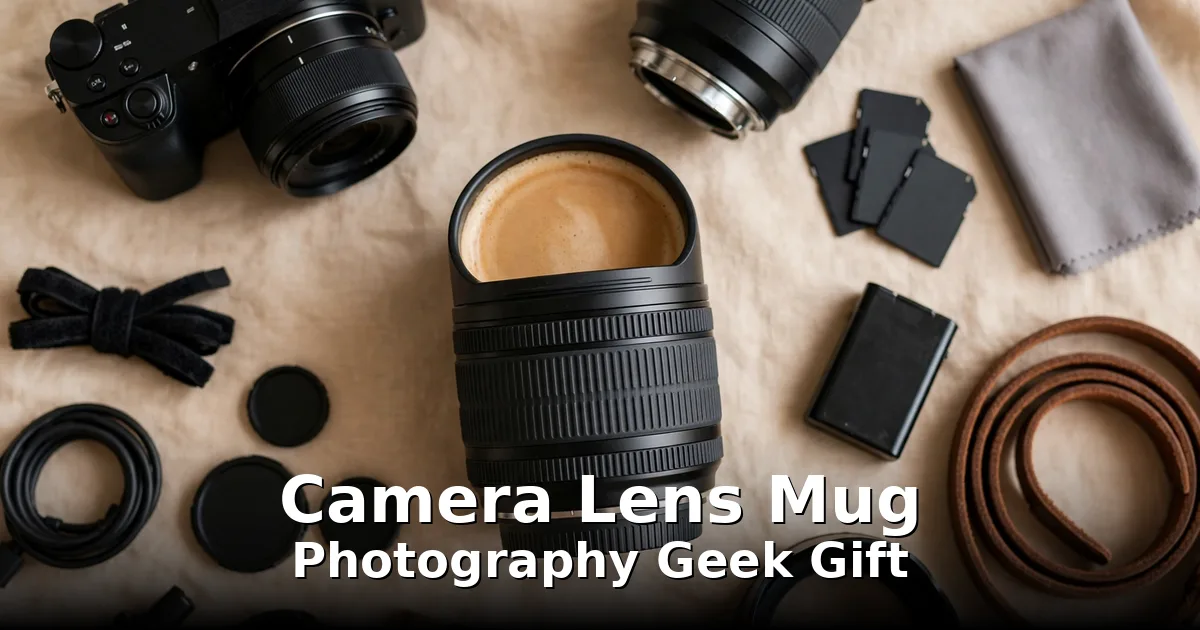
Walk into any production house or freelance photographer's home office and you will likely spot a Canon-style lens sitting precariously close to a keyboard. At first glance it is a heart-stopping sight, until you notice the steam rising from the "front element." The camera lens mug has graduated from gag gift to a genuine desk staple, but not all of them are built equally. This guide breaks down the anatomy, the insulation differences that matter on cold shoot mornings, and the details photographers actually notice before you buy.
Table of Contents
Key Takeaways
- The interior lining matters most: stainless steel keeps drinks warm far longer than plastic shells.
- Photographers notice details — focal-length markings and switches should look right.
- Never store a lens mug in a real camera bag; liquid and electronics are a bad combination.
- Check cup-holder fit and dishwasher/microwave limits before gifting.
Anatomy of a Good Lens Mug
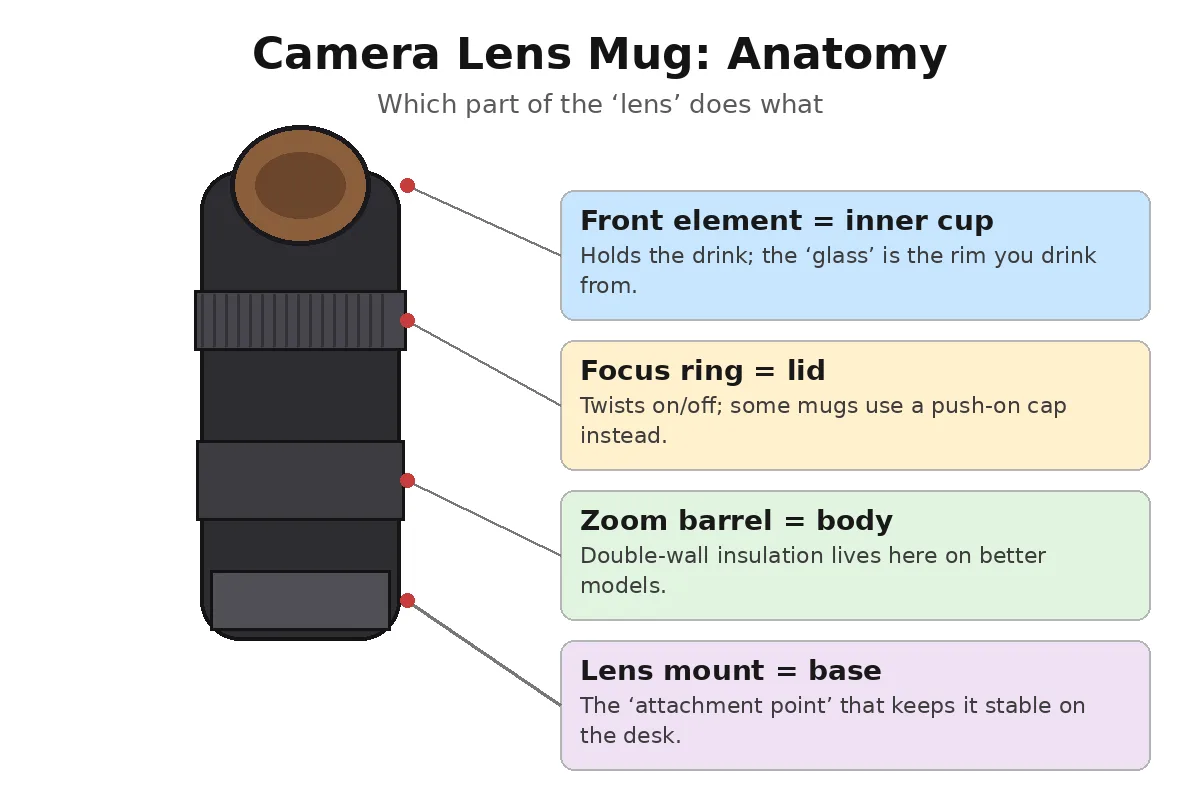
A lens mug has three parts worth judging before anything else: the exterior shell, the interior lining, and the lid.
The Exterior Shell
Most shells are high-impact plastic finished to mimic a lens body, often with rubber-style grip rings and branding accents. The better replicas copy real lens designs — the Canon-style 24-105mm profile is the most common — with believable focal-length markings and a focus switch that actually moves rather than being molded into the shell.
The Interior Lining
This is where quality splits. Cheap versions use a plastic interior that retains odors and loses heat quickly. Better ones use a stainless steel liner, which resists smell absorption and holds temperature noticeably longer. If the product description doesn't mention the interior material, assume plastic.
The Lid
Lids generally come in two styles: a screw-on "lens cap" type and a snap-on sip lid. Screw-on lids travel better. Snap-on sip lids are more convenient for desk use but tend to leak if the mug tips over.
Interior Materials: Stainless Steel vs Plastic
Insulation matters if the photographer in your life shoots early mornings. A plastic-lined mug feels light and toy-like and cools fast. A stainless steel-lined mug has a satisfying heft, keeps drinks warm much longer, and doesn't pick up yesterday's dark roast flavor. Stainless steel also avoids the plasticky smell some cheap mugs develop after a few months of use.
One trade-off: stainless steel interiors mean the mug should never go in the microwave. That is a safety point worth repeating when gifting, since many people heat their coffee by default.
The Common Replica Types
Most lens mugs on the market copy one of a few lens archetypes:
- The 24-105mm standard zoom replica: The most common and most recognizable. Usually around 12oz and sized to fit a standard cup holder.
- The 70-200mm tall telephoto: Larger capacity, often 14-16oz, but top-heavy — keep it away from desk edges.
- The "nifty fifty" mini: Small espresso-sized versions. Cute, but they cool quickly and hold little.
- Novelty editions: Gold finishes and special colors. Best treated as display pieces, since decorative finishes rarely survive dishwashers.
None of these are typically licensed by the camera brands; they are third-party replicas. That is worth knowing, but it doesn't matter much for a gift — the joke lands either way.
Etiquette and Safety
The classic prank is real: someone sees a "lens" on a desk, reaches for it, and gets coffee. But there are two rules worth following.
Rule one: never put a filled lens mug in an actual camera bag. Packing liquid next to thousands of dollars of electronics at 4 AM, when muscle memory takes over, is asking for an expensive accident. Cup holders and desks only.
Rule two: think about where you carry it. A hyper-realistic lens mug can attract attention in places where cameras are restricted — museums, secure buildings, events with no-photography rules. A confused security conversation is rarely worth the joke.
Creative Uses Beyond Coffee
Photographers accumulate mugs the way they accumulate lenses, so versatility helps:
- Pen and stylus holder: The standard-zoom size is ideal for pens and styluses on an editing desk.
- Tool organizer: Lens pens, memory cards in sleeves, and small hex keys live happily in one.
- Planter: A small succulent in a mini lens mug looks great on a windowsill — add gravel at the bottom since there are no drainage holes.
- Tip jar or coin jar: For studio counters and fundraisers.
The Detail Test: What Photographers Actually Judge
Here is the thing about gifting a camera lens mug to a photographer: they will inspect it like they inspect a lens. The better the details, the bigger the reaction. The most commonly copied designs mimic a 24-105mm standard zoom, so use that as your reference point.
The focus switch: On good replicas it is a separate, movable piece labeled AF/MF. On cheap ones it is molded into the shell and painted on. A photographer will flick it within seconds of picking the mug up — a real switch gets a laugh; a fake one gets a polite nod.
The focus and zoom rings: Look for textured rubber-style rings that rotate. They don't need to do anything functional, but a ring that turns feels right in the hand and sells the illusion from across a desk.
The mount-end details: The "rear" of the mug (where the lens mount would be) should have believable contacts and alignment markings. Cheap versions leave this blank or sloppy — and photographers always look at the back.
The front element: Some mugs include a glass-look front with a reflective coating that mimics lens glass. It looks great on a shelf but scratches if you stir with a metal spoon. Wooden or plastic stirrers only.
The hood look: A few designs include a petal-shaped lens-hood-style rim around the lid. It is pure decoration, but it completes the silhouette.
Care and Cleaning
A lens mug lasts years with basic care and months without it. Hand-wash the shell with warm soapy water and a soft cloth — dishwashers loosen the rubber-style grip rings and can trap water between the inner liner and the outer shell, which leads to rattling and odors. Dry the lid seal separately; trapped moisture under a screw-on lid is the most common source of musty smells.
For stainless steel interiors, the baking-soda-paste trick works for coffee stains without scratching. Never use bleach on the exterior — it fades the printed markings and can discolor the grip rings. And store it upright: the tall telephoto-style mugs tip easily in a crowded cupboard.
Gifting Scenarios
- Birthday: Pair the mug with a lens cloth or memory card — practical, photography-adjacent, and shows you thought about their actual hobby.
- Secret Santa / office exchange: The lens mug is a classic white-elephant winner: universally recognizable, funny on reveal, and genuinely usable afterward.
- Graduation (photo school): A lens mug with a congratulations card lands better than generic "follow your dreams" gifts. It says you see them as a real photographer now.
- Studio warming: For a photographer opening a studio, a set of two lens mugs (one standard zoom, one telephoto) makes a great counter display that clients will ask about.
Buyer's Guide: What to Check Before You Buy
Photographers are detail-obsessed, so the markings matter. If the barrel says something impossible like "24-1000mm," they will notice. Look for listings that describe the replica accurately.
Check the focus switch: on better models it is a separate piece that actually moves; on cheap ones it is molded into the shell. Check the volume against how the recipient drinks — espresso drinkers are fine with a mini, while commuters want 14oz or more. And check care instructions: most lens mugs are hand-wash only, and none with a steel interior should see the inside of a microwave.
For more on personalized drinkware in general, see our custom mugs guide, and browse the full collection on our designs page. Shopping for other occasions? See our nurse coffee mugs guide, funny retirement mugs, Class of 2026 mugs, and German Shepherd mom mugs.
Frequently Asked Questions
Are camera lens mugs dishwasher safe?
Usually not. Dishwasher heat can loosen the rubber-style grip rings and trap water between the liner and the shell. Hand-washing is the safest option for preserving the detail.
Can I microwave a camera lens mug?
No — not if it has a stainless steel interior, which most quality versions do. Metal in a microwave is a fire hazard, and even all-plastic versions often have metallic-painted accents.
Do lens mugs fit in car cup holders?
The standard 24-105mm-style replicas are generally sized to fit. Taller telephoto-style versions can be top-heavy, so drive accordingly.
Are camera lens mugs officially licensed?
Almost always no. The vast majority are third-party replicas. That doesn't reduce their gift value, but it explains the price.
What size should I buy as a gift?
A 12oz standard replica is the safe default for desk use. For commuters or heavy coffee drinkers, look for 14oz or larger telephoto-style versions.