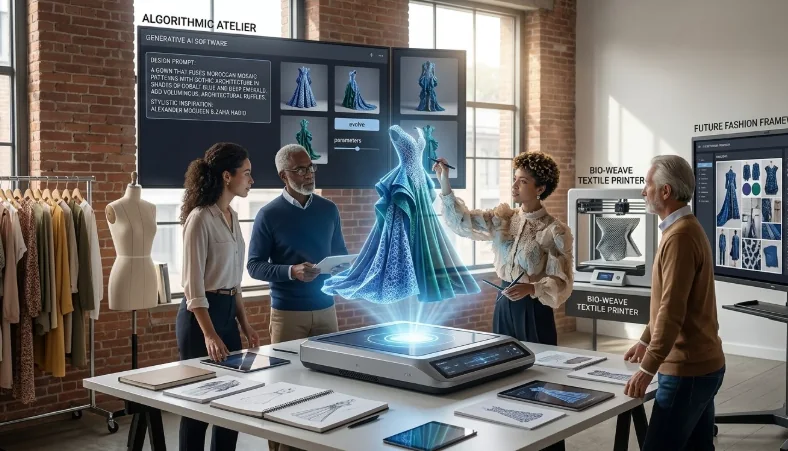
The Algorithmic Atelier: How AI is Reimagining the Future of Fashion Design
Table of Contents
Key Takeaways
AI is shifting fashion from mass production to hyper-personalized, on-demand manufacturing.
Generative Adversarial Networks (GANs) allow designers to explore "impossible" geometries and textures.
Digital-only fashion (NFTs and skins) is reducing the carbon footprint of the traditional sampling process.
Human intuition remains vital for emotional storytelling and ergonomic functionality.
The Evolution of Generative Fashion
Fashion has always been a mirror of the tools we use to create it. From the spinning jenny to the sewing machine, technology dictates the silhouette. But what happens when the tool begins to think—or at least, simulate thought? We are currently witnessing a seismic shift where futuristic clothing designs are no longer sketched solely by human hands, but generated through complex neural networks.
What’s fascinating about this shift is that it bypasses the traditional constraints of "trend forecasting." Traditionally, a designer looks at the past decade, sprinkles in some current cultural sentiment, and hopes for the best. AI, however, processes millions of data points across social media, historical archives, and even biological patterns to propose aesthetics we haven't yet conceptualized. It’s less about a new seasonal color and more about fundamentally re-engineering how fabric interacts with the human form.
Early experiments in AI fashion often looked like "glitch art"—unwearable, surrealist blobs of digital fabric. Today, brands like The Fabricant and RTFKT are proving that AI-driven design can produce high-fashion silhouettes that are not only aesthetically breathtaking but technically feasible for 3D printing and advanced textile weaving.
The Tech Stack: From GANs to Diffusion Models
To understand how these futuristic designs come to life, we have to look under the hood. Most AI clothing design relies on Generative Adversarial Networks (GANs). Imagine two artists: one (the Generator) tries to create a new dress design, while the other (the Discriminator) critiques it based on a dataset of thousands of existing high-fashion images. They iterate millions of times until the Generator produces something that looks like high fashion, yet is entirely original.
More recently, Stable Diffusion and Midjourney have entered the studio. These tools allow designers to use "text-to-image" prompts to visualize complex materials. A designer might prompt: "A kinetic exoskeleton jacket made of translucent bioluminescent mycelium leather, 8k, hyper-realistic." Within seconds, the AI provides a visual prototype that would have previously taken a concept artist weeks to render.
Industry Terminology to Know:
Latent Space: The mathematical "space" where the AI identifies patterns; exploring this space allows designers to find "in-between" styles that don't exist yet.
Procedural Texturing: Using algorithms to create fabric textures that mimic natural growth patterns, like coral or ice crystals.
Topology Optimization: Using AI to remove unnecessary material from a garment, making it lighter while maintaining structural integrity (often used in futuristic footwear).
Sustainability and the Zero-Waste Algorithm
Let's talk about the elephant in the room: fashion is one of the world's most polluting industries. Statistics from the Global Fashion Agenda suggest that the industry accounts for roughly 4% of global greenhouse gas emissions. This is where AI moves beyond just "looking cool" and starts solving real-world problems.
In my observation, the most significant impact of AI is in the sampling phase. Traditionally, a brand might produce 20 physical prototypes of a single jacket before finalizing the design. Each prototype involves shipping, fabric waste, and labor. AI-driven digital twins allow brands to perfect the drape, fit, and movement of a garment in a virtual environment. Only when the design is perfect is a single physical version produced. This "digital-first" workflow can reduce material waste by up to 30% in the design phase alone.
ومن زاوية أخرى مكملة, AI-driven pattern nesting algorithms are maximizing fabric yield. By calculating the most efficient way to cut pieces from a roll of cloth, AI minimizes the "scraps" that usually end up in landfills. It's a marriage of high-tech aesthetics and environmental ethics.
Comparison: Human vs. AI Design Methodologies
You might be wondering: is AI going to replace the fashion designer? Not exactly. It's more about a shift in the workflow. Here is how the different approaches stack up in the current market.
Design Method Pros Cons Rating Best For Traditional Human Design High emotional resonance; deep understanding of human ergonomics; brand storytelling. Slower time-to-market; limited by the designer's personal biases and experiences. ⭐⭐⭐⭐ Heritage luxury & bespoke tailoring. Pure AI Generation Infinite iteration speed; discovers "impossible" patterns; zero initial material waste. Often produces physically impossible garments; lacks "soul" or cultural context. ⭐⭐⭐ Conceptual art & digital-only fashion. AI-Augmented (Hybrid) Combines human taste with machine efficiency; optimizes for sustainability. Requires a high technical skill set; expensive software overhead. ⭐⭐⭐⭐⭐ Modern streetwear & performance gear. Procedural/Parametric Design Perfect for 3D printing; highly functional; data-driven fit. Can feel "cold" or overly technical; limited by current 3D printing materials. ⭐⭐⭐⭐ Athletic footwear & protective gear.
The Designer-Machine Collaboration
Here's the thing: an AI doesn't know what it feels like to wear a wool coat on a rainy Tuesday in London. It doesn't understand the nostalgia of a 1990s grunge aesthetic or the political statement behind a certain silhouette. This is why the most successful futuristic designs are coming from collaboration.
In my experience, the best designers use AI as a "super-powered mood board." They feed the algorithm their own sketches and let the AI propose 500 variations. The human then acts as a curator, selecting the 1% that actually resonates with human emotion. This process, often called "centaur designing," allows for a level of complexity that neither the human nor the machine could achieve alone.
Take, for instance, the work of Iris van Herpen. While she utilizes digital technologies, the final execution involves painstaking hand-craftsmanship. This hybridity is the hallmark of the new "futuristic" era—where the algorithm provides the blueprint for complexity, and the human provides the soul.
Technical Hurdles and Intellectual Property
It’s not all smooth sailing in the world of algorithmic couture. There are significant roadblocks that the industry is currently grappling with. What's interesting is that the biggest challenge isn't the technology itself, but the legal framework surrounding it.
The IP Conundrum: If an AI is trained on the archives of Alexander McQueen and produces a "new" dress in that style, who owns the copyright? Is it the software developer, the designer who wrote the prompt, or the estate of the original designer? Currently, the law is in a state of flux. In the US, the Copyright Office has generally maintained that works created solely by AI without "human authorship" cannot be copyrighted. This creates a massive risk for brands investing millions into AI-generated collections.
ومن زاوية أخرى مكملة, we have the "Physics Gap." An AI can easily render a dress made of liquid gold and floating feathers. However, translating that into a pattern that a seamstress can sew—or a 3D printer can execute—is a different story. We are seeing a rise in "Digital Pattern Making" software like CLO3D that attempts to bridge this gap by applying real-world physics (gravity, elasticity, friction) to AI-generated concepts.
Predicting the Next Decade of Wearables
Where are we heading? I believe the next ten years will see the rise of Adaptive Fashion. We are moving away from static garments toward "living" clothing. Imagine a jacket that changes its porosity based on your body temperature, controlled by a small on-board AI that learns your metabolic patterns. This isn't science fiction; companies are already experimenting with smart textiles and Shape Memory Alloys (SMAs).
We will also see the democratization of design. Soon, consumers might not buy a finished shirt. Instead, they’ll buy a "design license" from a brand, feed it into a local AI customizer that adjusts the fit to their specific body scan, and have it 3D-printed or knitted on-demand at a local micro-factory. This would effectively end the era of "size medium" and usher in the era of "Size You."
What I've found is that people are surprisingly open to this, provided the tech remains invisible. No one wants to look like a walking motherboard. The goal of futuristic AI design is to make clothing feel more natural, more personal, and more aligned with our biology than mass-produced garments ever could.
Frequently Asked Questions
Is AI-generated clothing actually wearable in real life?
Yes, though it requires a bridge. While many AI designs are purely conceptual, designers use them as blueprints for physical garments. By using 3D modeling software like CLO3D or Marvelous Designer, the AI visuals are converted into realistic patterns that can be sewn or 3D printed using technical fabrics.
How does AI fashion help the environment?
AI helps reduce waste by allowing for virtual sampling, which eliminates the need for multiple physical prototypes. It also optimizes fabric cutting patterns to minimize scrap waste and allows for "on-demand" manufacturing, reducing the massive overstock that usually ends up in landfills.
Are AI designs replacing human fashion designers?
No, but they are changing the designer's role. Designers are moving from "creators from scratch" to "curators and directors." Humans are still essential for emotional storytelling, cultural context, and ensuring the ergonomic comfort of a garment.
What is "Digital Fashion" or "Metaverse Clothing"?
Digital fashion consists of garments that only exist in virtual environments. These can be worn by avatars in games, used in AR (Augmented Reality) filters for social media, or traded as NFTs. AI is the primary tool used to create the complex textures and physics of these digital-only items.
Can I use AI to design my own clothes today?
Absolutely. Tools like Midjourney, DALL-E 3, and Adobe Firefly allow anyone to generate fashion concepts. For those wanting to go deeper, platforms like "New Black" are specifically designed to help users create AI-driven fashion designs that can eventually be manufactured.