Custom birthday shirts have grown from a niche craft into a staple of modern celebrations — from a toddler's first "Wild One" party to a "Dirty Thirty" bar night to a golden 50th. Done well, a custom shirt is the party's uniform, its photo backdrop, and its souvenir all at once. Done poorly, it is an itchy shirt nobody wears again.
This is the complete guide to getting it right: when custom shirts are worth it, the design themes that work, professional design principles, printing methods, fabrics, group ordering logistics, and care.
Table of Contents
- Why Custom Birthday Shirts Work
- Popular Themes and Trends
- Design Principles: Color, Fonts, Placement
- Printing Methods: DTG, Screen Print, Vinyl, Sublimation
- Fabric and Fit Choices
- Group Orders and Birthday Squads
- Order Timeline: Working Backwards From Party Day
- DIY at Home: Cricut and Heat Press Basics
- Common Mistakes to Avoid
- Care: Making the Print Last
- Frequently Asked Questions
Why Custom Birthday Shirts Work
A custom shirt earns its place at a birthday for practical reasons, not just decorative ones:
- Wayfinding: In a crowded restaurant, bar, or theme park, matching shirts make your group instantly findable.
- Photos: Coordinated shirts give group photos a cohesive, intentional look — the difference between a snapshot and a keepsake.
- Inclusion: Handing a guest a shirt says they are part of the inner circle, not just an attendee.
- Longevity: Unlike decorations, a good shirt gets worn for years — each wear is a small reminder of the day.
- Expression: Inside jokes, nicknames, and niche references that no store-bought shirt could capture.
Popular Themes and Trends
Milestone numbers
The classics endure for a reason: "Vintage [birth year]," "Aged to Perfection," "Level [age] Unlocked." They work for every decade and photograph clearly.
The birthday squad system
The birthday person gets the statement shirt ("Birthday Queen," "Birthday Legend"); the group gets the supporting version ("Birthday Squad," "Security Detail"). For a modern take, skip literal "squad" text and use a shared theme — a group trip might wear "The Nashville Tour 2026" with the honoree's shirt in a different color.
Pop culture parodies
Reworking a famous logo or movie-poster style with a birthday twist ("Birthday Brew" in coffee-shop lettering) is consistently popular. Keep it "inspired by" — direct copies of copyrighted characters or logos will get a professional order refused.
Minimalist statements
"This is my 40th birthday shirt" in bold type on a plain blank. Simple, modern, and the most likely to be worn again — because it reads as a design choice, not a costume.
Photo shirts
A favorite photo of the birthday person — baby pictures for milestones are a perennial hit — printed large. DTG printing handles this best; start from a high-resolution original.
Design Principles: Color, Fonts, Placement
- Contrast is everything. The number-one amateur mistake is ink too close to the shirt color. White or gold on black, charcoal on heather gray — if it doesn't read at thumbnail size, it won't read across a room.
- Two fonts, maximum. One expressive font for the headline (age, name), one clean font for everything else. Script for elegance, bold sans for energy, rounded playful fonts for kids' parties.
- Resolution matters. Photos and logos should be high-resolution (300 DPI at print size is the standard target); vector files scale cleanly to any size.
- Placement: Center chest is standard, starting a few inches below the neckline. Left-chest prints and sleeve hits look premium. Don't ignore the back — it's prime real estate for dates, locations, and group names.
- Less is more. A design the wearer would put on again in six months beats a design that screams "event merch."
Printing Methods: DTG, Screen Print, Vinyl, Sublimation
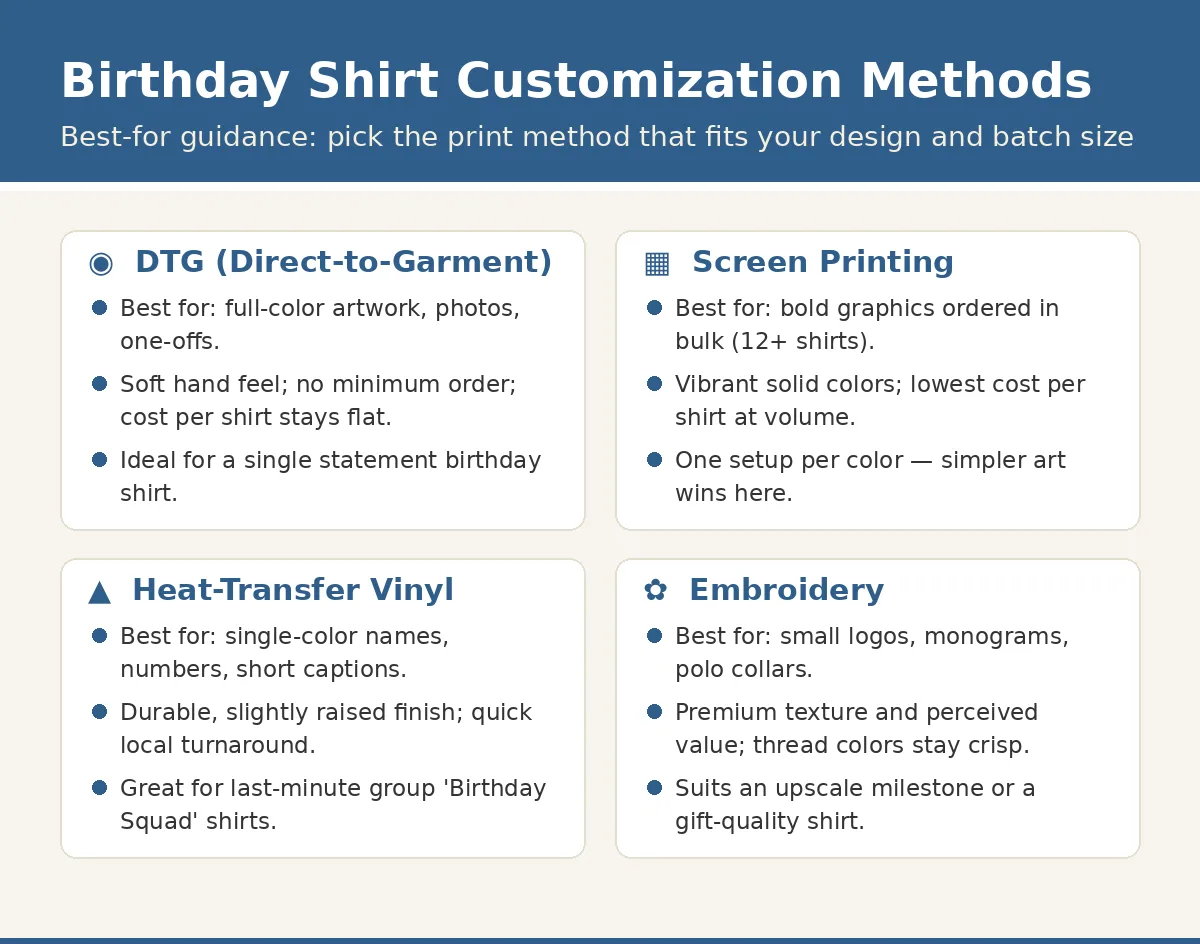
- Screen printing: The durability champion and cheapest per-shirt for large runs (roughly 20+). Limited color counts; setup costs make tiny orders expensive.
- DTG (direct-to-garment): Unlimited colors, no minimums, soft feel. The right choice for photos, gradients, and one-off personalized shirts.
- Heat-transfer vinyl (HTV): The DIY favorite — great for names, numbers, and glitter/metallic effects. Can feel heavy and peel over time; follow pressing instructions precisely.
- Sublimation: Ink becomes part of the fabric — zero feel, never cracks. Only works on light-colored high-polyester garments.
Fabric and Fit Choices
- 100% cotton: The breathable standard; the best surface for DTG and screen printing.
- Polyester blends ("heathers"): Softer hand feel, less shrinking, slight stretch.
- Tri-blends: The premium pick — exceptionally soft with a vintage drape.
Unisex is the safest choice for mixed groups. Women's fitted cuts look tailored but run small — always check the size chart, and remember custom orders are rarely returnable.
Group Orders and Birthday Squads
Group orders are where birthdays go wrong logistically. Run them like a small project:
- Set a size deadline at least three weeks before you need to place the order.
- Collect money first. Use a payment app before finalizing — chasing payments after printing is miserable.
- Order spares. One or two extra mediums and larges cover the inevitable surprises.
- Differentiate the honoree. Same design system, different color for the birthday person.
For milestone-specific planning, see our 40th, 50th, and 60th birthday shirt guides, plus vintage 1991 birthday shirts for birth-year ideas.
Order Timeline: Working Backwards From Party Day
Custom shirts have a lead time that surprises first-timers. Plan backwards:
- 4+ weeks out: Finalize the design and collect everyone's sizes. This is also when to order a single sample shirt if quality matters — a $25 test print can save a $300 group mistake.
- 3 weeks out: Place the order. Confirm the proof carefully: spelling of names, dates, and the exact placement before approving.
- 2 weeks out: Production window. Most printers need 5–10 business days depending on method and quantity.
- 1 week out: Shirts in hand. Try them on, check prints for defects, and distribute before the event — not at it.
If you're inside two weeks, filter for rush production or local shops, and simplify the design — fewer colors print faster.
Common Mistakes to Avoid
- Ordering without a proof. Always approve a digital mockup on the actual shirt color before production — colors shift between screen and fabric.
- Guessing sizes. The number-one group-order failure. Collect real sizes; don't estimate from height.
- Too many colors for screen printing. Each color adds cost. Simplify the design or switch to DTG for multicolor artwork.
- Forgetting the back. A blank back is a wasted canvas — at minimum, add the date or location.
- Last-minute changes. Design changes after proof approval restart the clock. Lock the design before ordering.
Care: Making the Print Last
- Wash inside out in cold water — this alone does most of the work.
- Skip bleach and fabric softeners; both attack prints.
- Hang dry when possible; otherwise tumble dry low.
- Never iron directly over the design — iron the reverse side if needed.
DIY at Home: Cricut and Heat Press Basics
Making a birthday shirt yourself is realistic for simple designs — names, numbers, bold slogans. What you need to know:
- Equipment: A cutting machine (Cricut/Silhouette) plus a heat press or a household iron. A proper heat press gives far more even results than an iron and is worth borrowing for a group order.
- Materials: Heat-transfer vinyl (HTV) in the colors of your design, plus a weeding tool for removing the negative space. For glitter or metallic effects, buy vinyl made for that finish — regular vinyl can't fake it.
- Process: Cut the design mirrored, weed the excess, position on the shirt, press at the vinyl manufacturer's recommended temperature and time, peel as directed (hot or cold peel matters — check the instructions).
- Limits: DIY suits bold text and simple graphics. Photographs, gradients, and fine detail belong with DTG or screen printing — vinyl can't reproduce them.
DIY makes sense for one to five shirts with simple designs. Beyond that, the time cost usually exceeds what a print shop charges.
Frequently Asked Questions
How far in advance should I order custom birthday shirts?
Two to three weeks minimum for design approval, production, and shipping. Add a week for group orders to absorb sizing issues.
Can I print a photograph on a birthday shirt?
Yes — DTG printing is made for photos. Use a high-resolution original with good lighting, not a compressed social media copy.
Do custom shirts shrink?
100% cotton can shrink in hot water or high heat. Choose pre-shrunk cotton or a polyester blend, and wash cold to minimize it.
Is there a minimum order quantity?
Print-on-demand and DTG services have no minimums — you can order a single shirt. Traditional screen printing usually needs 12–24+ to be economical.
Can each shirt in a group order have a different name?
Yes. DTG and vinyl both handle per-shirt personalization easily — names, nicknames, or roles like "The Bestie" and "The Sister" on otherwise matching shirts.