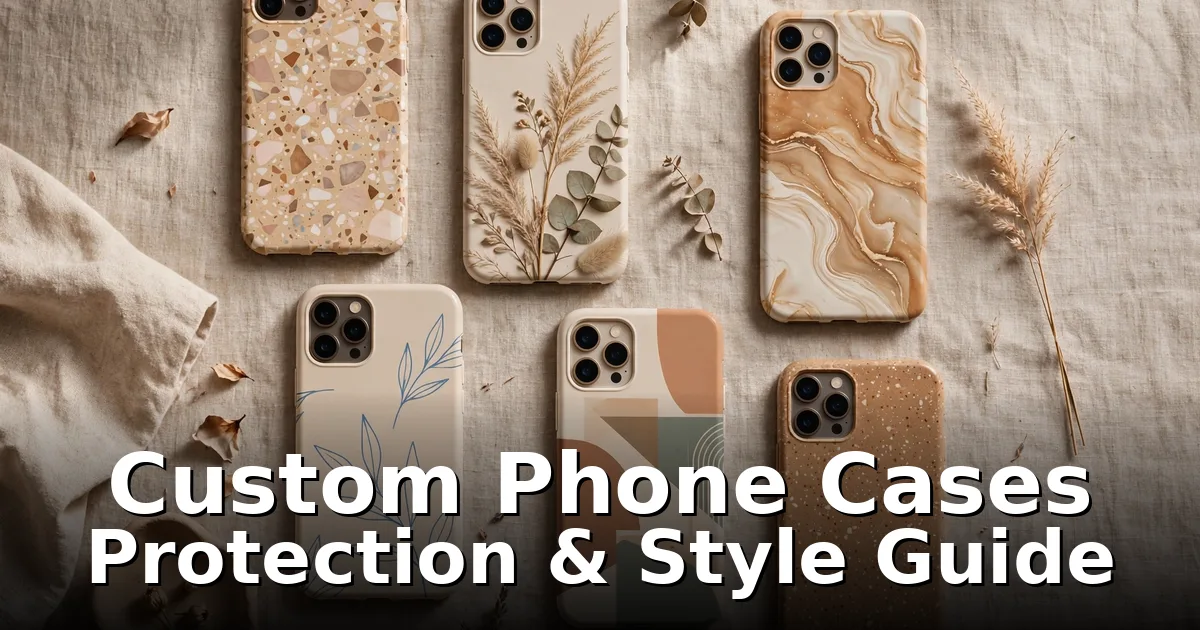
A custom phone case has two jobs: protect an expensive device and look like you. Getting both right means understanding case types, materials, and fit before you fall in love with a design. This guide covers snap versus tough cases, the materials that matter, protection levels, MagSafe and wireless charging compatibility, style choices, and the design mistakes that ruin a custom print — so you can buy once and buy right.
Key takeaways
- Case type first: snap (slim) cases prioritize looks; tough (dual-layer) cases prioritize drop protection.
- Material decides the trade-off: TPU absorbs shock, polycarbonate resists scratches, and hybrids combine both.
- Fit is non-negotiable: cases are model-specific — confirm your exact phone model before ordering.
- Check charging: look for explicit MagSafe compatibility on iPhones, not just "wireless charging compatible."
- Design smart: keep the focal point clear of the camera cutout and use high-resolution source images.
Table of contents
- Choosing your canvas: snap vs. tough cases
- Material breakdown
- Protection levels: how much bulk do you need?
- Fit, compatibility, and features
- Style and aesthetics
- Design tips for a pro finish
- Custom phone case designs from our collection
- Care instructions
- Frequently asked questions
Choosing your canvas: snap vs. tough cases
Before the fun part — pictures and colors — the "base" case determines how well your phone survives a drop.
The snap case (slim)
The snap case is for the minimalist. It is usually a single piece of hard plastic (polycarbonate) that clips onto the back of the phone. It is thin, preserves the device's original silhouette, and shows off printed artwork beautifully. The trade-off: minimal screen protection, since the lip rarely rises above the glass, and less shock absorption on hard drops.
The tough case (dual-layer)
Tough cases typically combine two layers: a soft silicone or TPU inner liner that absorbs shock, and a hard outer shell that provides structure and holds the custom print. Yes, it adds a few millimeters of bulk — but that is a small price compared to a screen repair. If you drop your phone regularly, this is the sensible default.
Material breakdown
| Material | Impact protection | Print quality | Grip | Best for |
|---|---|---|---|---|
| Polycarbonate (hard plastic) | Low to medium — deflects rather than absorbs | High — crisp, vibrant prints | Low — can feel slippery | Vibrant photos and intricate artwork |
| TPU / silicone (soft) | High — absorbs shock | Medium — prints well with UV printing | High — non-slip | Everyday drops and tactile feel |
| Hybrid (TPU + PC) | High — the practical sweet spot | High on the hard shell | Medium to high | Balanced protection and style |
| Tempered glass back | Medium | Very high — glossy finish | Low | A premium, high-gloss look |
| Leather / faux leather | Medium | Low — usually debossed or minimal print | Medium | Professional, patina-developing style |
The most practical advice for most buyers: a hybrid case gives you the shock absorption of TPU with the print-friendly surface of polycarbonate. All-TPU cases protect well but show prints less crisply; all-polycarbonate cases print beautifully but transfer drop energy to the phone.
Protection levels: how much bulk do you need?
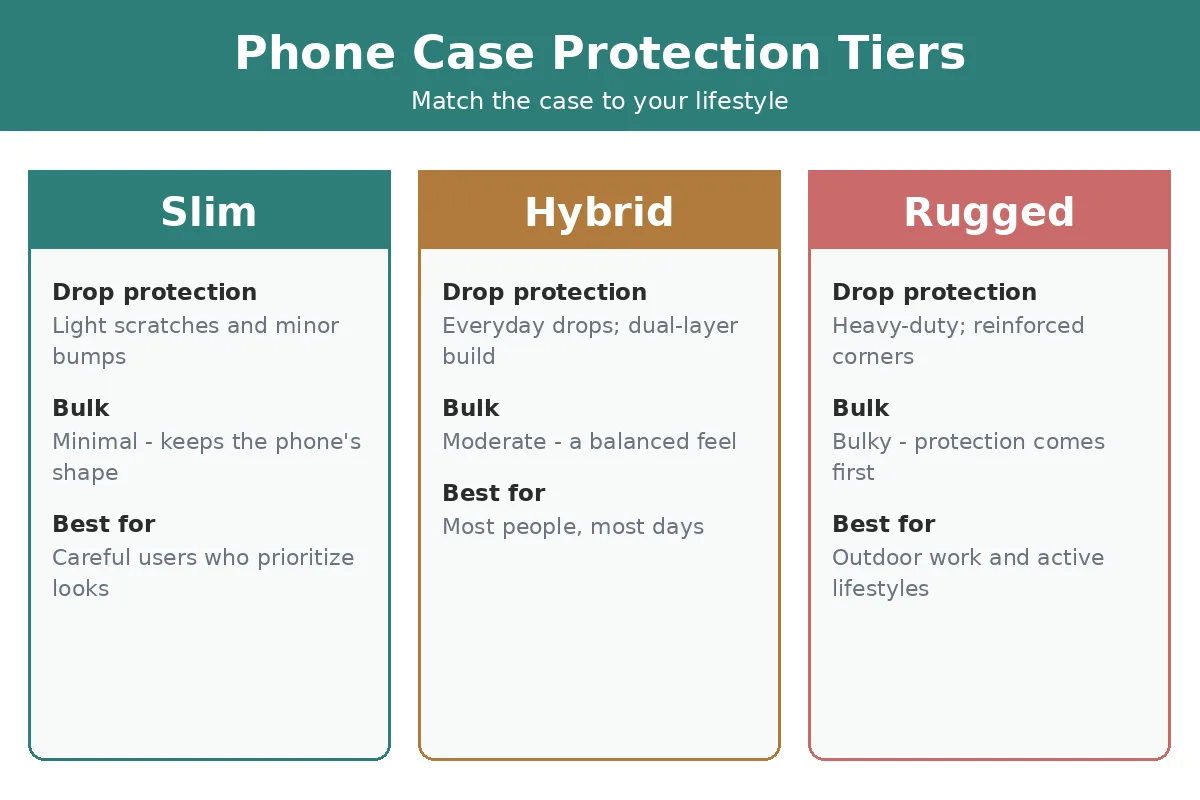
Think of protection in three tiers and pick honestly based on your habits.
1. Slim — scratch and scuff protection
For careful users who mainly want to prevent scratches and keep the phone's original shape. A slim case will not save a screen from a waist-high drop onto concrete.
2. Hybrid — the sensible middle
Where most buyers should land: a soft TPU interior plus a hard polycarbonate exterior, with reinforced corners (corners are the weak point of any glass phone). Good everyday drop protection without turning the phone into a brick.
3. Rugged — maximum armor
For construction sites, hiking, or phones that live in the hands of toddlers. Look for cases tested to military drop-test standards (MIL-STD-810G) — the meaningful detail is the drop height and number of drops tested, not just the badge. Expect real bulk.
One feature worth insisting on at any tier: a raised lip around the screen and camera. That small bezel is what keeps glass from meeting a flat tabletop directly.
Fit, compatibility, and features
Confirm your exact model
Cases are model-specific down to the millimeter — camera cutouts, button positions, and port openings all differ between models and even between sizes of the same generation. Check your exact model (on iPhone: Settings > General > About) before ordering. A case that is "almost right" will block a button or leave the camera half-covered.
MagSafe and wireless charging
If you use an iPhone with MagSafe, do not settle for "wireless charging compatible." Without built-in magnets aligned to Apple's ring, the magnetic connection to chargers, wallets, and car mounts weakens noticeably. Look for cases that explicitly list MagSafe compatibility. Thick rugged cases and metal-backed cases can also interfere with standard wireless charging — when in doubt, check the manufacturer's charging notes.
Worthwhile extras
- Wallet/card slots: convenient, but a stuffed wallet case adds bulk and can stretch over time.
- Built-in kickstands: genuinely useful for video calls and recipes; metal hinges outlast plastic ones.
- Textured finishes: matte and micro-textured surfaces resist fingerprints and improve grip over glossy plastic.
Style and aesthetics
Your phone is the accessory you wear most — it appears in every mirror selfie and sits on every dinner table. Treat the case like part of your outfit: coordinate it with your daily style the way you would a bag or watch.
The clear-case dilemma: clear cases show off the phone's original color, but many yellow over time from UV exposure and skin oils. If you go clear, look for "anti-yellowing" labeling and prefer harder polycarbonate over soft TPU, which discolors faster. Expect to replace a clear case sooner than an opaque one.
Finish matters: matte finishes are trending because they resist fingerprints and feel refined; textured or "grit" finishes grip better than smooth gloss. A glossy print pops more in photos, a matte print looks more premium in person — neither is wrong.
Design tips for a pro finish
You do not need a design degree to make a custom case look good — but these rules separate crisp results from disappointing ones.
1. Watch the camera cutout
The number-one beginner mistake: placing the focal point of a photo — a face, a pet, a logo — where the camera array will slice it off. Modern camera bumps are large; keep key elements centered or offset away from the cutout, and use the printer's preview tool if one is offered.
2. Use high-resolution source images
Images pulled from social media are heavily compressed. Use the original file from your camera roll whenever possible, and take "low quality" warnings from the customizer seriously — a blurry source prints blurry.
3. Keep it simple
A phone case is a small canvas viewed at arm's length. One strong image, a short phrase, or a bold pattern reads far better than a collage of tiny details. High contrast between the design and the case background helps the artwork stay legible.
4. Mind copyright
Reputable printers will not print trademarked logos or copyrighted characters you do not own the rights to. Stick to your own photos, original artwork, or properly licensed elements.
Custom phone case designs from our collection
Most phone-case guides stop at blank cases. A custom case with an original design turns the most-handled object you own into something personal. These are real designs from our collection, available as iPhone cases:

"Kitty Biscuits" Bakery Cat iPhone Case
A funny sourdough-bakery cat graphic — the kind of lighthearted, high-contrast design that reads well on a small case canvas. Available on Redbubble as an iPhone case.
View on Redbubble →
"Silly Teachers Build Character" Goose iPhone Case
A funny goose design for educators — bold typography that stays legible at phone-case scale, and a natural pick for the teacher bag setup in our teacher tote guide. Available on Redbubble as an iPhone case.
View on Redbubble →
"What's Behind" Frog iPhone Case
A playful frog-and-bats graphic with a dark background — dark-background designs like this one hide fingerprints and wear gracefully. Available on Redbubble as an iPhone case.
View on Redbubble →
"Cozy Ghost" Halloween iPhone Case
A cozy ghost with fall vibes — a seasonal design that shows how a custom case can rotate with the calendar, the same way people swap watch bands. Available on Redbubble as an iPhone case.
View on Redbubble →Care instructions
A custom print lasts longer with gentle treatment. Clean the case with warm water and mild dish soap using a soft cloth, and avoid alcohol wipes or bleach on the printed area — harsh chemicals fade or lift UV and sublimation inks over time. Keep clear cases out of prolonged direct sunlight to slow yellowing. Replace any case that cracks or whose bumper separates from the shell: once the structure is compromised, the protection is gone.
Frequently asked questions
Will the image on my custom phone case fade?
Quality custom cases use sublimation or UV printing that resists fading well. Longevity mostly comes down to care: avoid harsh alcohol or bleach-based cleaners on the printed area and keep the case out of constant direct sun.
Which type of custom case offers the best protection?
A tough or hybrid dual-layer case: a soft TPU or silicone inner liner to absorb shock plus a hard polycarbonate outer shell for structure, with reinforced corners and a raised lip around the screen.
Do custom cases support wireless charging and MagSafe?
Most slim and hybrid cases are thin enough for standard wireless charging. For iPhones, look specifically for "MagSafe compatible" — a case without built-in magnets weakens the magnetic hold on chargers and mounts.
Can I use a copyrighted image on my custom case?
Generally no — reputable printers will not print trademarked logos or copyrighted characters unless you own the rights. Use your own photos, original artwork, or properly licensed elements.
How often should I replace my phone case?
Immediately if it cracks or the bumper separates from the shell, since its protection is compromised. Otherwise, replace when wear bothers you — clear cases typically show yellowing sooner than opaque ones.
Browse the AIPrintVerse design collection for original artwork for custom phone cases and tech accessories.
Related guides
Continue with these related AIPrintVerse guides: