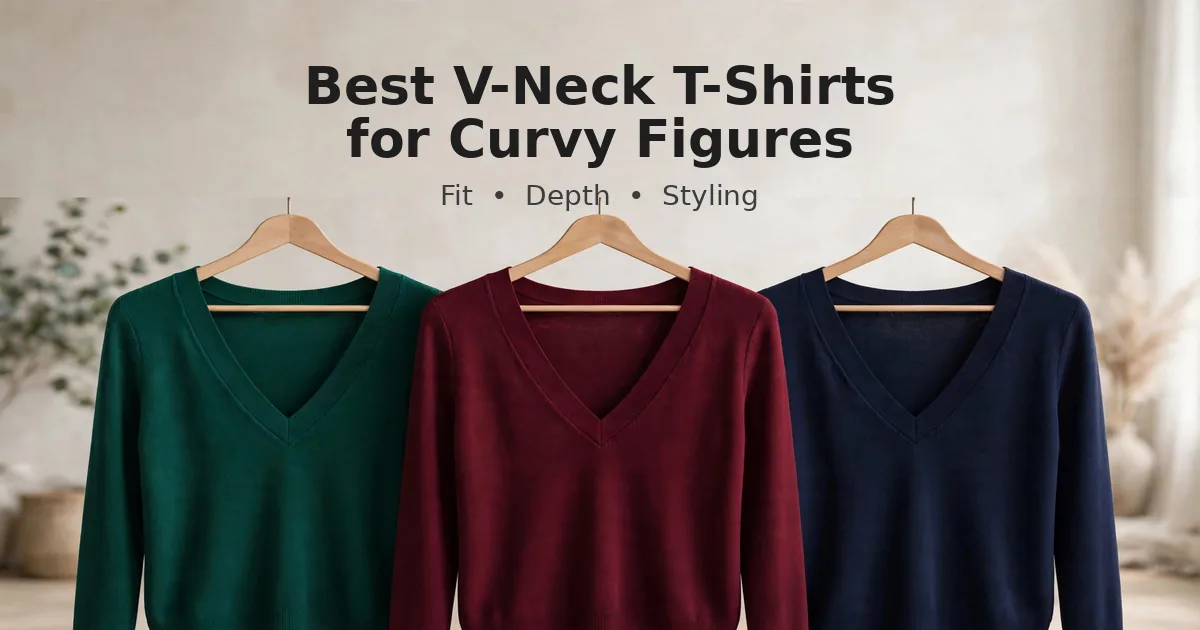
For curvy figures, the V-neck isn't just a style preference — it's geometry. The downward point breaks the horizontal line across the bust, draws the eye vertically, and gives larger busts visual breathing room that crew necks don't. But most V-necks on the rack are cut for straight-size proportions, which is why so many curvy women end up with gaping necklines, pulling across the chest, or shoulder seams sitting halfway down the arm. This guide covers what actually matters when choosing one: depth measured for larger busts, fabrics that drape instead of cling, and a fit checklist you can use in any fitting room.
Table of Contents
Why the V-Neck Flatters Curvy Figures
Three things happen when a V-neckline meets a curvy silhouette:
- It breaks the horizontal line. A crew neck creates one unbroken horizontal band across the fullest part of the bust, which visually widens it. The V interrupts that line and pulls the eye downward toward the waist.
- It elongates the neck and torso. The vertical point creates length above the bust, which balances fuller hips and gives the whole upper body a longer line.
- It creates a frame for the face. The open neckline leaves room for a pendant or collar detail, drawing attention upward instead of letting the bust dominate the visual field.
None of this works, though, if the depth, fabric, or fit is wrong — which is where most off-the-rack V-necks fail curvy shoppers. For the general principles that apply to every body type, see our ultimate V-neck guide; everything below is specific to curvy figures.
Depth Guide for Larger Busts
Depth is the single most important variable, and the standard advice ("not too deep") is useless without numbers. Measure from your collarbone to the point of the V:
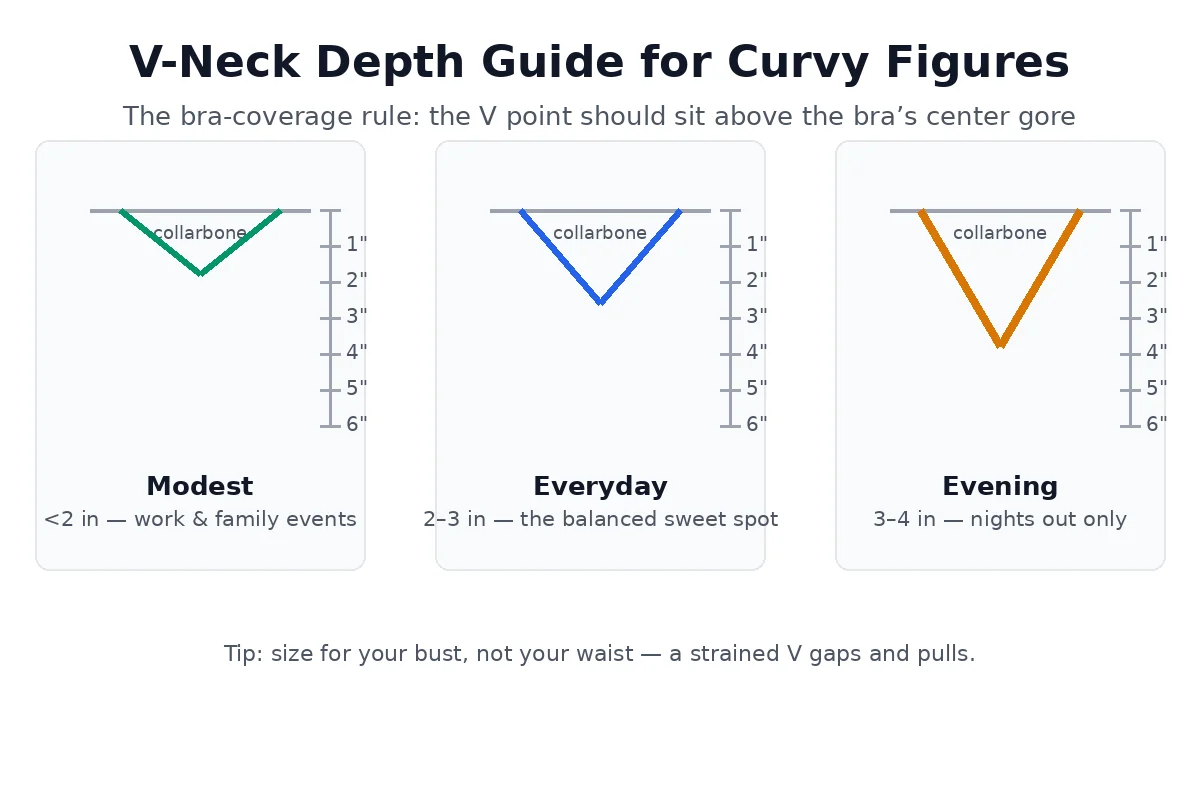
- 2–3 inches below the collarbone — the everyday sweet spot. Elongating without revealing. This is the right depth for work and daily wear on most curvy figures.
- Under 2 inches — the modest option. Choose this for conservative workplaces or when you'll be leaning forward a lot (teaching, childcare, food service).
- 3–4+ inches — evening and casual only. A deeper V can look striking on a curvy figure for nights out, but it demands a well-fitting bra and a neckline with enough structure not to collapse inward.
The Bra-Coverage Rule
Whatever the depth, the point of the V should land above the top edge of your bra's center gore (the piece between the cups). If the V dips below it, the neckline will gape and shift every time you move — a sign the cut is too deep for your bust, not that your body is wrong for the style.
Why Larger Busts Need Shallower Cuts Than They Expect
Fabric stretches over a fuller bust, which pulls the V point lower and wider than it sits on the hanger. A V that measures 2 inches in the store can easily become 3+ inches on the body. When in doubt, choose the shallower option — it will settle into the right place once worn.
Fabric and Drape: What to Look For
On a curvy figure, fabric decides whether a V-neck skims or clings. Look for these qualities on the label:
- Some stretch with recovery — 3–5% elastane or spandex. Pure cotton with no stretch pulls across the bust and stays pulled. A small percentage of elastane lets the fabric move over curves and snap back instead of bagging out.
- Mid-weight with drape. Very thin jersey clings to every line underneath (including bra edges); very stiff heavy cotton tents out from the bust and hides the waist. The middle ground — cotton-modal blends, Pima cotton, quality tri-blends — falls from the bust instead of gripping it.
- Opaque enough for the bust. Hold the shirt up to light stretched slightly, the way it will sit over your chest. If you can see through it stretched, you'll see through it worn.
- Ribbed, reinforced neckline. Check that the V binding feels firm and springs back when you tug it gently. A flimsy neckline is what turns into a gaping "bacon neck" after five washes.
Avoid: 100% polyester athletic jersey for everyday wear (clings and shows texture), and boxy tubular-knit tees with no side seams — without shaping, they hang from the bust like a tent.
The Fit Checklist
Use this in the fitting room, in order:
- Shoulder seams sit at the shoulder point. If the seam droops down your upper arm, the shirt is too big overall and the V will slide sideways. If it pulls toward your neck, the bust is too tight.
- No pulling across the bust. Look for horizontal stress lines radiating from the buttons area — or in a tee, diagonal pull lines from the armpit toward the bust point. The fabric should lie smooth.
- The V keeps its shape when you move. Raise your arms, sit down, lean forward. The point shouldn't migrate or gape open. Some shifting is normal; a full collapse means the neckline lacks structure for your bust.
- Length covers the hip bone. On curvy figures, a tee that ends at the waistband rides up and needs constant tugging. Look for a length that hits mid-hip or lower.
- Side seams hang straight. If the side seams twist toward the front, the shirt's proportions don't match yours — try a "curvy fit" cut rather than sizing up in a straight cut.
Size for Your Bust, Not the Size Chart's Idea of You
The most common mistake is buying for the waist or hips and hoping the bust works out. It won't. Choose the size that fits your bust without pulling; a slightly roomy waist can be half-tucked or tailored, but a too-tight bust can't be fixed. Many brands now offer "curvy fit" lines cut with extra room through the bust and hip while keeping the shoulders and waist true — if you can find them, start there.
Colors and Patterns
- Solid colors are the most forgiving. Navy, black, burgundy, forest green, and rich neutrals let the neckline do the work without visual noise.
- If you wear stripes, keep them narrow and vertical-ish. Wide horizontal stripes across the bust emphasize width; fine stripes or vertical details echo the V's elongating effect.
- Scale prints to your frame. Tiny prints can look busy and distort over curves; medium-scale prints hold their shape visually. A graphic design with vertical composition works particularly well under a V-neck.
- Use the neckline as the accessory zone. The open V is a natural frame — a pendant that lands an inch above the point of the V draws the eye up to your face.
Styling Ideas
- The half-tuck. Tuck just the front of the tee into high-waisted jeans or trousers. It defines the waist while the back stays loose for hip coverage — the single most flattering way to wear a tee on an hourglass or pear shape.
- Layer with structure. An open blazer or structured cardigan over a V-neck creates long vertical lines from shoulder to hem. The blazer's lapels echo the V for a cohesive, lengthening effect.
- Go monochrome. A dark V-neck with dark bottoms eliminates horizontal breaks in your silhouette and lets your shape read as one continuous line.
- High-waisted bottoms. They anchor the half-tuck and keep the tee's hem from riding up — plus they visually lengthen the leg line, balancing a fuller top half.
- Third piece for polish. A long open shirt, lightweight duster, or denim jacket over a V-neck tee turns a basic into an outfit while adding vertical lines.
Looking for V-neck designs with actual personality rather than another plain blank? Browse our designs collection — the fit principles above apply to any graphic V-neck you choose.
Frequently Asked Questions
What V-neck depth is best for a DD+ bust?
Stick to 2–3 inches below the collarbone for daily wear. Deeper cuts pull wider and lower on a fuller bust than they do on the hanger, so what looks moderate in the store often wears deep.
How do I stop a V-neck from gaping?
Gaping means the neckline lacks structure for your bust, the depth is too deep, or the size is wrong through the chest. Look for ribbed, reinforced V binding; size for your bust; and check the bra-coverage rule — the V point should sit above your bra's center gore.
Should I size up for a relaxed fit?
Not in a straight-cut tee — sizing up drops the shoulder seams and widens the whole shirt, which reads as sloppy rather than relaxed. Instead, look for "curvy fit" or "relaxed cut" lines in your true bust size.
V-neck or crew neck for a large bust?
V-neck, in most cases. The crew's horizontal band emphasizes bust width, while the V breaks it up and elongates. The exception is high-intensity activity, where a higher neckline stays put better.
Should I tuck or untuck a V-neck tee?
The half-tuck (front tucked, back loose) is the most versatile: it shows your waist while keeping hip coverage. A full tuck works with high-waisted bottoms; fully untucked works if the hem hits mid-hip and the shirt has enough structure not to tent.