Let’s be honest: in today’s digital world, if it doesn’t look good, people stop scrolling. Whether you are building a brand from your kitchen table, managing a corporate marketing team, or simply want your presentation slides to pop, graphic design is the unspoken language of success.
Think of graphic design like a perfectly organized spreadsheet—everything has a place, a purpose, and a relationship to the data around it. It is where logic meets creativity. As someone who loves efficient workflows and beautiful aesthetics, I believe that understanding the mechanics of design is just as crucial as understanding your P&L statement.
✨ Key Takeaways: The Executive Summary
Design is Function, Not Just Form: It solves problems through visual communication using hierarchy, typography, and color theory.
The Tool Matters: Choosing between Canva, Illustrator, or Figma depends entirely on your end goal (and budget).
Consistency is Queen: A cohesive visual identity builds trust and increases revenue potential.
Future-Proofing: AI is here to assist, not replace. Learning to leverage it will speed up your workflow.
Table of Contents
1. The Fundamentals: It’s More Than Just Making It Pretty
Many people mistake graphic design for "decoration." But at its core, design is about controlling where the viewer looks. It is strategic. Just like we highlight a cell in Excel to draw attention to the bottom line, design uses specific principles to guide the eye.
Hierarchy & Alignment
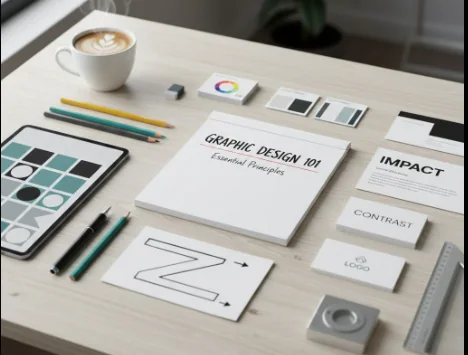
Visual hierarchy is the arrangement of elements in a way that implies importance. You achieve this through scale (making things bigger), color (making things brighter), and position (putting things at the top).
Alignment is what gives your design structure. Nothing should be placed on the page arbitrarily. Every element should have some visual connection with another element on the page. This creates a clean, sophisticated look that screams "professional."
Contrast & Balance
Contrast attracts the eye. If two elements are different, make them very different. Think black text on a white background, or a bold serif font paired with a delicate script. Balance, on the other hand, provides stability. It doesn't mean everything has to be symmetrical; it just means the visual "weight" of the design is distributed evenly.
2. The Toolkit: Comparing the Titans of Design Software
Choosing the right software can feel overwhelming. Do you need the heavy lifting of Adobe, or is the drag-and-drop efficiency of Canva enough? Let’s break down the data so you can make an informed decision.
Graphic Design Software Comparison Matrix Software Platform Best Used For Learning Curve Price Model Top Feature Adobe Illustrator Logos, Vector Icons, Typography Steep (High Expertise) Subscription ($$) Infinite scalability (Vectors never pixelate) Adobe Photoshop Photo Editing, Digital Painting, Web Layouts Steep (High Expertise) Subscription ($$) Unmatched layer manipulation and raster editing Canva Pro Social Media, Presentations, Quick Printables Low (Beginner Friendly) Freemium / Sub ($) Thousands of pre-made, high-quality templates Figma UI/UX Design, App Prototyping, Collaboration Medium Free / Sub ($) Real-time collaboration (like Google Docs for design) Procreate Digital Illustration, Hand-lettering Medium One-time Purchase ($) Intuitive iPad pencil integration
3. Branding & Business: Why Design is Your Secret Weapon
Why do we pay more for coffee in a beautiful cup? Perceived value. High-impact graphic design elevates your brand identity, signaling to customers that you are premium, trustworthy, and established.
Your visual identity includes your logo, color palette, typography, and imagery style. When these are consistent across all touchpoints—from your Instagram grid to your email signature—you build brand recognition. Inconsistent design creates confusion, and a confused mind doesn't buy.
Investing in professional design isn't an expense; it's an asset with a measurable ROI. It differentiates you in a saturated market and allows you to command higher prices.
4. From Screen to Product: Applied Design
One of the most exciting aspects of graphic design is seeing your work in the physical world. This is where digital files transform into tangible assets. However, designing for print requires a different mindset than designing for the web (CMYK vs. RGB, bleed lines, and resolution).
Merchandising Your Brand
If you are an influencer or a business owner, putting your design on merchandise is a fantastic revenue stream. However, you need to understand how design translates to fabric and ceramics.
For example, if you are looking to create apparel that aligns with current trends, you need to know what's in style. Check out The Ultimate Style Guide: 10 Fresh Ways to Wear Graphic Tees in 2026 to understand how your designs might be styled by the end consumer. A design that looks good on a screen might sit awkwardly on a shirt if the placement isn't right.
Corporate Gifting and Swag
Beyond fashion, branded items for the office or corporate gifts are huge for retention and marketing. But don't just slap a logo on a cheap plastic cup. Aim for high-quality items that people actually want to keep on their desks.
If you are considering drinkware, you should read Boost Your Brand: Why Custom Mugs are the Best Corporate Swag. It explains why a well-designed mug stays on a prospect's desk for years, offering thousands of brand impressions for a one-time cost.
Team Apparel
Uniformity creates unity. Whether it's for a company retreat or a startup launch, custom gear brings a team together. If you are venturing into heavier apparel, I highly recommend reading The Ultimate Guide to Designing Your Own Custom Hoodies. Designing for thicker fabrics involves different constraints regarding embroidery versus screen printing.
5. Conclusion
Graphic design is a journey of continuous learning. Trends change, tools evolve (hello, AI!), but the fundamental principles of clear communication remain the same. Whether you are tweaking a template or building a brand from scratch, approach it with the same precision you would a complex dataset. Measure your results, refine your visuals, and don't be afraid to experiment.
Stay creative, stay organized, and keep designing.
Frequently Asked Questions
Do I need to be good at drawing to be a graphic designer?
Not necessarily! While illustration skills are a bonus, graphic design is primarily about layout, composition, typography, and photo manipulation. Many top designers rely on arranging existing elements creatively rather than drawing from scratch.
What is the difference between RGB and CMYK?
RGB (Red, Green, Blue) is the color mode used for digital screens (websites, social media). CMYK (Cyan, Magenta, Yellow, Key/Black) is the color mode used for printing physical products. Always design in the mode intended for your final output to avoid color shifting.
Is graphic design a good career in 2026?
Yes, but the role is evolving. There is high demand for designers who understand branding, UI/UX (user experience), and how to leverage AI tools for efficiency. Specialists often earn more than generalists.
Can I use Canva for professional client work?
Yes, for certain projects like social media graphics or presentations. However, for logo design or complex vector work, industry standards like Adobe Illustrator are preferred because they provide files that can be scaled without losing quality.
From Pixel to Paper: The Ultimate Guide to High-Quality Prints