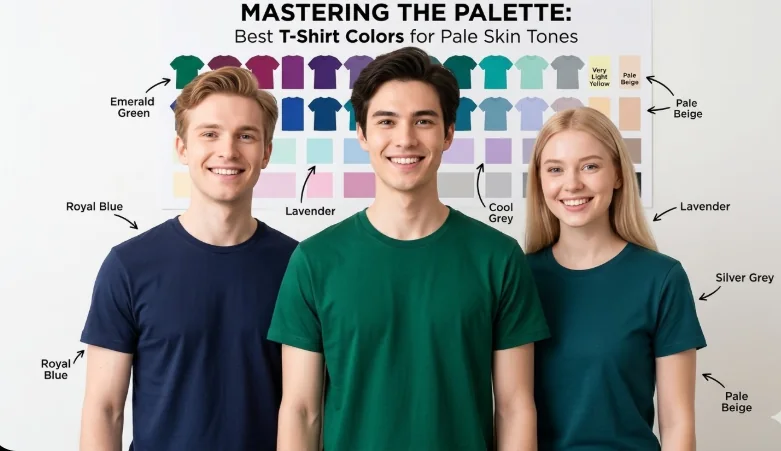
Mastering the Palette: The Best T-Shirt Colors for Pale Skin Tones
Table of Contents
- Understanding Your Skin Undertone
- The Best Colors for Cool, Pale Skin
- The Best Colors for Warm, Pale Skin
- Navigating Neutral Pale Skin
- The "Washout" List: Colors to Avoid
- Color Palette Comparison Table
- How Fabric Texture Affects Color Perception
- Pro Tips for Styling Light Skin
- Frequently Asked Questions
Key Takeaways
- Identifying your undertone (cool, warm, or neutral) is more important than your surface skin shade.
- Jewel tones like emerald and sapphire are universally flattering for most pale complexions.
- Contrast is your best friend; high-contrast colors prevent the "ghostly" look.
- Pastels can work, but they require careful selection to avoid matching your skin tone too closely.
- Navy blue is the ultimate "safe" neutral for fair skin, outperforming black in most scenarios.
Beyond the Surface: It’s All About the Undertones
We’ve all been there. You see a vibrant t-shirt on a mannequin, buy it, put it on at home, and suddenly look like you haven't slept in three weeks. Why does that happen? It isn't just because you're "pale." It's because the color of the garment is clashing with your undertone.
Pale skin is a broad category. You might be "fair" with pinkish hues, or "fair" with a hint of golden yellow. Industry experts categorize these as cool, warm, and neutral. If you look at the veins on your wrist and they appear blue or purple, you’re likely cool-toned. If they look greenish, you’re warm. Can’t tell? You’re probably neutral, which—lucky you—means you have the widest range of options.
What's interesting is that according to color theory studies used in the fashion industry, people with lighter skin often have less melanin to "buffer" the reflection of light from their clothes back onto their faces. This means the wrong color doesn't just look bad; it actually casts a shadow or a yellow/green tint onto your jawline and under-eyes.
The Best Colors for Cool, Pale Skin
If you have that classic porcelain skin with pink or blue undertones, your goal is to complement the coolness without looking "icy." You want colors that provide a rich backdrop. Think of the "Winter" or "Summer" seasonal palettes.
- Emerald Green: This is a powerhouse color. The depth of emerald provides a sharp contrast to fair skin while highlighting the clarity of your complexion.
- Royal Blue and Navy: Navy is practically a neutral for pale people. It is much softer than black but provides the same slimming and grounding effect.
- Deep Purple and Plum: These shades bring out the brightness in your eyes and help neutralize any unwanted redness in the skin.
- Raspberry Red: Unlike a fire-engine red, which can make you look flushed, a berry-toned red works in harmony with cool undertones.
In my experience, sticking to the "jewel" end of the spectrum is a foolproof way to look put-together. These colors are saturated enough to ensure you don't disappear into the background.
Sun-Kissed Without the Sun: Warm, Pale Skin
Some fair-skinned individuals have a subtle "peaches and cream" or golden glow. This is common among natural redheads or those with light brown hair and hazel eyes. For this group, the "earthy" palette is king.
You’ll want to gravitate toward colors that have a yellow or golden base. Olive green is perhaps the most transformative color for warm, pale skin. It brings out the warmth in the skin without making it look sallow. Similarly, terracotta and burnt orange add a healthy "glow" that mimics a light tan.
Avoid harsh, icy blues or neon pinks. These will fight against your skin’s natural warmth and make you look slightly "off." Instead, reach for a creamy off-white or ivory rather than a stark, bleached white.
Color Palette Comparison Table
Choosing the right hue can be overwhelming. Here is a breakdown of how different color families interact with fair complexions.
| Color Family | Pros | Cons | Rating | Best For |
|---|---|---|---|---|
| Jewel Tones (Emerald, Ruby) | High contrast; makes skin look vibrant and healthy. | Can be "too much" for very casual settings. | ⭐⭐⭐⭐⭐ | Cool undertones; formal-leaning casual. |
| Earth Tones (Olive, Ochre) | Brings out golden warmth; very trendy and natural. | Can make cool-toned skin look tired or yellow. | ⭐⭐⭐⭐ | Warm undertones; redheads. |
| Pastels (Baby Blue, Lavender) | Soft and approachable; great for spring/summer. | High risk of "washout" if the shade is too light. | ⭐⭐ | Very dark hair with pale skin. |
| Deep Neutrals (Navy, Charcoal) | Safe, versatile, and provides excellent framing. | Can look a bit "boring" without accessories. | ⭐⭐⭐⭐⭐ | Everyday wear; all pale types. |
| Neons (Electric Lime, Hot Pink) | Bold and attention-grabbing. | Overpowers fair skin; often causes a "ghost" effect. | ⭐ | Only for very high-contrast features. |
The "Washout" List: Proceed with Caution
You might be wondering, "Are there colors I absolutely cannot wear?" While "never" is a strong word in fashion, there are certain shades that require a lot of work to pull off if you have fair skin.
Stark White: Believe it or not, pure bleached white can be too harsh. It often makes pale skin look dull or even slightly grey. An off-white or "eggshell" is usually a much better alternative.
Yellow: Most yellows are the enemy of the pale. Bright yellow can reflect onto your face, giving you a sickly, jaundiced appearance. If you must wear yellow, go for a deep, saturated mustard rather than a lemon or pastel yellow.
Nude/Beige: If the t-shirt is the same color as your skin, you’ll end up looking like a mannequin from a distance. You need a "boundary" between your clothes and your skin. If you love beige, look for "camel"—the extra brown depth provides the necessary separation.
The Science of Sheen: Why Fabric Matters
Here’s something most guides miss: the fabric of your t-shirt changes how the color works. A matte cotton t-shirt absorbs light, while a synthetic blend with a slight sheen reflects it.
For pale skin, matte fabrics are generally more forgiving. High-sheen fabrics (like those found in some "performance" or "dri-fit" shirts) can bounce light back onto your chin and neck, emphasizing any redness or shadows. If you're experimenting with a risky color like heather grey, choose a heavy-weight 100% cotton. The texture adds "visual weight" that helps ground the light color against your skin.
Pro Tips for Styling Light Skin
What I've found over years of styling is that it’s not just about the shirt—it’s about the frame. Here are three ways to make any color work:
- The Layering Trick: If you have a t-shirt in a "risky" color like light grey, wear a dark navy jacket or flannel over it. This provides a dark frame near your face, making the pale shirt act as a highlight rather than a wash-out tool.
- Mind the Neckline: A V-neck shows more skin, which can sometimes exacerbate the washout effect. A classic crew neck provides a solid line of color closer to the face, which is generally more flattering for fair complexions.
- Contrast with Hair: If you have dark hair and pale skin, you are "high contrast." You can handle much bolder, darker colors. If you have blonde hair and pale skin, you are "low contrast," and should stick to medium-depth colors (like sage green or sky blue) to avoid being "swallowed" by your clothes.
Frequently Asked Questions
Can pale people wear black t-shirts?
Yes, but with a caveat. Black can sometimes be too "heavy" for very fair skin, making you look tired. To fix this, ensure the shirt has a clean crew neck and consider adding a accessory or a layer in a jewel tone to break up the darkness.
What is the single best color for fair skin?
Navy blue is widely considered the most universally flattering color for pale skin. It provides enough contrast to make the skin pop without the harshness of black or the "sickly" potential of yellow-based colors.
Do pastels work for pale skin?
They can, but you should choose "pigmented" pastels. Avoid "dusty" or "muted" pastels which can look like old dishwater against fair skin. Instead, go for a vibrant lavender or a clear mint green.
How do I know if I have a cool or warm undertone?
The simplest way is the jewelry test. If silver jewelry looks better on you, you're likely cool-toned. If gold jewelry complements your skin more, you're likely warm-toned.
Should I avoid grey t-shirts?
Light heather grey is notoriously difficult for pale skin as it often matches the skin's value too closely. If you love grey, opt for a dark Charcoal or Slate grey, which provides much-needed contrast.