
Walk through any tech conference, hackathon, or co-working space and you'll see them: laptop lids layered with logos — Kubernetes, GitHub, Docker, a dozen framework badges — and among them, one phrase that never quite disappears: Eat Sleep Code Repeat. It's half joke, half identity, and entirely a rite of passage.
Developer sticker culture is its own world with its own etiquette, economics, and in-jokes. This guide explains what the "Eat Sleep Code Repeat" phenomenon is actually about, how developers collect and display stickers, and the practical side — choosing laptop-safe vinyl so your badge of honor doesn't become a residue nightmare.
Table of Contents
Key Takeaways
- Developer stickers function as a public portfolio — the frameworks and communities on your lid say what you work with.
- "Eat Sleep Code Repeat" endures because it's self-aware: it celebrates the grind while admitting it's a grind.
- Conference swag is the primary source; the best stickers are earned (hackathons, contributions) rather than bought.
- Only vinyl belongs on a work laptop — clean removal matters when the machine isn't yours.
Developer Sticker Culture: A Résumé in Adhesive
In most professions, a decorated laptop is decoration. In tech, it's documentation. The stickers on a developer's lid typically map to real experience: languages they write, tools they maintain, conferences they've attended, communities they belong to. A Kubernetes sticker usually means "I've fought with Kubernetes." A GitHub Octocat means "I live here." Recruiters at conferences have been known to read lids the way other industries read name tags.
This is also why the culture skews toward earned stickers over bought ones. A sticker picked up at a conference booth, won at a hackathon, or sent for a first open-source contribution carries a story. Bought stickers aren't scorned — the meme designs like "Eat Sleep Code Repeat" are almost all purchased — but the lid tells a better story when most of it was collected, not ordered.
Why "Eat Sleep Code Repeat" Endures
The phrase has survived a decade of tech trend cycles, which is remarkable for a meme. It endures because it does two things at once: it celebrates the craft ("I love this enough to live it") while winking at the absurdity ("yes, I know how this sounds"). That self-awareness is the whole joke — it's the developer equivalent of a band t-shirt, worn by people who know exactly what it signals.
It's also perfectly designed as a sticker: short, readable at a glance, and typographically flexible. It works as bold block letters, as a terminal-style monospace, as a retro badge. The phrase is a template as much as a slogan, which is why you'll see dozens of artistic variations rather than one canonical version.
Collecting: Conferences, Swag & Trading
The primary sticker economy in tech runs on conference swag. Booth stickers, sponsor stickers, and community stickers are free, abundant, and often genuinely well-designed — companies spend real money on sticker design because they know developers keep the good ones. Veteran conference-goers develop strategies: hit the sponsor hall early, trade duplicates, and always check the community booths (they usually have the best art).
Beyond conferences: hackathons (participation stickers are prized), open-source programs (Hacktoberfest's sticker packs are legendary), company swag (employer stickers are common lid residents), and print-on-demand shops for the meme designs you can't earn. Sticker trading at meetups is a real, if informal, tradition.
Display Rules: The Unwritten Etiquette
Yes, there are rules — unwritten, but widely observed. Don't sticker what you can't remove cleanly: work laptops especially (see materials below). Anchor with meaning: the most prominent spots go to the tools and communities that define you; fillers go to the edges. Retire honestly: when you stop using a framework, its sticker can stay as history or go — but a lid full of tools you've never touched reads as costume, and other developers notice.
The sticker-bomb full-coverage look and the minimalist 3-sticker grid are both respected; the only real sin is the random bulk-pack lid with no personal connection to anything on it. Curate like you mean it. For layout technique, the laptop sticker application guide covers the mechanics.
Materials: Laptop-Safe Vinyl Only
This matters more for developers than anyone, because the laptop often isn't yours — it's the company's. Vinyl only: waterproof, UV-resistant, and removable without residue. Paper stickers are a liability on any machine you might need to return. Before sticking anything on a work laptop, check your employer's policy; some companies are fine with it, others aren't, and finding out via a security review is the bad way.
Application follows the standard method: clean with isopropyl alcohol, hinge with tape, smooth from the center. Removal with gentle heat (hairdryer, 20–30 seconds) softens the adhesive for a clean peel. Never cover vents, and keep stickers off the bottom panel where serial numbers live — IT departments have opinions about that.
Gifting Developer Stickers
Developer stickers make excellent small gifts because they're personal without being presumptuous — a good meme sticker says "I know your world" without guessing wrong about sizes or tastes. Best occasions: a new job (a fresh-lid starter pack), hackathon teammates (commemorative stickers beat trophies for desk presence), and open-source contributors (a thank-you sticker pack is a beloved tradition).
When buying, favor individual artist designs over generic bulk packs — the lid is a curated space, and one good design beats ten forgettable ones. Browse the design catalog for single designs with actual personality, and check the custom sticker guide if you want to design your own team or event stickers.
The Iconic Developer Sticker Genres
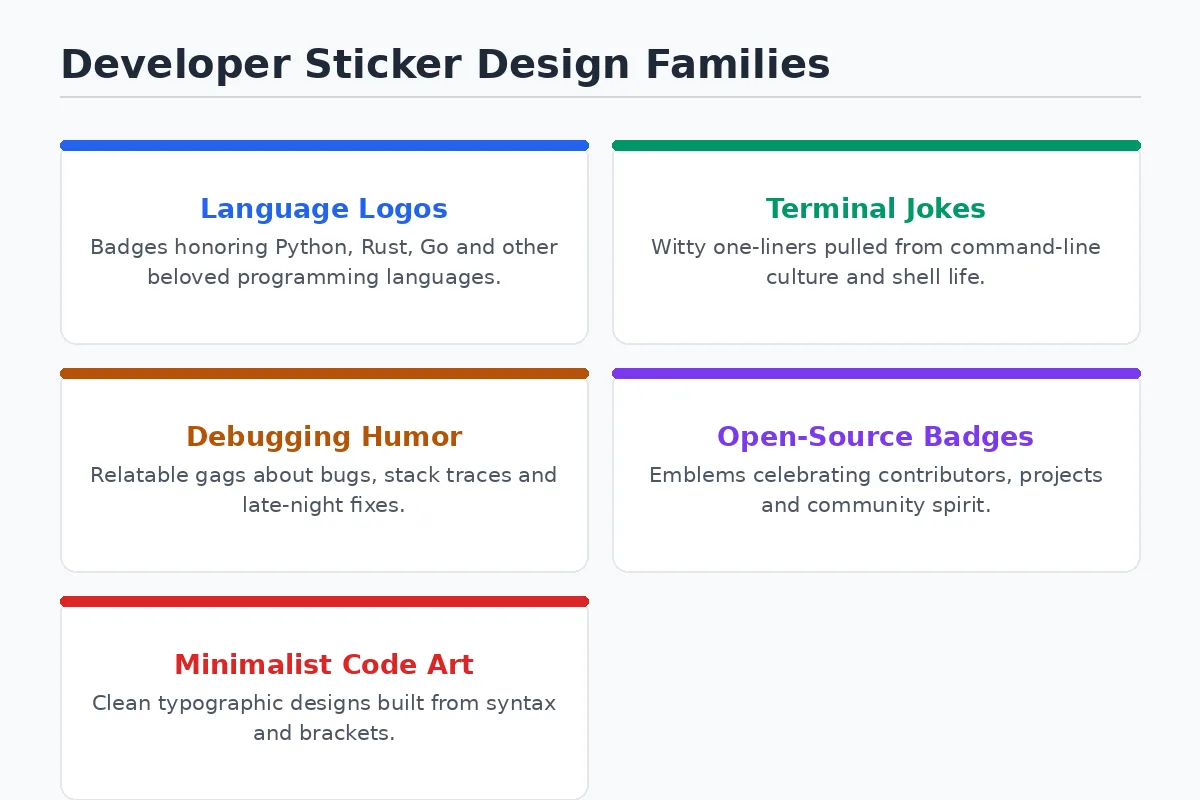
Developer lids draw from a recognizable set of genres. Framework and language badges: the React atom, the Python snakes, the Rust crab — the professional core of most lids. Conference swag: booth stickers and event badges, often the best-designed stickers a developer owns. Meme stickers: "Eat Sleep Code Repeat" and its cousins ("It works on my machine," "There's no cloud, just someone else's computer") — the humor layer. Employer and team merch: company logos and team inside jokes, common on work machines. Open-source contributor packs: Hacktoberfest and project-specific stickers, prized because they represent actual contributions.
The synthwave/retro aesthetic behind the 80s retro sunset sticker trend shows up on plenty of dev lids too — it is practically the unofficial wallpaper of the terminal generation. A well-balanced lid usually has two or three of these genres, not all five — and the mix says a lot. All framework badges reads as "professional"; all memes reads as "student"; a thoughtful blend reads as a real person. Whatever your mix, the material rule from the custom sticker guide applies double on work machines: vinyl only, removable, and check the policy first.
Sticker Trading & Community Etiquette
Beyond collecting, there's a genuine trading culture. At conferences and meetups, developers swap duplicates — the unwritten rules are simple: trade, don't sell (selling free swag is frowned upon); duplicates are currency (that third Docker whale is someone's missing piece); and earned stickers stay personal (nobody trades their first-contribution sticker). Hacktoberfest and similar programs formalize this with official sticker packs that become yearly collectibles.
Online, community Discords and subreddits run informal swap threads, and some open-source projects mail sticker packs to contributors as thank-yous — one of the most beloved traditions in the ecosystem. If you maintain a project, a small sticker budget is one of the highest-ROI community investments you can make: a $2 sticker that says "thanks for your PR" gets kept for years.
Frequently Asked Questions
What does "Eat Sleep Code Repeat" mean?
It's a self-aware developer motto celebrating the coding lifestyle — eat, sleep, code, repeat. It works as both genuine enthusiasm and a joke about the grind, which is why it's endured as one of tech's most popular sticker phrases.
Where do developers get their laptop stickers?
Mostly from conference swag, hackathons, open-source programs, and employer merch — earned stickers with stories. Meme designs like "Eat Sleep Code Repeat" are typically bought from print-on-demand shops or sticker sellers.
Is it okay to put stickers on a work laptop?
Check your employer's policy first — many companies allow it, some don't. If allowed, use only quality vinyl that removes cleanly without residue, and avoid covering vents or serial numbers on the bottom panel.
How do you remove developer stickers without residue?
Warm the sticker with a hairdryer for 20–30 seconds to soften the adhesive, peel slowly back over itself, and wipe any faint residue with rubbing alcohol on a microfiber cloth. Quality vinyl stickers are designed for clean removal.
Are developer stickers a good gift for programmers?
Yes — they're personal without being risky, and they suit occasions like new jobs, hackathons, or thanking open-source contributors. Choose individual artist designs over generic bulk packs; a developer's lid is a curated space.