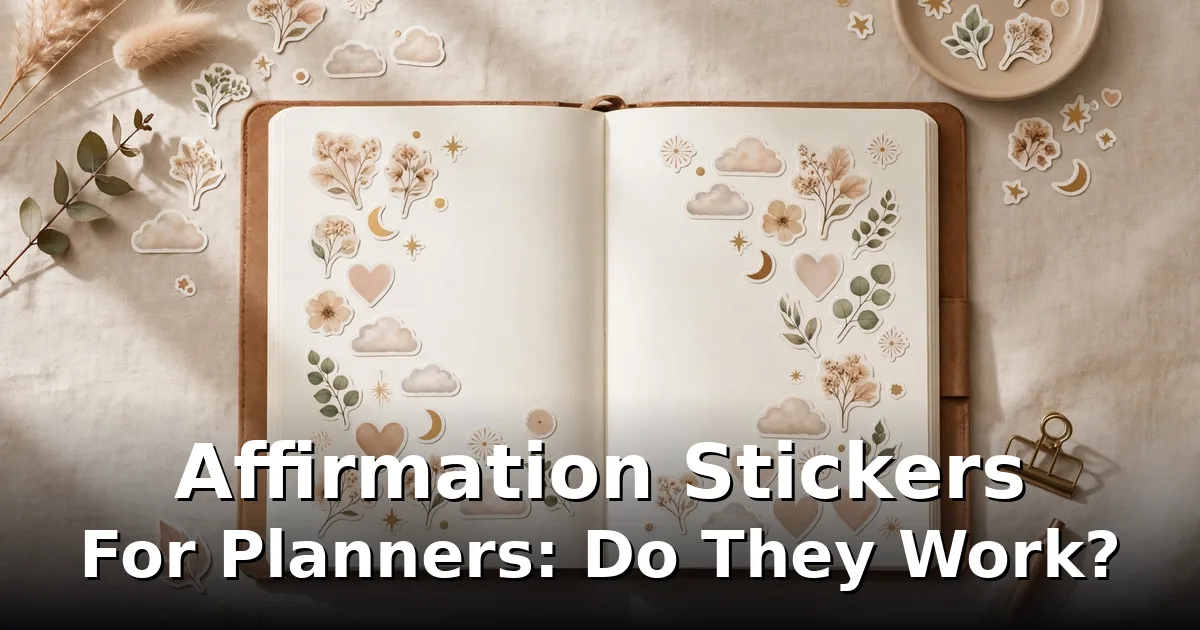
Every planner community has them: the little stickers that say "you are enough," "one day at a time," "progress over perfection." They're some of the bestselling designs on Etsy and the backbone of a thousand GoodNotes sticker packs. But do daily affirmation stickers for planners actually work — or are they just pretty paper?
The honest answer is somewhere in between. Affirmation stickers aren't magic, but they're not nonsense either. Used right, they're a well-designed habit cue — a small, visible nudge that keeps an intention in front of you. This guide covers the honest psychology, how to choose designs that work for you, and the practical differences between physical and digital planner stickers.
Table of Contents
Key Takeaways
- Affirmation stickers work as visible habit cues — they keep an intention in front of you at the moment you need it.
- Believable, specific affirmations ("I can handle today's meeting") beat grandiose ones you don't buy.
- Planners are ideal because you open them daily — the cue meets the routine.
- Physical stickers suit paper planners; pre-cropped PNG packs suit GoodNotes, Notability, and other tablet apps.
The Honest Psychology: Cues, Not Magic
Let's be straight about what the science does and doesn't support. There's genuine research on self-affirmation — the practice of reflecting on your values — showing it can reduce defensiveness and help people handle stress. There's also solid behavioral science on implementation intentions: pairing a cue with an action ("when I open my planner, I read my intention for the day") measurably improves follow-through.
What affirmation stickers add to this is visibility engineering. A goal written once in a journal gets buried; a sticker on this week's spread gets seen every morning. The sticker isn't changing your brain chemistry — it's doing the much humbler and very real job of keeping a chosen thought in front of you at the right moment. Think of it as a Post-it from your past self, designed by someone with better typography.
Why Planners Are the Perfect Delivery System
Affirmation stickers live in planners for a structural reason: planners are opened daily, at a moment of planning and intention. That timing is everything. An affirmation on a water bottle is seen randomly; an affirmation on today's spread is seen exactly when you're deciding what today is about.
Planners also pair affirmations with action naturally. "One day at a time" sits above a to-do list, and the brain connects the two — the affirmation frames the work, the work makes the affirmation feel earned. That's why planner stickers outperform the same quotes as phone wallpapers: context turns a slogan into a practice.
Choosing Affirmations That Work for You
The most common mistake is picking affirmations that sound good to strangers. "I am a radiant goddess of abundance" might look great on Instagram and feel absurd on a Tuesday morning. Research on self-affirmation suggests believability matters: statements you can actually endorse ("I've handled hard days before," "rest is part of the plan") work better than ones that trigger an inner eye-roll.
Look for three qualities: specific ("progress over perfection" beats "be your best self"), kind (something you'd say to a friend), and present-tense actionable ("today I choose calm" beats "someday I'll be calm"). Many bestselling Etsy packs mix categories — "Note to Self," "Daily Check-In," "Permission Slips" — because different days need different messages.
Physical vs. Digital: Paper vs. GoodNotes
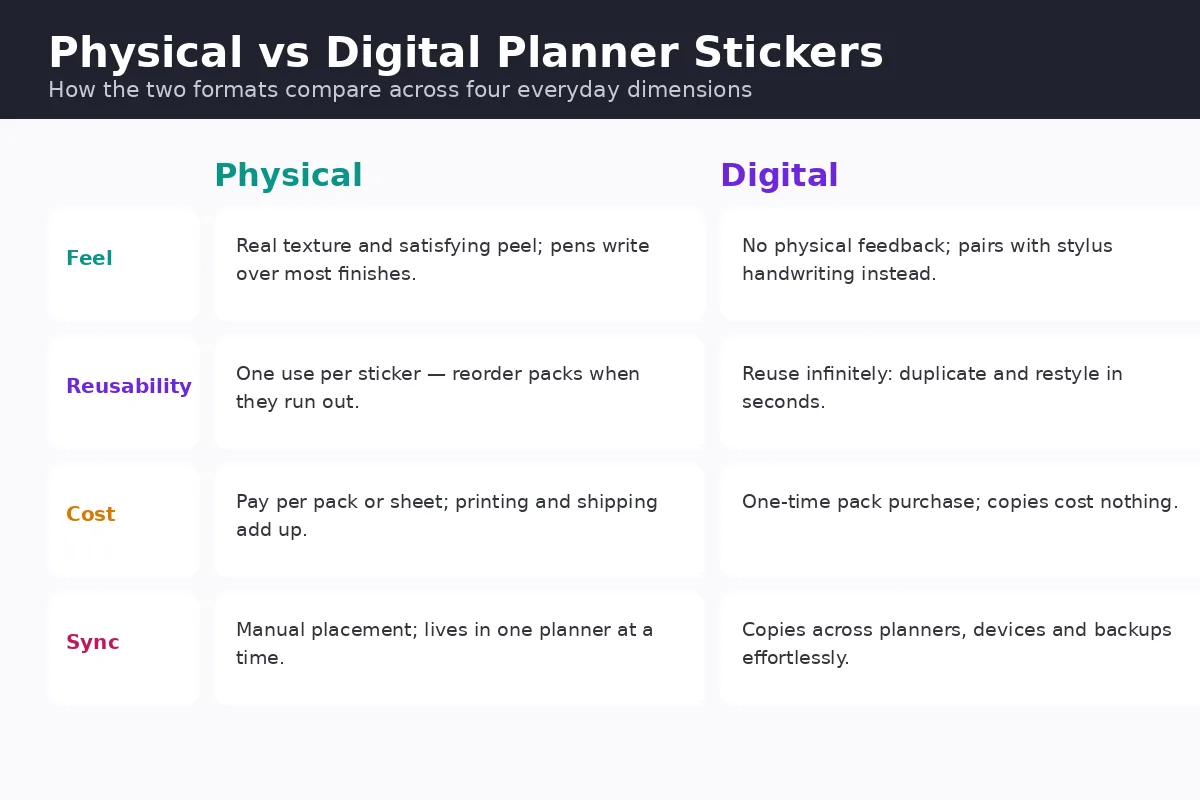
The planner world split in two, and affirmation stickers exist in both. Physical stickers (glossy or matte vinyl/paper sheets) suit paper planners — Hobonichi, Erin Condren, bullet journals. They're tactile, permanent-feeling, and commitment is the point: placing one is a small ritual.
Digital stickers are PNG packs (often pre-cropped for GoodNotes, Notability, or Noteful) that you drag onto tablet planners. They're cheaper per design, endlessly reusable, and easy to resize — but they lack the ritual of peeling and placing. Many planners use both: digital for daily flexibility, physical for the spreads that matter.
For physical planner use, choose paper or matte stickers over glossy vinyl — they sit better on paper pages and you can write over them. Save the waterproof vinyl for water bottles and laptops.
Using Them So They Actually Stick
The difference between a sticker that works and décor is the routine around it. Three practices that make affirmation stickers earn their keep:
1. Rotate, don't wallpaper. One affirmation per week beats twenty per spread. Familiarity breeds invisibility — when a message stops registering, it's time to change it.
2. Pair with a real action. Put "rest is productive" on the day you've scheduled a break, not the day you're drowning. The sticker should support the plan, not substitute for one.
3. Write your own. Pre-made packs are great starters, but the most effective affirmations are personal — the sentence you actually need. Blank sticker sheets and a good pen complete the system.
When Affirmation Stickers Don't Help
Honesty requires the other side. Affirmation stickers don't treat anxiety, depression, or burnout — and for some people, forced positivity can feel worse than nothing (the research on "toxic positivity" is real). If affirmations consistently make you feel worse, drop them without guilt; mood-honest designs (see the mental health sticker guide) or plain functional stickers might suit you better.
And if you're genuinely struggling, the sticker is not the intervention — a counselor, therapist, or trusted person is. Stickers are stationery, not treatment. Keeping that boundary clear is what lets the category be genuinely helpful instead of vaguely icky.
Affirmation Categories & Building Your Own Pack
Commercial affirmation packs tend to sort into a few categories, and knowing them helps you buy (or make) what you actually need. Permission slips: "rest is productive," "it's okay to say no" — for the over-scheduled. Daily check-ins: "how am I really doing?" — prompts rather than statements, for journalers. Notes to self: "drink water," "text her back" — practical kindness disguised as affirmation. Mantras: "one day at a time," "progress over perfection" — the classics, for a reason.
Building your own pack is straightforward: a sheet of blank matte sticker paper, a good pen, and your own sentences. Handwritten affirmations have a real advantage — your own handwriting carries more personal weight than a stranger's typography, and you can write exactly the sentence you need instead of settling for the closest pre-made option. For digital planners, the same principle applies: most apps let you import your own PNGs, so a photo of your handwritten affirmation becomes a reusable digital sticker. Start with pre-made packs — the design catalog and retro-inspired sticker art are good hunting grounds for planner-worthy designs — to learn what resonates, then graduate to your own words — that's when the practice gets personal.
Digital Planner Apps: GoodNotes, Notability & Beyond
If your planner lives on a tablet, affirmation stickers live there too. GoodNotes is the most popular home for digital planner stickers: pre-cropped PNG packs import directly, and the Elements tool lets you save favorite affirmations for one-tap reuse. Notability and Noteful handle PNG stickers similarly via drag-and-drop. Zinnia and Noteshelf cater specifically to journaling aesthetics with built-in sticker libraries.
When buying digital packs, check three things: that files are pre-cropped with transparent backgrounds (saves enormous time), that resolution is high enough for your page size, and that the license covers personal use at minimum. Many Etsy sellers offer both physical and digital versions of the same affirmation designs — handy if you run a hybrid paper-plus-tablet system. And remember the rotation rule from the main guide: even digital stickers go invisible with overuse, so keep a folder of spares and swap weekly.
Frequently Asked Questions
Do affirmation stickers actually work?
They work as visible habit cues — keeping an intention in front of you at the moment you plan your day. They don't rewire your brain by themselves, but paired with real routines, they're a genuinely useful nudge. Believable, specific affirmations outperform grandiose ones.
Should I use physical or digital affirmation stickers?
Match your planner: physical sticker sheets for paper planners (matte/paper stickers you can write over), pre-cropped PNG packs for GoodNotes, Notability, or other tablet apps. Many planners use both.
What are the best affirmations for planners?
The best affirmations are specific, kind, and believable — "progress over perfection," "rest is part of the plan," "I've handled hard days before." Choose messages you'd say to a friend, not ones that sound good on Instagram.
How often should I change my affirmation stickers?
Rotate weekly or whenever a message stops registering. One affirmation per spread beats a crowded page — familiarity breeds invisibility, and the cue only works while you actually notice it.
Can affirmation stickers help with anxiety?
They can be a small supportive tool — a visible reminder of coping intentions at a stressful moment. But they're not treatment for anxiety or any mental health condition. If you're struggling, professional support is the step that matters.