The white V-neck is the hardest basic in your wardrobe to buy. A black V-neck hides everything; a white one hides nothing. Sheerness, yellowing, and a collar that waves like a flag after three washes are the three ways it fails — and most buying guides never teach you how to test for any of them before you pay. This guide does: a 3-step sheerness test you can do in the fitting room, a fabric and opacity guide, a fit checklist, and a washing routine that keeps it white.
Table of Contents
Why the White V-Neck Fails (and How to Spot It Early)
Every white V-neck dies one of three deaths:
- Sheerness. You can see skin — or worse, the outline of undergarments — through the fabric, especially in daylight or when the fabric stretches across the chest.
- Yellowing and graying. Sweat, deodorant, and detergent buildup turn bright white into dingy off-white within months.
- Collar collapse. The "V" stretches into a sagging U ("bacon neck") because the binding was too light or the shoulder seams weren't reinforced.
All three are preventable at the buying stage — if you know what to check. That's what the next three sections are for.
The 3-Step Sheerness Test
None of the top-ranking guides give you a repeatable method for this. Use these three checks in the fitting room:
1. The Hand Test
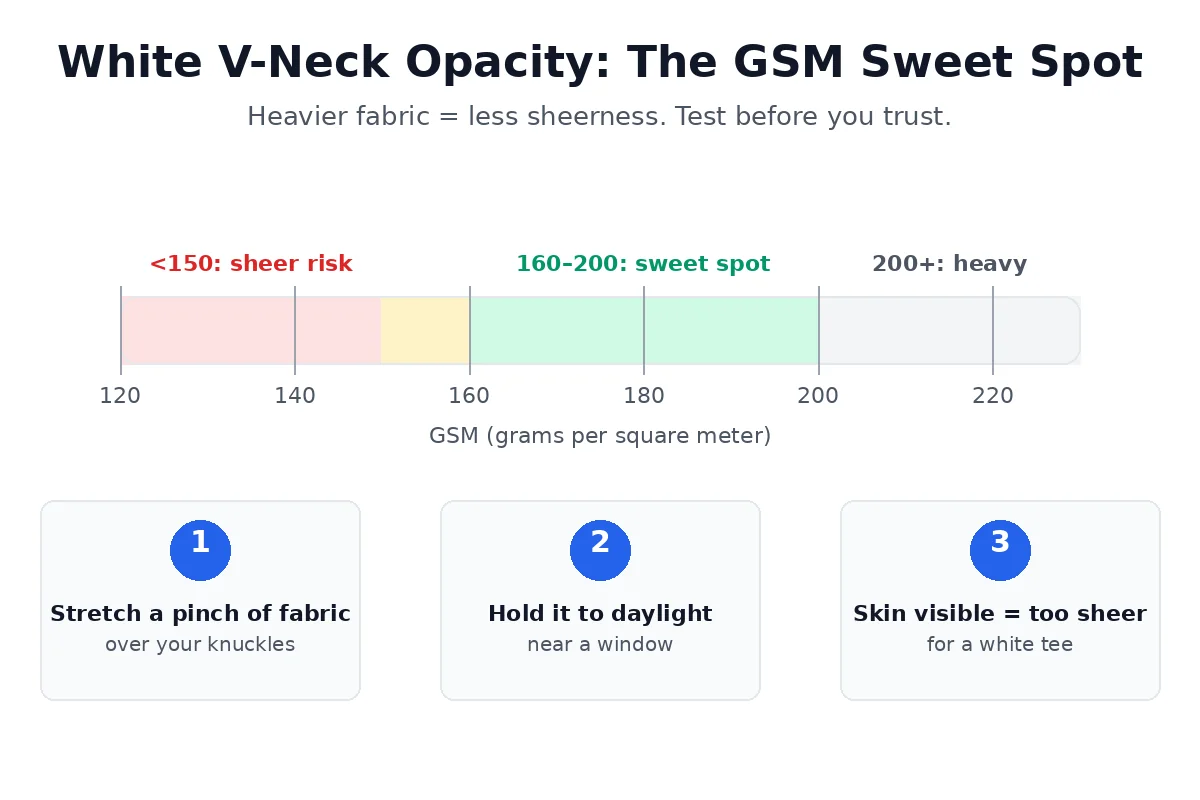
Hold the shirt up with one hand pressed flat behind the fabric, under store lighting. If you can clearly see your fingers' outlines, it will be sheer on your body. A faint blur is acceptable; distinct shapes are not.
2. The Daylight Check
Store lighting is dim and flattering. Step near a window or doorway with the shirt on. White fabric that looked fine indoors often turns translucent in daylight — this is the check most people skip, and it's the one that matters most.
3. The Stretch Test
Knit fabric gets more transparent when stretched. Pull the shirt gently across your chest and check the mirror. If opacity drops noticeably at the chest and shoulders, the knit is too loose for a standalone shirt — it will only get worse as the fabric relaxes with wear.
A shirt that passes all three is rare enough that it's worth buying two.
Fabric and Opacity: What Actually Matters
Weight (GSM)
Fabric weight, measured in grams per square meter, is the first clue. Below ~140 GSM, a white tee is almost always sheer. The 160–180 GSM range is the sweet spot for a standalone white V-neck: opaque without feeling heavy. Above 200 GSM you're in heavyweight territory — very opaque, but warm.
Knit Structure
Weight alone doesn't guarantee opacity. A tight jersey knit blocks more light than a loose one at the same weight, and an interlock (double-knit) construction is noticeably more opaque than a single jersey. If a product page mentions "interlock" or "double-knit," that's a good sign for white.
Cotton Types
Long-staple cottons (Pima, Supima, Egyptian) spin into smoother, finer yarns that knit tighter and pill less. They cost more, but for a white shirt — where every imperfection shows — the smoother surface is worth it. Standard cotton works fine at mid-weight; it just won't stay as smooth as long.
Blends
A small percentage of elastane (3–5%) helps the collar keep its shape, and modal or Tencel blends drape well and resist the graying that pure cotton develops. The trade-off: blends can feel less "crisp" than 100% cotton. For a fitted white V-neck, a blend usually wins; for a classic boxy white tee, pure cotton is fine.
What Sits Underneath
Even an opaque shirt reveals a dark bra or printed undershirt. Under white, wear nude-for-you seamless undergarments — white under white actually shows more, because the bright white layer contrasts against skin through the fabric.
The Fit Checklist
- Shoulder seam sits exactly where your arm meets your shoulder — not drooping down the arm, not pulling toward the neck.
- Sleeves hit around mid-bicep and lie flat without squeezing.
- Hem ends around mid-fly: long enough to stay tucked if you want, short enough to wear untucked without looking sloppy.
- V depth: for a white V-neck, stay shallow to standard (1–4 inches below the collarbone). Deep Vs in white read beachwear, not wardrobe staple. See our complete V-neck fit guide for exact measurements.
- Binding: the strip around the V should be narrow (about ½ inch) and lie flat. If it ripples on the hanger, it will ripple on you.
- Shoulder seams: look for taped or reinforced shoulder seams — a thin strip of fabric sewn over the seam. Without it, the weight of the sleeves gradually pulls the V into a sagging U.
Keeping It White: The Washing Routine
White tees don't stay white by accident. The routine:
- Wash cold, inside out. Heat sets stains and breaks down elastic in the collar; inside-out protects the outer finish from the drum.
- Skip chlorine bleach. It reacts with sweat proteins and can yellow the shirt over time, and it weakens fibers — the source of those mysterious pinholes.
- Use oxygen bleach instead. Sodium percarbonate–based whiteners (like OxiClean) lift dinginess without the fiber damage.
- Add white vinegar to the rinse. Half a cup strips detergent and mineral buildup that makes shirts look gray.
- Air-dry when you can. Dryer heat accelerates collar breakdown and sets any stains you missed. If you must tumble-dry, use low heat.
- Switch to aluminum-free deodorant. Yellow armpit stains come from aluminum compounds reacting with sweat — not from sweat alone. This one change extends a white shirt's life more than any detergent.
- Wash promptly after wearing. Letting sweat sit in the fabric gives salts and oils time to set.
Even with perfect care, a white tee worn weekly has a lifespan — plan on yearly replacement for daily drivers, and keep one pristine spare for occasions that matter.
Styling for Men
Casual
White V-neck, dark indigo denim, clean white sneakers. The V draws the eye upward and adds more visual interest than a crew neck in the same outfit.
Smart Casual
Under an unstructured blazer, the white V-neck mimics the lines of an open-collar dress shirt — sharper than a crew neck under tailoring, without the fuss of buttons. Keep the V shallow and the shirt crisp.
Styling for Women
Effortless
A white V-neck tucked into high-waisted jeans with a leather belt and ankle boots. Add a pendant that sits above the point of the V.
Layered
Under a cardigan, denim jacket, or blazer — the white V-neck is the neutral base that lets the outer layer do the talking. Nude seamless undergarments keep the look clean.
The Invisible Undershirt Angle
The white V-neck's original job is as an undershirt: worn under a dress shirt with the top button undone, the V stays hidden while a crew neck would peek through the collar. If you're buying for this purpose, prioritize a close fit (no bunching under the dress shirt), a shallow V, and a long enough hem to stay tucked. A slightly sheer fabric is actually acceptable here — it's hidden — but the collar must stay flat.
Looking for graphic designs on V-neck cuts instead of plain basics? Browse the full designs collection.
Frequently Asked Questions
How can I tell if a white V-neck is see-through before buying?
Use the 3-step test: the hand test (hold your hand behind the fabric), the daylight check (step near a window), and the stretch test (pull gently across the chest). If it passes all three, it's opaque enough to wear alone.
Why do my white shirts turn yellow?
Usually aluminum in deodorant reacting with sweat, plus chlorine bleach use. Switch to aluminum-free deodorant, skip chlorine bleach, and use oxygen-based whiteners instead.
Is 100% cotton or a blend better for a white V-neck?
For a fitted V-neck, a cotton blend with a few percent elastane or modal holds its shape and collar better. For a classic relaxed white tee, 100% cotton — preferably long-staple — is excellent.
How deep should the V be on a white V-neck?
Shallow to standard: 1–4 inches below the collarbone. Deep Vs in white tend to read as beachwear rather than a wardrobe staple.
What should I wear under a white V-neck?
Nude-for-you seamless undergarments. White under white shows more than you'd expect, because the bright layer contrasts against skin through the fabric.
How often should I replace a white V-neck?
A white tee worn weekly lasts roughly a year of looking truly white, even with good care. Keep a rotation of two or three and one pristine spare for occasions that matter.