
You can spend good money on a dress shirt and still look sloppy for one reason: a white crew-neck collar peeking out of your open collar like a stray piece of laundry. The V-neck undershirt exists to solve exactly that problem — it does everything an undershirt should (absorbs sweat, protects the outer shirt, smooths the silhouette) while staying out of sight. This guide covers the rules that matter: how deep the V should be, which fabrics actually work, what color disappears under a white shirt, how it should fit, and when to skip the undershirt altogether.
Table of Contents
The Problem: The Peeking Crew Neck
An undershirt has three jobs: absorb sweat and body oil before they reach your dress shirt, add a thin layer of insulation, and smooth out the chest so the outer shirt drapes cleanly. A crew-neck undershirt does all three — but the moment you undo the top button of your dress shirt, its collar becomes visible. In professional settings that reads as careless, because the eye catches a horizontal white band cutting across the open collar.
The V-neck solves this geometrically: the neckline drops below the open collar's sightline, so the undershirt keeps working without announcing itself. It is the default choice any time a dress shirt won't be buttoned to the top.
Deep V vs. Standard V: Match It to Your Buttons
Not all V-neck undershirts dip equally. Match the depth to how you wear your collar:
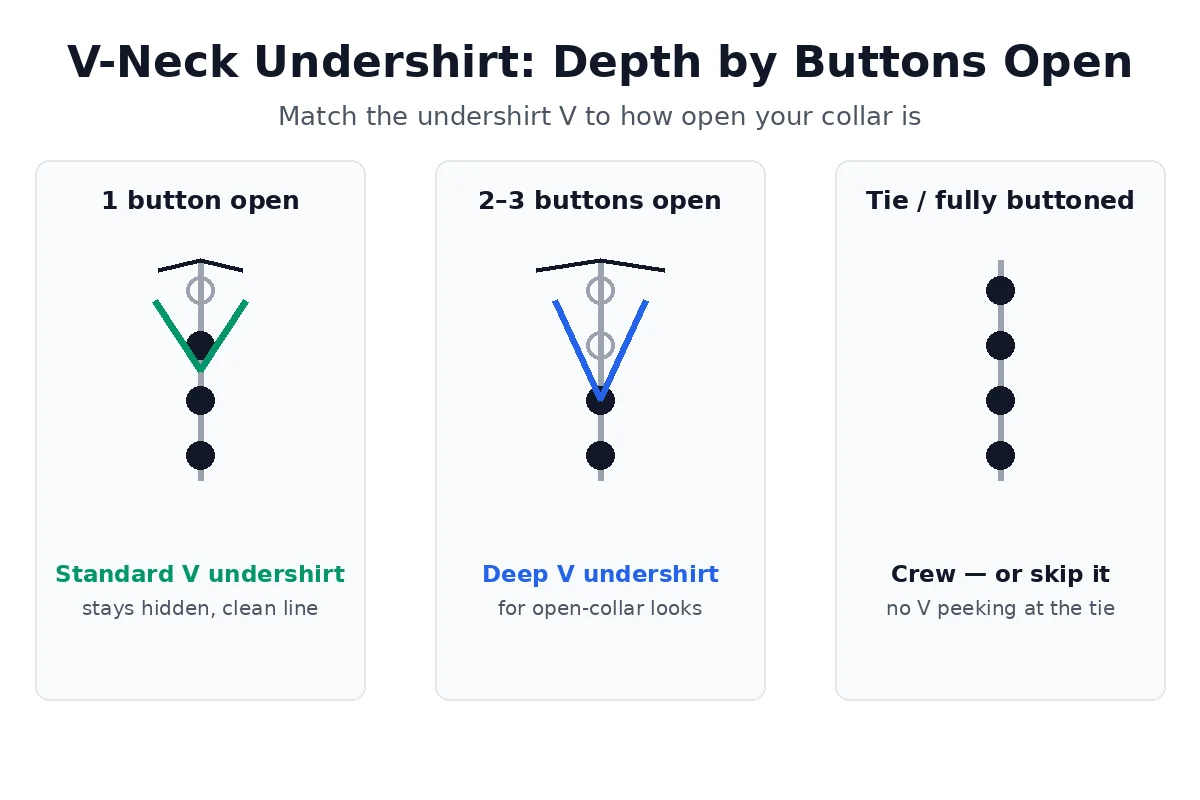
- Standard V-neck (point sits 2–3 inches below the collarbone): stays hidden with the top button undone. This covers the most common business-casual look.
- Deep V-neck (point drops toward armpit level, 4–5 inches below the collarbone): stays hidden with two or even three buttons undone. The right call for warm weather, evening events, or anyone who wears their collar relaxed.
- With a tie, buttoned to the top: depth stops mattering — a crew neck is actually the better pick here, because it gives maximum coverage and sweat protection with zero visibility concerns.
The common mistake is buying a standard V and then unbuttoning two buttons: the undershirt's point creeps into view. If you routinely open two buttons, buy the deep V from the start.
Fabric: What Actually Works Under a Dress Shirt
An undershirt lives against your skin all day under another layer, so fabric choice matters more here than in a standalone tee:
- Micro-modal / TENCEL blends: the current standard for premium undershirts. Softer than cotton, holds its shape wash after wash, and resists the stretched-out collar that ruins cheap undershirts. If you wear dress shirts daily, this is the fabric to look for.
- Bamboo viscose: naturally breathable with a cool hand-feel; a good option if you run warm. Tends to cost more and can pill faster than modal if washed aggressively.
- Cotton with spandex (95/5): the workhorse. The small amount of stretch keeps the shirt fitted and the collar flat; pure cotton without stretch bags out and the neckline goes wavy. Avoid 100% cotton undershirts if you want them to stay invisible — they shrink and lose shape.
- Performance synthetics: genuinely better at wicking sweat, but they can retain odor and feel clammy compared to modal or cotton blends. Worth considering only if sweat is your main problem.
Whatever the fabric, look for a ribbed collar that lies flat — a thick, raised collar seam will show through a thin dress shirt even if the neckline itself is low enough.
Color Rules: What Disappears Under White
This is the rule most men get backwards:
- Under a white or light dress shirt: wear grey, beige, or nude — not white. A white undershirt against your skin creates a high-contrast edge that shows straight through a white dress shirt. A tone close to your skin, or a light heather grey, blends and effectively disappears.
- Under a dark or patterned dress shirt: white is fine — nothing shows through anyway. Black undershirts work under black shirts.
- Under a thin or semi-sheer shirt: match the undershirt to your skin tone as closely as possible, regardless of the shirt color.
If you buy one undershirt color for office wear, make it light grey or nude — it covers the most situations.
Fit: Long, Fitted, and Tucked
An undershirt that bunches, rides up, or billows defeats its own purpose — every fold shows through the dress shirt. Four fit rules:
- Long enough to stay tucked. The body should extend several inches below the waistband. If it untucks during the day, it's too short — look for "tall" or "stay-tucked" cuts.
- Fitted through the torso, not tight. It should skim the body without pulling. Excess fabric bunches; a compression fit shows every contour through thin shirting.
- Sleeves that end mid-bicep. Short enough to stay hidden under a dress shirt's sleeve, long enough to absorb underarm sweat — which is half the point.
- A collar that keeps its shape. Try the pinch test: pinch the V's ribbing — it should snap back flat. If it stays stretched, it will bacon-neck within weeks.
Size by your chest measurement and the brand's size chart, not by your usual t-shirt size — undershirts are cut slimmer by design.
When to Skip the Undershirt
The undershirt is the default, but not the rule. Skip it when:
- The dress shirt is linen or a very breathable weave worn solo in heat. Adding a layer under linen cancels out the airflow you bought the linen for.
- The shirt has built-in sweat-wicking or performance fabric. Doubling up traps heat for no benefit.
- You're going deliberately casual — an untucked short-sleeve button-up at a beach restaurant doesn't need a base layer.
- The undershirt would show no matter what. With a sheer or open-weave shirt, any base layer is visible — in that case a visible, intentional-looking layer (or none) beats a failed attempt at invisibility.
Frequently Asked Questions
Is it okay if my undershirt shows a little?
A glimpse of a V-neck point with two buttons open is a minor offense most people won't register; a full crew-neck band across an open collar is the one that reads as sloppy. When in doubt, go deeper on the V.
What color undershirt should I wear under a white dress shirt?
Light grey, beige, or a nude tone close to your skin — not white. White-on-skin creates a visible contrast line through the dress shirt; a skin-blending tone disappears.
V-neck or crew neck undershirt with a tie?
Crew neck. With the collar buttoned and a tie on, nothing shows anyway, and the crew gives more coverage and sweat protection. Save the V-neck for open collars.
How long should an undershirt be?
Long enough to stay tucked through a full day of sitting and standing — generally a few inches below the waistband. If it untucks, size up in length, not width.
Can I wear a V-neck undershirt on its own?
You can, but undershirts are cut thin and fitted to disappear — they look underdone solo compared to a real t-shirt. For more on V-necks as outerwear, see our ultimate guide to V-neck shirts.
Looking for V-neck designs with actual personality for when the undershirt comes off? Browse the full designs collection.