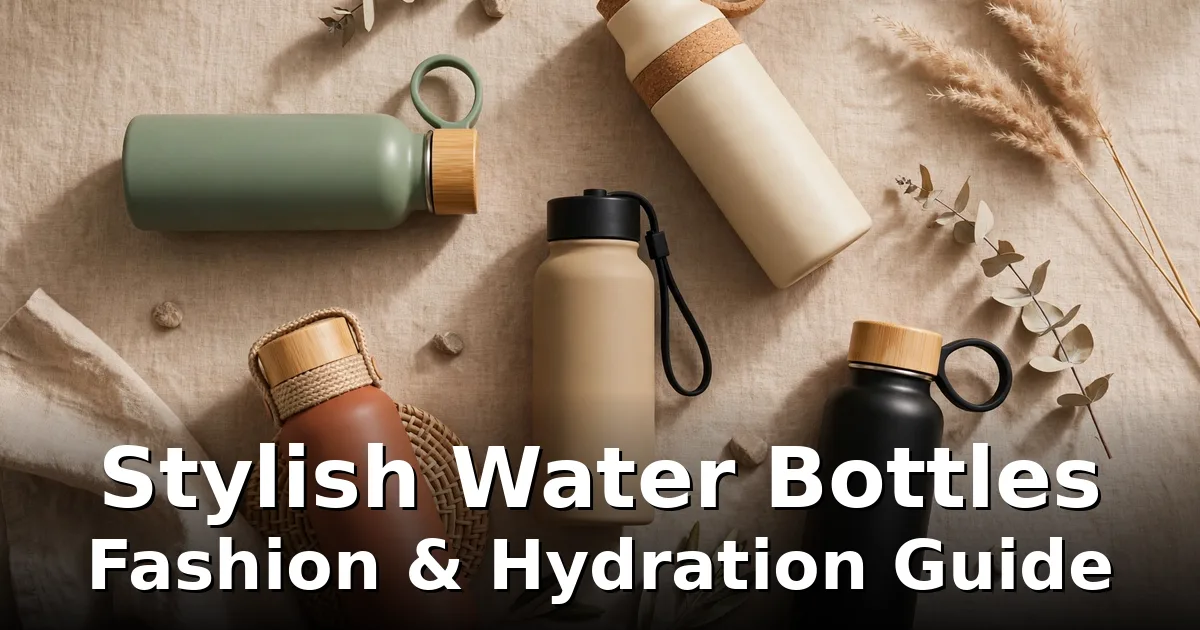
The water bottle has left the gym bag. Over the past decade, reusable bottles moved from pure utility to visible personal style — carried in hand, clipped to bags, and color-coordinated with outfits. Whether you want a bottle that disappears into a minimalist wardrobe or one that starts conversations, this guide covers materials, style archetypes, wardrobe coordination, bottle accessories, and the sticker-customization trend that lets you make any bottle unmistakably yours.
Key takeaways
- Material sets the look and feel: stainless steel for versatility, glass for elegance, BPA-free Tritan for lightweight color.
- Match the bottle to your style: minimalist, professional, trendsetter, and streetwear each point to different finishes.
- Coordinate like an accessory: monochrome-match it, use it as a pop of color, or contrast textures.
- Accessories upgrade the look: carrying straps, sleeves, and bottle bags turn a bottle into a styled piece.
- Stickers make it yours: quality vinyl decals are the cheapest way to personalize — choose waterproof ones and prep the surface.
Table of contents
- From utility to accessory
- Material matters: steel, glass, and Tritan
- Find your bottle archetype
- Size and capacity
- Coordinating your bottle with your wardrobe
- Bottle accessories: straps, sleeves, and carriers
- Customizing with stickers
- Waterproof sticker designs from our collection
- Care and maintenance
- Frequently asked questions
From utility to accessory
For decades, the water bottle was purely functional — a plastic vessel in a gym bag or a rugged thermos for camping. The shift began in the mid-2010s, driven by the athleisure movement and a broader wellness focus: the bottle became a visible extension of personal style. Social platforms accelerated it, with specific models, colors, and limited "colorways" turning hydration gear into collectibles.
Today, the bottle functions much like a bag or a pair of sneakers: a lifestyle signal. A sleek matte-steel bottle reads minimalist-professional; a bright, sticker-covered bottle reads creative and playful. Neither is better — the point is that the choice now communicates something, so it is worth choosing deliberately. And the most fashionable signal of all remains a genuinely reusable bottle instead of single-use plastic — a small choice that pairs naturally with a sustainable everyday carry.
Material matters: steel, glass, and Tritan
Stainless steel — the versatile choice
The workhorse of the stylish-bottle world. Double-wall vacuum insulation keeps drinks cold or hot for hours, and the finish options are the widest: matte, gloss, metallic, iridescent, powder-coat. Steel suits nearly every style archetype and survives drops that would kill glass. Look for food-grade 18/8 stainless steel, which resists metallic aftertastes.
Borosilicate glass — the elegant choice
Glass offers taste purity and a high-end look, often paired with silicone sleeves or leather-look holders. It leans "quiet luxury" — but it is heavier and breakable, so a protective sleeve is not optional. Best for desk and home use rather than the trail.
BPA-free Tritan plastic — the lightweight choice
High-quality Tritan allows transparency and vivid colors that metals cannot match, at a fraction of the weight. Ideal for sport and travel where every gram counts. It will scratch and show wear sooner than steel, and it does not insulate.
Find your bottle archetype
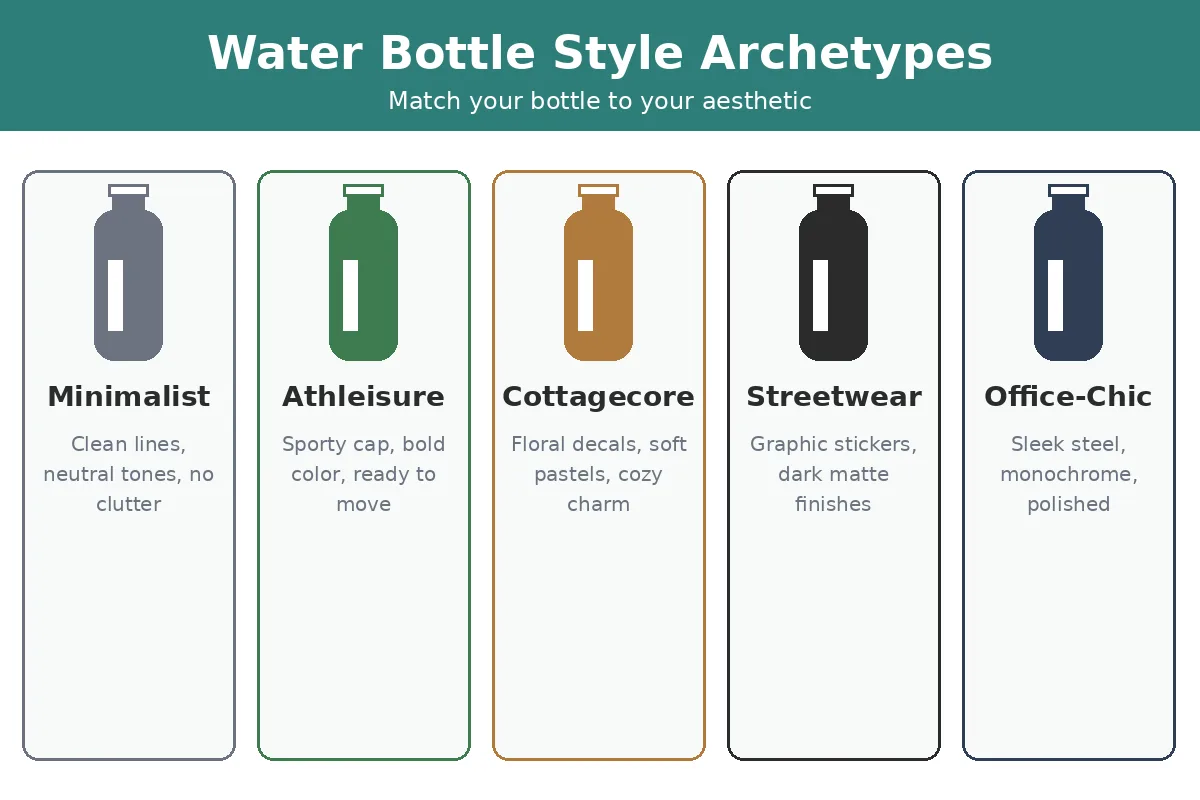
- The Minimalist: sleek, monochromatic — sand, slate, cream, or matte black. Clean lines, no busy graphics.
- The Professional: slim matte-steel bottles that slide into a tote or briefcase without bulk; understated finishes.
- The Trendsetter: seasonal colors and limited drops — pastels, earthy neutrals like terracotta and sage, or bold brights.
- The Streetwear Enthusiast: bold graphics, oversized silhouettes, collaboration-style designs.
- The Outdoors Type: rugged powder-coat steel, carabiner-friendly caps, earthy tones that hide trail dust.
Size and capacity: how much bottle do you need?
Capacity is a style decision as much as a practical one. Compact bottles (350–500 ml) disappear into small bags and suit minimalists and commuters who can refill during the day. The mid-range (750 ml–1 liter) is the all-rounder — enough for a workday or a workout without constant refills. Oversized bottles (1.5 liters and up) make a bold visual statement and suit long hikes or desk-bound days, but they are heavy and do not fit standard cup holders. Match the size to your routine first, then pick the finish: a giant bottle in the wrong lifestyle ends up abandoned in a cupboard, no matter how good it looks.
Coordinating your bottle with your wardrobe
Treat the bottle the way you would a scarf or a watch:
- Monochrome matching: match the bottle to your outfit — a forest-green bottle with a forest-green workout set looks deliberate and streamlined.
- The pop of color: if you wear mostly neutrals (black, white, navy), let the bottle supply the accent — a vivid hue against a quiet outfit.
- Texture contrast: pair a high-shine metallic bottle with soft knit fabrics, or a matte bottle with polished accessories, for visual interest.
- Match your metals: silver jewelry pairs naturally with brushed steel; gold-tone hardware pairs with champagne or rose-gold finishes.
Bottle accessories: straps, sleeves, and carriers
Accessories are what push a bottle from "container" to "styled piece":
- Carrying straps: leather, woven, or fabric straps in colors and patterns that complement the bottle — and they free your hands.
- Insulated sleeves: neoprene or knit sleeves add color and texture while protecting the finish and improving insulation.
- Bottle bags and crossbody carriers: small dedicated carriers (some with zip pockets for keys and cards) let the bottle ride visibly as part of the outfit.
- Carabiners and charms: clip the bottle to a tote bag or backpack for a functional-charm look.
Customizing with stickers
The most popular personalization trend needs no custom order: decorating a bottle with stickers. Done well, it is a curated collage rather than clutter. Here is how to get it right.
Choose the right sticker material
Not all stickers survive bottle life. Paper-based stickers peel, fade, and turn soggy with condensation. Look for thick vinyl stickers — non-porous, water-resistant, and far more durable. The real quality marker is UV lamination: a clear coating that protects the ink from sun fading and scratches. Note the distinction: "water-resistant" is not "waterproof." For gym, hiking, or frequent washing, choose stickers explicitly labeled waterproof with permanent adhesive.
Prep the surface
The secret to edges that do not peel: start with a clean, dry bottle. Wipe the area with a damp cloth (or a little rubbing alcohol on steel), let it dry fully, then apply from the center outward, smoothing as you go to push out air bubbles. Avoid placing stickers over seams, textured powder-coat ridges, or curved edges where adhesion is weakest.
Curate, don't clutter
Pick a theme and a palette — travel memories, botanical illustrations, affirmations, or a single color family — and leave breathing room between decals. A few well-placed stickers with intentional negative space look designed; a wall-to-wall collage reads chaotic. For more on sticker types and application, see our complete custom sticker guide and our laptop sticker styling guide — the same principles apply.
Waterproof sticker designs from our collection
A bottle covered in generic decals looks like everyone else's. Original artwork is what makes the collage yours. These are real designs from our collection, available as stickers:

"Off To Cause A Kerfuffle" Frog Sticker
A sarcastic frog graphic with bold, high-contrast linework — exactly the kind of punchy single decal that anchors a bottle collage. Available on Redbubble as a sticker.
View on Redbubble →
"We Ride at Dawn" Frog & Goose Sticker
A chaotic retro frog-and-goose meme graphic — a conversation-starter decal for the playful end of the bottle-styling spectrum. Available on Redbubble as a sticker.
View on Redbubble →Care and maintenance
A scratched, dented, or grimy bottle ruins the look. Hand wash even "dishwasher safe" bottles to preserve exterior paint and finishes. Use a silicone sleeve on glass bottles to prevent shattering and add color. Deep-clean weekly with a bottle brush — and if you use straw lids, clean the straw mechanism, which is where odors start. For steel bottles, avoid abrasive scrubbers on powder-coat finishes.
Frequently asked questions
What is the best material for a stylish water bottle?
Stainless steel is the most versatile: durable, insulated, and available in the widest range of finishes. Glass wins on taste purity and elegance but needs a protective sleeve; BPA-free Tritan is lightest and most colorful but does not insulate.
How do I match my water bottle to my outfit?
Three approaches work: monochrome-match the bottle to your clothes, use it as a single pop of color against neutrals, or contrast textures — for example, a metallic bottle with soft knit fabrics.
What kind of stickers stay on a water bottle?
Thick vinyl stickers with UV lamination and permanent adhesive. Avoid paper stickers — they peel and fade with condensation. Prep the surface (clean and fully dry), apply from the center outward, and keep decals away from seams and sharp curves.
Can I bring a metal water bottle on a plane?
Yes — as long as it is empty when you go through security. Refill it at a hydration station past security, and it doubles as a stylish travel companion.
How do I keep my bottle's finish looking new?
Hand wash instead of using the dishwasher, use a protective sleeve on glass and powder-coat finishes, and avoid abrasive scrubbers. Deep-clean with a bottle brush regularly to prevent odors, especially in straw lids.
Browse the AIPrintVerse design collection for original sticker artwork and accessories.
Related guides
Continue with these related AIPrintVerse guides: