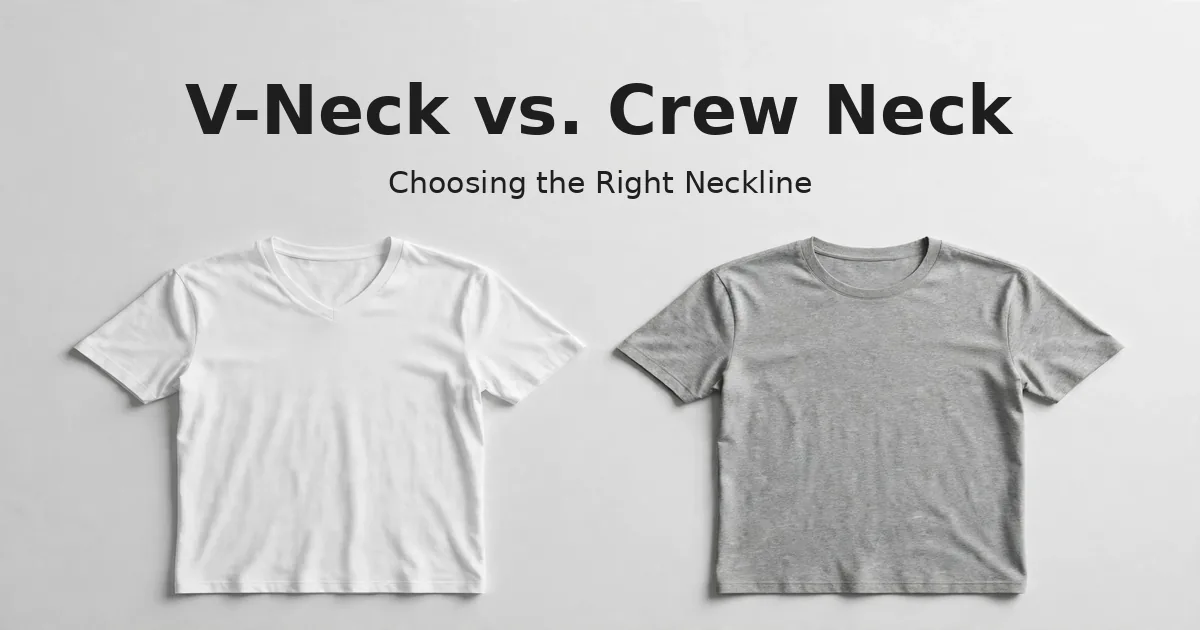
Short answer: pick a crew neck when you want the most dependable everyday T-shirt — casual wear, training, and discreet layering. Pick a V-neck when you want more openness around the neck: to frame the face, show a necklace, or sit neatly under an open shirt. Neither is universally more flattering. Fit, fabric, and the outfit around the shirt matter more than the neckline itself.
The difference is small on the hanger but visible on the body. A crew neck draws a clean horizontal line at the base of the neck; a V-neck opens that line and directs the eye downward. Below is a quick verdict table, then an honest breakdown of where each neckline earns its place — plus a real graphic V-neck example so you can see the cut in action. For a deeper dive into the V side, see our ultimate guide to V-neck shirts.
Table of Contents
Quick verdict: V-neck vs crew neck at a glance
| Consideration | Crew neck | V-neck |
|---|---|---|
| Overall effect | Contained, balanced, structured | Open, directional, visually longer |
| Everyday role | Default casual tee, gym, discreet base layer | Warm-weather tee, intentional smart-casual base |
| Layering | Disappears cleanly under hoodies and sweaters | Stays part of the outfit under open shirts and blazers |
| Coverage | More coverage at neck and chest | Choose depth deliberately — shallow is most versatile |
| Jewelry | Usually keeps attention on the garment | Leaves room for a chain, pendant, or scarf |
| What to check when buying | Collar lies flat, recovers after washing | Point stays centered, no gaping, even binding |
When a V-neck is the better pick
To frame the face and open the neckline
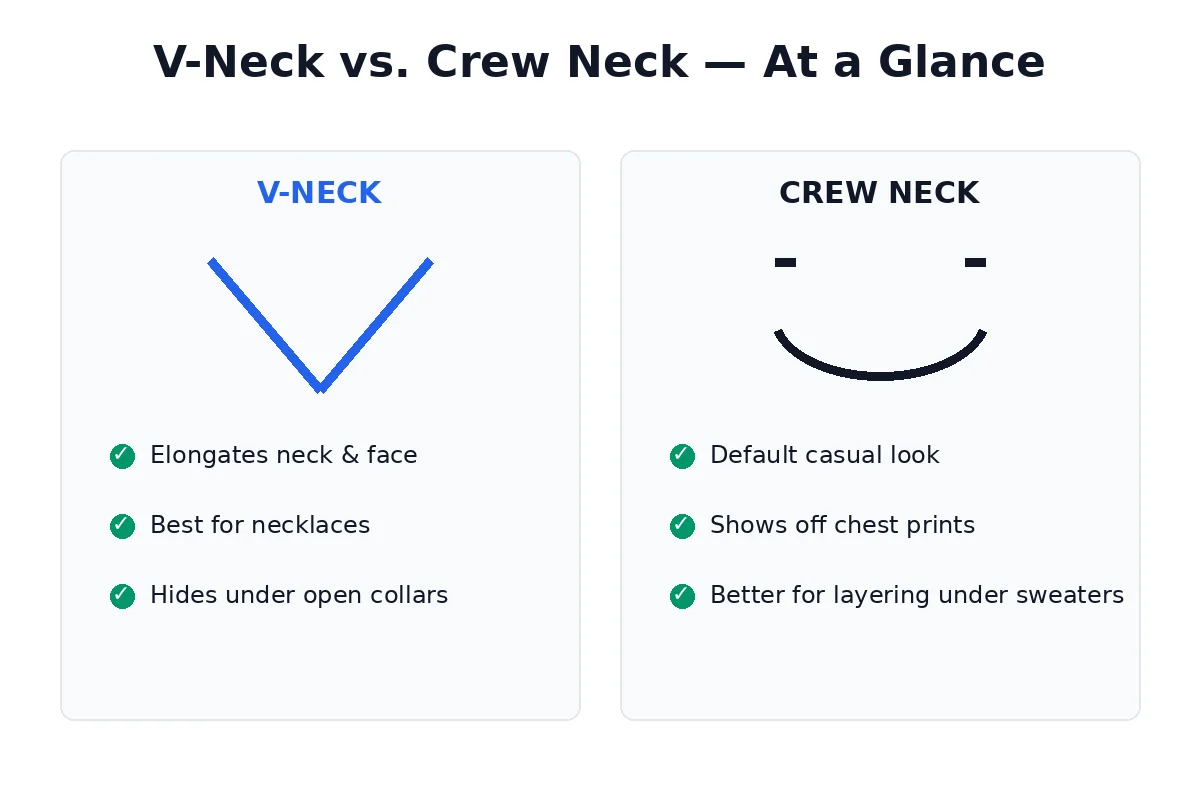
The diagonal edges of a V draw the eye downward, which creates a longer visual line through the neck and upper chest. Many people find this flatters a rounder face or a shorter-looking neck — but treat that as a tendency, not a rule. A high, shallow V works for most people; a deep plunge is a deliberate fashion choice with far fewer settings where it fits. Comfort and coverage should decide the depth, not a face-shape chart.
Under an open shirt, overshirt, or blazer
This is the V-neck's strongest use case. Under an open button-down, overshirt, or unstructured blazer, a shallow V echoes the opening above it and creates one continuous line. A crew neck in the same spot can look like an accidental layer peeking out. Keep the V's fabric smooth and the point intact — a stretched or wavy point undoes the effect.
When you want jewelry to show
Chains, pendants, and necklaces sit naturally in the open space of a V. A crew neck either hides the chain entirely or forces it to sit on top of the fabric, which looks cluttered. If you regularly wear a necklace, a V-neck earns its place in the rotation.
The undershirt rule
An undershirt should match the opening of the shirt above it. Wearing a dress shirt open at the collar? A V-neck undershirt stays hidden. Buttoned to the top, or with the tee intentionally visible? A crew neck is the cleaner choice. Visible undershirt lines at the collar are what make an outfit look unintentional.
In warm weather
The open cut genuinely feels lighter when it's hot. A V-neck in a breathable, medium-weight cotton or cotton blend is a solid summer staple — cooler than a crew in the same fabric, without going sleeveless.
A real graphic V-neck, up close
One concern with V-necks is that a bold graphic can look less grounded than on a crew. In practice, a well-cut V gives a print room to breathe — the design below works precisely because the neckline keeps it looking intentional rather than sloppy:

"Off To Cause A Kerfuffle" Groundhog V-Neck
A funny groundhog-on-a-scooter graphic on a V-neck cut — the kind of conversation-starter design that works precisely because the neckline keeps it looking intentional, not sloppy. Available on Redbubble as a V-neck tee in multiple colors.
View on Redbubble →Want more designs cut this way? Browse the full designs collection — several tees come in V-neck variants.
When a crew neck is the better pick
As the default everyday tee
If you're buying one T-shirt and one only, make it a crew neck. It works with denim, chinos, joggers, and shorts without any styling decisions. The contained opening reads as neutral — it neither dresses the outfit up nor down, which is exactly what a default should do.
For graphic prints and statement designs
Large prints, bold typography, and busy artwork usually sit best on a crew neck. The round opening acts as a stable frame that keeps attention on the design itself. A V-neck can work with graphics (see the example above), but for your loudest prints, the crew is the safer canvas.
For training and active days
Crew necks stay put. The higher, contained opening is less likely to gape when you bend, reach, or move, and it provides more coverage during exercise. A performance V-neck can still work for the gym, but only if it genuinely stays flat in motion — test it before committing.
Under hoodies, sweaters, and closed layers
When the layer above is closed at the neck, the base layer's neckline should disappear. A crew neck sits cleanly under a hoodie, crew-neck sweater, or zipped jacket. A V-neck under a closed crew sweater creates a visible, mismatched line at the collar.
When you want maximum coverage
For workplaces, family events, or any setting where chest exposure should be zero, the crew neck is the uncomplicated answer. No depth decisions, no checking the mirror when you lean forward.
Neckline by occasion
- Office casual / smart casual: shallow V-neck under an open overshirt or blazer; crew neck on its own with chinos.
- Gym and sports: crew neck, for coverage and stability in motion.
- Date night: shallow V-neck in a dark, smooth fabric — the open neckline reads as more intentional.
- Summer weekends: V-neck for heat; crew neck if you'll be active.
- Layering under a hoodie: crew neck, so nothing competes at the collar.
- Showing a necklace or chain: V-neck, always.
- Formal-adjacent events: neither beats a proper collared shirt — but a dark crew neck under a blazer is the safer fallback if a tee is unavoidable.
Getting the fit right (both cuts)
The neckline only works if the shirt fits. Check three things before buying either cut:
- Shoulder seam: it should sit at the edge of your shoulder. No neckline rescues a shirt that's too narrow or too wide through the shoulders.
- Collar behavior: on a crew, the rib should lie flat without pressing into the throat. On a V, the point should stay centered and flat when you bend or reach — if it gaps or drifts, try another size or cut.
- Fabric and care: medium-weight jersey generally holds a cleaner line than tissue-thin fabric. Wash per the label, reshape the neckline while damp, and don't assume "pre-shrunk" means zero shrinkage.
The honest 30-second test: put on both necklines in the same fabric, color, and size, then move — reach forward, lift your arms, sit down. Buy the one that stays flat and comfortable. If both pass, you don't have a neckline problem; you have a two-shirt wardrobe.
One last construction detail worth knowing: crew necks usually use a ribbed collar, which grips and recovers well, while V-necks are typically bound with self-fabric tape at the point. Neither is inherently better, but a thin, flimsy binding on a cheap V will curl and gape within a few washes — feel the collar before you buy, and skip anything that already feels limp on the hanger.
Frequently Asked Questions
Which is better, a V-neck or a crew neck?
A crew neck is the easiest all-purpose choice for casual wear, active days, and discreet layering. A shallow V-neck is better when you want an open neckline, visible jewelry, or a deliberate base layer under an open shirt or blazer.
How deep should an everyday V-neck be?
Choose a shallow or moderate V that ends around the upper chest and stays flat when you bend or reach. If the opening exposes more than you want or the point gaps, choose a higher cut or a different size.
Can I wear a V-neck under a blazer?
Yes. A clean, shallow V-neck in a smooth, opaque fabric works for relaxed smart-casual outfits under an unstructured blazer. Keep the shirt fitted without pulling, and avoid deep or stretched necklines in professional settings.
Which neckline should I wear for the gym?
A crew neck is the more secure choice for training: it provides coverage and is less likely to shift during movement. A performance V-neck can work if it stays flat and does not gape when you move.
Do V-necks suit women as well as men?
Yes. The same principles apply: a crew neck creates a higher, quieter frame, while a V-neck opens the neckline and shows a necklace. Women's fitted V-necks follow the same depth guidance — shallow and stable is the most versatile choice.