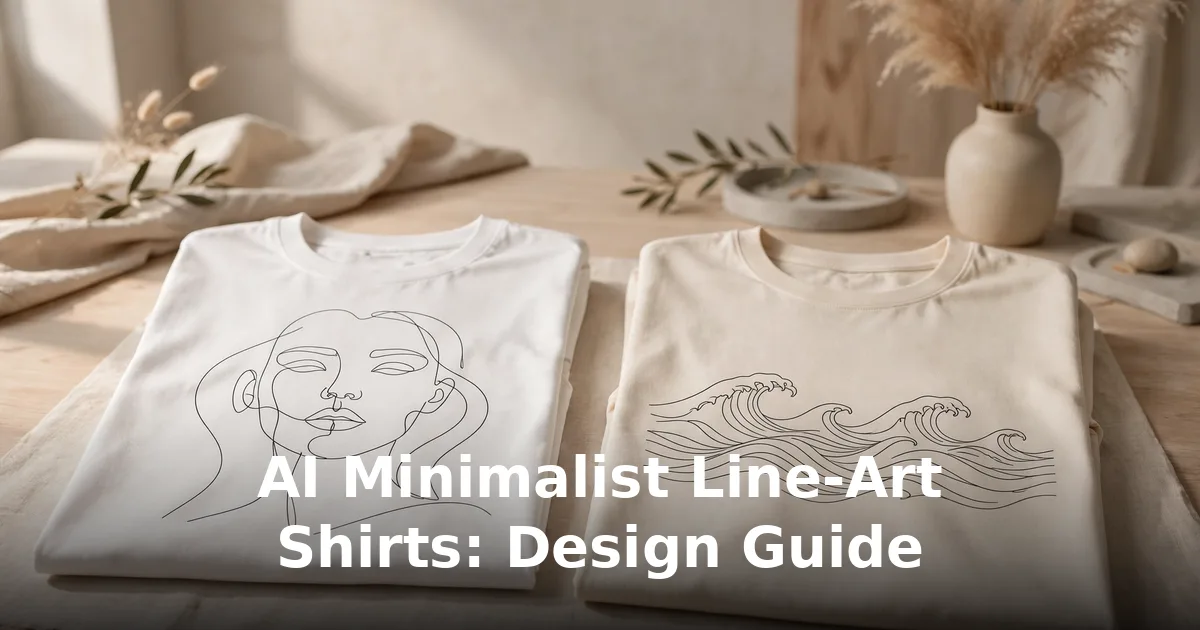
There's a particular elegance in a single confident stroke of ink on a clean tee — a face, a wave, a mountain range reduced to its essence. Minimalist line art has moved from gallery walls to everyday wardrobes, and AI image generators have made the style radically more accessible. This guide covers why line art works on shirts, the sub-styles worth knowing, prompt recipes that produce clean results, the vectorization step that makes prints crisp, and how to style the finished piece.
Table of Contents
Key Takeaways
- Line art prints beautifully because less ink means fewer things that can go wrong.
- Constrain prompts with "single-weight stroke," "monoline," and "no shading" for clean output.
- Vectorize every line-art design — it's the difference between boutique and blurry.
- Small chest prints and large back prints are the two placements that flatter minimal art.
Why Line Art Works So Well on T-Shirts
Line art is the rare style where the printing process is an ally, not an obstacle. Screen printing and DTG both reproduce bold, simple shapes flawlessly; it's gradients, photorealism, and hairline detail that cause trouble. A design made of clean strokes sidesteps nearly every common print defect — no banding, no muddy blends, no lost detail.
There's also an economic logic. Fewer ink colors mean lower screen-printing costs and simpler DTG passes. And aesthetically, minimalism ages well: a single-line face from five years ago still looks current, while last year's maximalist trend print already looks dated. If you're building a print-on-demand catalog, line art is one of the most durable styles to invest in — see our complete guide to AI-generated t-shirt designs for the broader strategy.
Psychologically, minimal designs invite the viewer in. The brain completes the suggestion of a form — a few curves become a face — which makes the shirt feel like art rather than merchandise.
The Line-Art Style Taxonomy
"Line art" covers several distinct aesthetics. Knowing which one you're after sharpens both your prompts and your taste:
- Continuous / single-line: one unbroken stroke forming the subject. The most iconic and the hardest to get right — specify "single unbroken line, no lifting the pen."
- Contour minimalism: clean outlines describing faces, hands, or objects with no fill. Elegant and highly wearable.
- Monoline illustration: uniform stroke weight throughout, often with small decorative details. Modern, friendly, and very printable.
- Botanical line art: delicate plant and flower studies. A perennial favorite for gifts and nature niches.
- Abstract line composition: flowing curves and geometric line play with no representational subject. Works as subtle texture-like design.
- Minimalist silhouette: not strictly line art, but its close cousin — solid shapes with no interior detail, like pine trees against a setting sun. Maximum impact from minimum ink.
Prompt Recipes for Clean Line Art
AI models default to adding shading, texture, and detail — everything line art avoids. Your prompts must actively suppress that instinct:
Single-line portrait: "Continuous single-line drawing of a woman's profile with flowing hair, one unbroken stroke, elegant minimal contour, black ink on white, generous negative space, no shading, no fill, centered, t-shirt graphic."
Botanical study: "Minimalist botanical line illustration of eucalyptus branches, delicate uniform stroke weight, monoline, black on white, scientific illustration elegance, no shading, no background elements, t-shirt graphic."
Abstract composition: "Abstract minimalist line art, flowing parallel curves forming a wave, single weight stroke, high contrast black on white, lots of negative space, modern gallery aesthetic, t-shirt graphic."
Key modifiers to reuse: "single-weight stroke," "monoline," "no shading," "no gradients," "no cross-hatching," "clean vector lines," "isolated on white." And always add the negative prompt: "shading, gradients, sketchy lines, messy strokes, textured background, watermark."
For the full prompt engineering system behind these recipes, see our AI t-shirt prompt guide.
Vectorization: The Crisp-Print Secret
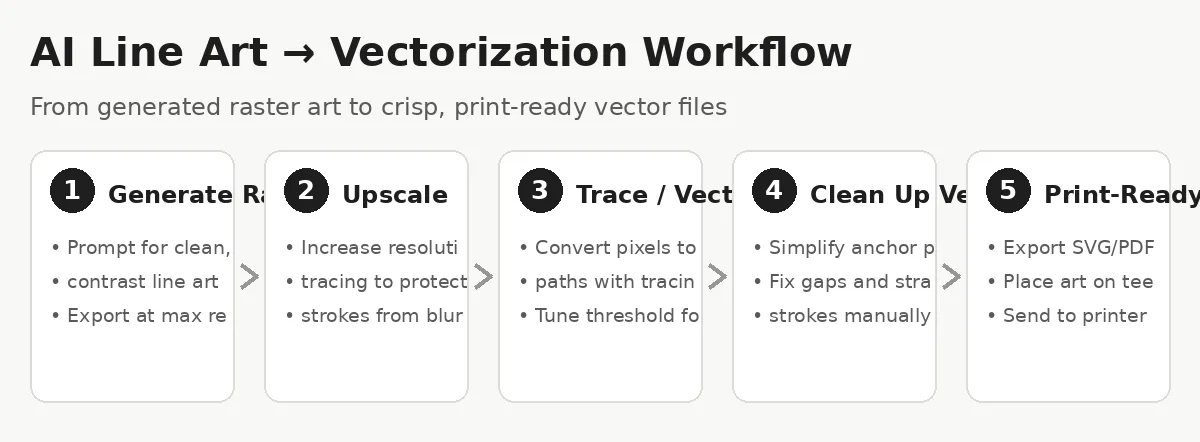
AI generators output raster images — grids of pixels. Enlarge a raster line drawing and the edges stair-step; print it small and fine lines may vanish. Vectorization converts the art into mathematical paths that stay razor-sharp at any size, which is exactly what line art needs.
- Clean the source first. Remove the background and boost contrast so lines are pure black on pure transparency.
- Trace it. Vector Magic, Illustrator's Image Trace, or Inkscape's Trace Bitmap convert strokes to paths. For monoline art, use a centerline trace mode if available — it follows the stroke rather than outlining it.
- Simplify. Reduce anchor points so curves stay smooth; thousands of nodes create jagged prints.
- Proof at size. Export and view at the actual print dimensions before uploading.
This step is non-negotiable for line art. Bold graphics can survive as high-res rasters; fine linework cannot.
Placement and Garment Choices
Minimal art is placement-sensitive. Two positions consistently work:
- Small left-chest print: a 3–4 inch design over the heart reads as a refined signature. Ideal for single-line faces and tiny botanical studies.
- Large centered back print: gives flowing compositions room to breathe. A wraparound-feeling abstract piece earns its drama here.
Garment color matters more than with bold graphics: black ink needs a light shirt, white or cream ink needs a dark one. Mid-tone inks on mid-tone shirts disappear — keep contrast decisive. A heavyweight ringspun cotton provides a stable surface that keeps fine lines from bleeding into the weave.
The Pocket-Print Revival
Worth calling out separately: the small left-chest print has become a quiet status signal in streetwear — a tiny embroidered-looking mark that suggests confidence precisely because it doesn't shout. AI line art is perfect source material for this look, since a single clean motif scales down to three inches without losing legibility. If you generate with pocket placement in mind, keep the design to one focal element; two competing shapes at that size just read as a smudge.
A Minimalist Design From Our Collection
Theory is useful; seeing the aesthetic on a real garment is better. This is the design DNA this guide is about — a limited palette, bold simple shapes, and nothing that doesn't need to be there:

Minimalist Pine Tree Forest Sunset
Three pine silhouettes against a burnt-orange sun disc — two ink colors, zero clutter. This is minimalist outdoor design done right: bold shapes that read from across the room and print flawlessly. Available on Redbubble (shown on a hoodie; the artwork suits tees equally).
View on Redbubble →For more styles in this vein, browse our full designs collection.
Styling Minimalist Line-Art Tees
Minimalist shirts are the easiest in your wardrobe to style because they don't compete with anything:
- Smart casual: white line-art tee under an unstructured blazer with dark trousers. The art reads as intentional, gallery-adjacent taste.
- Off-duty: oversized fit with relaxed denim and clean sneakers. Minimal art keeps the oversized silhouette deliberate rather than sloppy.
- Layered: under an open overshirt or chore coat, letting the design peek through. The simplicity survives partial concealment.
Keep the rest of the outfit quiet — the shirt is the statement, even when the statement is whispered.
Caring for Fine Linework
Line art's one vulnerability is mechanical: thin strokes can crack if the print is repeatedly stressed by high heat. Wash inside out in cold water, skip the hot dryer in favor of hang-drying, and avoid ironing directly over the design. Treated gently, a vector-based line print will outlast most full-color graphics in the same drawer.
One more practical note: if you're ordering through a print-on-demand service rather than printing yourself, upload the vector-derived PNG at the service's recommended dimensions and check their preview carefully. POD previews render your transparency against the garment color, which is the fastest way to catch contrast problems before a single shirt ships.
Frequently Asked Questions
Can AI really draw clean single-line art?
Yes, with the right constraints. Prompts must specify "single unbroken line" and exclude shading and texture via negative prompts. Expect to generate several variants — AI still occasionally lifts the imaginary pen — and pick the cleanest.
What file format is best for printing line art?
Vector formats (SVG, EPS, PDF) are ideal since lines stay crisp at any size. If you must use raster, export a transparent PNG at 300 DPI at the final print dimensions — never upscale a small JPG and hope for the best.
Do minimalist shirts fade faster than bold graphic tees?
Less ink on the fabric generally means less to crack or fade. Fine lines benefit most from gentle care: wash inside out in cold water and hang dry to keep strokes sharp.
What colors work best for line-art shirts?
Black ink on white, cream, or heather grey is the timeless choice. For a moodier look, cream or white ink on forest green, navy, or black garments works beautifully. Avoid mid-tone ink on mid-tone fabric — contrast is everything.
Can I sell AI-generated line art on shirts?
Generally yes, subject to your AI tool's license terms — most paid plans grant commercial rights. Keep your subjects original and avoid trademarked characters or logos in your prompts.