
Pulling a perfectly faded graphic tee from a crowded thrift rack is a specific thrill that fast fashion cannot replicate. But thrifting good graphic tees is a skill — most racks are overwhelmingly filler, and the gems hide behind a wall of stained corporate polos. This guide gives you the hunting playbook, 18 retro aesthetic find types worth your time, and the authentication basics that separate a real score from a dud.
The Thrift-Hunting Playbook
Where to hunt
Big-chain thrift stores have the deepest racks but the most competition. Estate sales and flea markets skew older — better odds for genuine 80s and 90s prints. Online, resale marketplaces work, but you lose the ability to feel the fabric and check for stains, so reserve those for specific grails you already know.
Rack strategy
Work the rack back to front, flipping quickly and scanning for three signals: interesting graphics, heavy-feeling cotton, and faded colors. Do not read every shirt — scan for print, then pull candidates. Check the men's section regardless of who you are; that is where most of the good vintage tees live.
The 4-point inspection
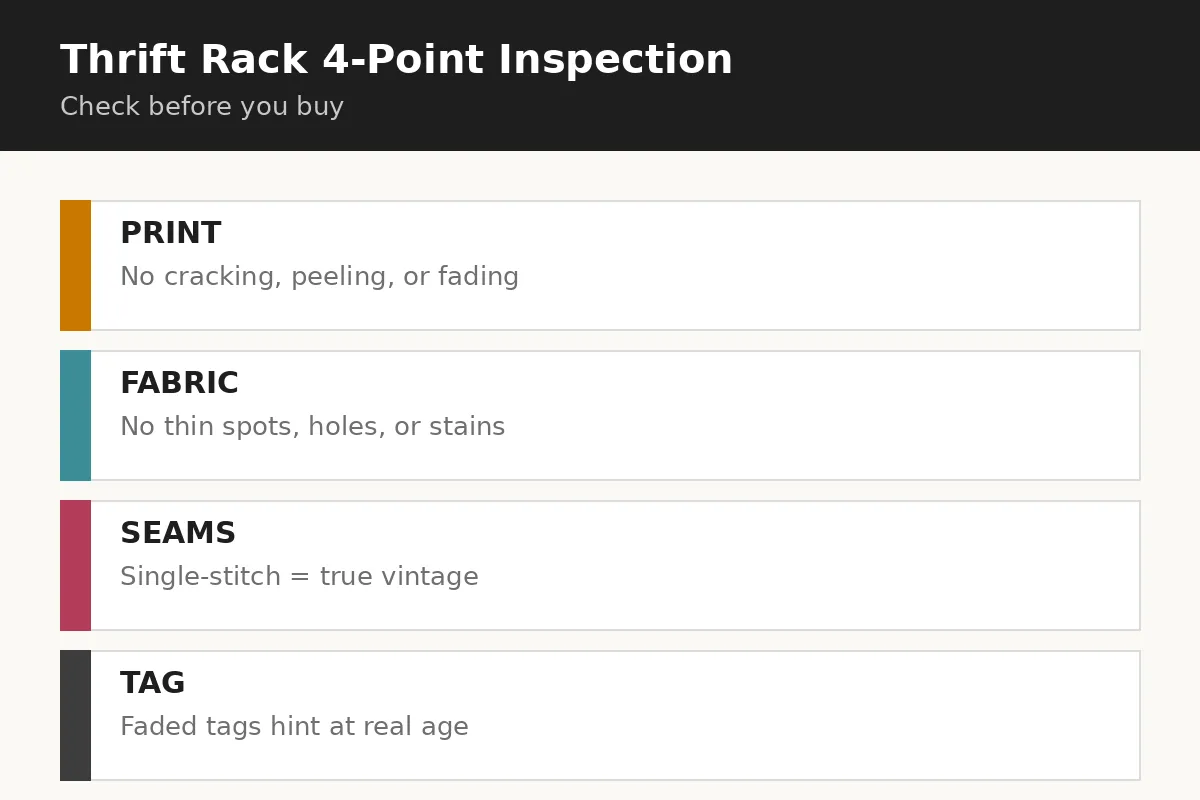
Before anything goes in your basket, check four things:
- Pits and collar: Yellow pit stains and a stretched, wavy collar are the two most common deal-breakers. Some yellowing washes out; a destroyed collar never recovers.
- Stains: Hold the shirt up to the light. Small spots near the hem are livable; anything on the graphic itself is not.
- Print condition: Light cracking is character. Flaking — where ink lifts off in chunks — means the print is dying. Scratch the print lightly with a fingernail; if ink comes off, put it back.
- Seams: Flip the shirt inside out. Intact seams with no unraveling mean the shirt has life left. Check the shoulder seams especially — they take the most stress.
18 Retro Aesthetic Finds Worth Hunting
The thrift graphic-tee universe breaks down into recognizable aesthetic families. Learn them and you will spot the good stuff in seconds.
- 90s bootleg rap tees: Collage layouts, heavy drop shadows, dramatic typography — the louder the better.
- Faded national park souvenirs: Earth tones, 70s serif fonts, bison and pine-tree illustrations.
- Ironic corporate logos: Defunct tech companies, old grocery chains, and forgotten brands reimagined with a wink.
- Botanical illustrations: Scientific-style mushroom and wildflower sketches on off-white cotton.
- Vaporwave sunsets: Purple-pink-cyan gradients over 80s grid landscapes.
- Fake collegiate athletics: "State University Athletic Dept" graphics for schools that never existed.
- Western gothic: Bleached skulls, cacti, and desert scenes with a moody edge.
- 90s anime stills: High-contrast, grainy frames from cel-shaded classics.
- Tourist-trap tees: Airbrushed-style Florida, Hawaii, and roadside-attraction graphics.
- Grandpa's fishing club: Goofy fish illustrations with slogans like "Born to Fish, Forced to Work."
- Psych-rock concert posters: Melting typography and kaleidoscopic color straight off a venue wall.
- Minimalist line art: Single-line portraits and abstract shapes — the quiet counterpoint to loud prints.
- Lo-fi photography prints: Grainy 35mm-style shots with a soft blur that reads as age.
- Motivational irony: Aggressively cheerful slogans paired with bleak imagery.
- Retro automotive: Distressed oil-brand logos and muscle-car graphics from the 60s and 70s.
- Astrology and celestial: Sun-and-moon woodcut designs that look lifted from an old almanac.
- Geometric Bauhaus: Primary colors and rigid shapes channeling 1920s design.
- Workwear patches: Graphics styled like embroidered name tags for mechanics and gas-station attendants.
Authentication Basics
Not every "vintage" tee is old. Here is how to tell what you are holding:
- Single-stitch hems: One line of stitching on sleeve and bottom hems was the standard before the mid-90s. Double-needle stitching on both means it is almost certainly post-1995.
- The tag: Look for papery, faded tags from makers like Screen Stars, Hanes Beefy-T, or Fruit of the Loom's older runs. A crisp modern tag on a "vintage" graphic is a reproduction.
- Copyright line: Real licensed tees usually carry a small copyright date near the bottom of the graphic. No date does not automatically mean fake, but a date anchors the era.
- Fabric feel: Decades of washing give cotton a thin, buttery softness that enzyme washes approximate but rarely nail. If it feels brand-new stiff, it probably is brand-new.
- Print texture: Old plastisol prints crack in fine networks ("crazing"). Reproductions often distress mechanically, which looks more uniform — real aging is uneven.
Washing Thrifted Prints
Most thrifted tees die in the first three washes. Keep yours alive:
- Wash cold, inside out. Cold water protects old ink; turning the shirt inside out keeps the graphic from grinding against the drum.
- Skip the dryer. Heat makes old ink brittle and shrinks cotton unevenly. Hang dry in shade — direct sun bleaches the fabric.
- Go easy on detergent. A small amount of mild detergent is enough. Skip fabric softener, which can break down the bond between ink and cotton.
- Sanitize the first wash. Thrifted means unknown history — a first wash with a laundry sanitizer or a hot-water soak (only if the print can take it) is worth it for peace of mind.
Styling Your Thrift Finds
You brought the tee home. Now make it look like a choice, not an accident. Thrifted graphics tend to be boxy, faded, and visually busy — so the styling rules are simple: give the print room and anchor the rest of the outfit.
- Structural contrast: Pair a soft, worn tee with something structured — a denim jacket, a leather blazer, or crisp chinos. The contrast between the faded cotton and a sharper texture is what makes thrift finds look curated.
- The French tuck: Tuck just the front of the tee into high-waisted denim. It defines your waist while the back keeps its relaxed, found-in-a-bin drape.
- Repeat a color: Pick one color from the graphic and echo it in your shoes, belt, or bag. This single trick makes even the loudest thrift print look like part of a plan.
- Layer under open overshirts: An unbuttoned flannel or chore coat over a thrifted tee adds a vertical line that breaks up boxy width — and it is the easiest way to wear a faded print in cooler months.
For more on the oversized side of this look, see our oversized graphic tee styling guide.
Real Vintage vs. Vintage-Look: An Honest Comparison
Should you hunt the real thing or buy a well-made reproduction? Both are legitimate — they just serve different jobs.
- Real vintage wins on character: the patina, the story, the one-of-one factor. It loses on sizing consistency, fragility, and price — the best pieces are genuinely expensive now, and decades-old cotton needs gentle handling.
- Quality reproductions win on wearability: true-to-size fits, intact fabric, and accessible prices. They lose the historical aura, and cheap ones use thin fabric that never drapes like the real thing.
The practical move is a mix: hunt thrift racks for the character pieces you will baby, and fill the gaps with heavyweight vintage-look blanks you can wear hard. Check the fabric weight before buying any reproduction — 6 oz or heavier, ring-spun cotton if the listing says — because that is what separates a convincing vintage feel from a flimsy imitation.
4 Vintage-Look Picks From Our Store
Cannot make it to the racks this weekend? These real designs from our shop nail the retro aesthetic families above. Pick your garment on the product page.

"Tis The Season" Vintage Halloween Design
Skeletons and pumpkins in a genuinely vintage Halloween layout — the distressed, old-print feel that thrift hunters chase. Pick your garment on the product page.
View on Redbubble →
Halloweentown "Vintage Est. 1998" Design
A haunted-house graphic stamped "Est. 1998" — the tourist-trap tee aesthetic (#9 on the list) without the actual 1998 thrift-store hunt. Pick your garment on the product page.
View on Redbubble →
Forbidden Forest National Park Vintage Tee
The faded national-park souvenir look (#2 on the list) — earthy, retro, and instantly thrift-rack credible. Pick your garment on the product page.
View on Redbubble →
Mystical Sun and Moon Vintage Tee
A celestial woodcut-style design in the astrology family (#16 on the list) — the kind of print that looks like it survived three decades of washes. Pick your garment on the product page.
View on Redbubble →Browse the full collection in our shop.
Frequently Asked Questions
How can I tell if a thrifted tee is genuinely vintage?
Check for single-stitch hems (standard before the mid-90s), a papery faded tag, and a copyright date on the graphic. Uneven, natural print cracking also signals real age versus manufactured distressing.
What should I check before buying a thrifted graphic tee?
Pits, collar, stains, and print condition. Yellow pit stains and stretched collars are the most common deal-breakers; light print cracking is fine, but flaking ink means the graphic is dying.
Are reproductions worth buying instead of real vintage?
For daily wear, often yes — reproductions offer consistent sizing, intact fabric, and lower prices. Real vintage wins on character and collectibility but is fragile and inconsistently sized.
How do I wash a thrifted tee without ruining the print?
Cold water, inside out, mild detergent, and hang dry in shade. Never put old prints in the dryer — heat makes vintage ink brittle and causes it to flake.
Can I distress a new tee to look thrifted?
Partially — sandpaper on edges, mild bleach soaks, and repeated washing add age, but replicating decades of natural wear exactly is difficult. Enzyme-washed blanks get you most of the way there.