Every collector has the same story: a shirt they passed on that turned out to be worth a fortune, or one they overpaid for that sits in a drawer. The difference is rarely luck. Value in the vintage t-shirt world follows a logic — rarity, condition, cultural moment, provenance, and construction — and once you understand it, you can evaluate any shirt you pick up with confidence.
Table of Contents
The Five Value Drivers
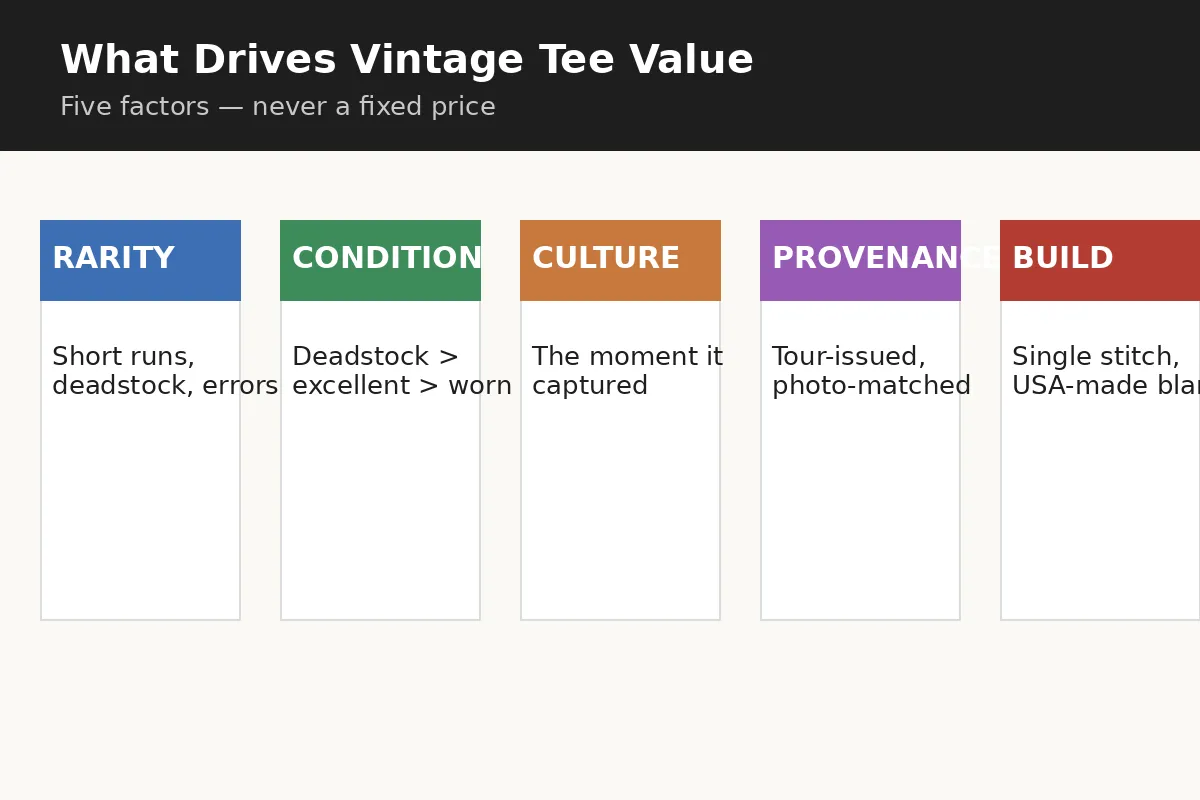
Why does one 1990s band shirt command many times the price of another from the same era? It comes down to five factors. Learn them and you will never look at a thrift rack the same way.
1. Rarity
A shirt printed for a single tour stop, a staff-only crew shirt, or a short-run promo will always command more than a mass-produced mall design. Bootlegs are a fascinating exception: produced in tiny runs and often thrown away, some parking-lot prints are now rarer and more sought after than the official merch they copied.
2. Condition
Condition is where most of the price difference between two "identical" shirts lives. Two copies of the same design, one deadstock and one thrashed, can be worth dramatically different amounts. Collectors pay for precision in description, because it determines whether they are buying a wearable piece or a display artifact.
3. Cultural Moment
A shirt is a timestamp. Designs tied to moments that still resonate — a landmark album, a cult film, a defining tour — hold attention across generations. The shirts that appreciate most are the ones from the moments people still talk about, not necessarily the biggest bands.
4. Provenance
Provenance is the story of where a shirt has been. A crew shirt worn on tour, a piece with a verifiable chain of ownership, or one tied to a documented event carries a premium no condition grade can replicate. When provenance exists and can be documented, it overrides almost everything else.
5. Construction and Print Quality
Collectors examine the garment, not just the graphic. Single-stitch hems (standard before the mid-90s), heavyweight blanks, all-over prints, and crisp original tags all push value upward. A great graphic on a flimsy blank is worth less than the same graphic on the blank collectors prize.
The Grading Scale Collectors Use
Vintage clothing has no single grading authority, but the resale community has converged on a descriptive hierarchy that sellers like Defunkd have used for years — the closest thing the market has to a standard.
Deadstock / Mint
Never worn, never washed. The tag and print are pristine. True deadstock — a shirt that sat in a warehouse for thirty years — is the rarest condition and commands the highest prices. Be honest with yourself here: a shirt that has been washed even once is not deadstock.
Excellent
Worn and washed, but with no serious issues: no stains, holes, rips, or seam problems. Minor fade or a faint mark is acceptable in this tier. Most of the best wearable grails live here.
Great
One more serious issue, or several minor ones — a tiny hole, a small underarm seam separation, a few faint marks. Still very wearable, and this is where much of the actual buying and selling happens.
Good
Noticeably worn: more significant marks, a few small holes, heavier fade. The shirt has character and is priced accordingly.
Fair / Worn
Years of wear and washing. Multiple marks, several small holes, thinned fabric — but the construction is still stable. This condition can be genuinely sought after for the authentic vintage look, especially in grunge and punk niches where wear is the aesthetic.
Poor to Distressed
Gaping holes, major seam issues, heavy staining. At this end of the scale you are buying the graphic and the vibe, not a wearable garment — think Sid Vicious, not Sunday brunch. Distressed shirts still sell, but only to buyers who want exactly that look.
The "See-Through" Modifier
This modifier can apply anywhere from Excellent to Distressed: fabric worn so thin you can faintly see through it. Some collectors love it; it proves decades of genuine wear. Disclose it either way.
One truth worth internalizing: "thrashed" is not always worth less than mint. In 90s grunge and early-80s punk, heavy wear is the desired aesthetic, and thrashed examples can outperform pristine ones. Condition affects value, but each category's market decides which condition it wants.
How to Inspect a Shirt
Inspect top to bottom, every time:
- The collar: check for "bacon neck" — the waviness that appears when the ribbing's elastic fails. A stretched collar drops a shirt's grade noticeably.
- The stitching: look at the sleeve and bottom hems. One line of thread is single-stitch (generally pre-1994); two parallel lines is double-stitch. Check for loose threads or unraveling at the hems.
- The pit test: turn the shirt inside out and check the armpits for yellowing or stiffness — often permanent, and it devalues the piece.
- The side seams: is the shirt tubular (one piece of fabric) or does it have side seams? Tubular construction is common on true vintage and avoids the twisting cheaper modern garments show.
- The dry-rot tug test: grab an inconspicuous area of fabric and give it a firm tug. If it rips like tissue paper with a distinct zipper sound, the shirt has dry rot — a chemical breakdown of black-dyed cotton where sulfur in the dye eats the fibers. Dry rot cannot be fixed. The shirt is a display piece, not a wearable one, and should be graded and priced accordingly.
For sellers, the rule is brutal honesty: photograph every flaw and grade down, not up. Transparency builds the reputation that lets your "Mint" claims be trusted.
Categories Collectors Chase
These are the categories with the deepest collector markets:
Rock, Metal, and Grunge
The blue chips. Classic rock and 90s grunge have the most liquid markets — the most buyers, the most recorded sales, the most reference knowledge. Nirvana, Pink Floyd, Iron Maiden, and Soundgarden designs dominate here. The catch: they are also the most faked, so authentication matters more in this category than anywhere else.
Rap and Hip-Hop
90s rap tees were often produced in smaller runs than rock merch, and many were bootlegs sold outside venues. Those parking-lot prints — wild collage graphics, memorial tees — are now among the most culturally significant pieces in the hobby. Authentication is harder here because bootlegs were the product, which is exactly why provenance and construction knowledge pay off.
Movie and Pop Culture Promos
Original promos for horror, sci-fi, and cult films cross over between film fans and fashion collectors. Staff and crew shirts — printed for theater employees, never sold to the public — are the sleeper picks: low production runs, genuine wear history, and still underappreciated relative to music tees.
Sport
Vintage sportswear has its own deep market, from 90s basketball to boxing and motorsport. Team loyalty gives these shirts a buyer base that never really cools off, and event-specific pieces (championship runs, single-season designs) carry the same rarity logic as tour merch.
Streetwear Pioneers
The 90s birth of modern streetwear — Stüssy, and the brands hip-hop culture adopted and redefined — created its own grail tier. That cultural-crossover story is what gives these pieces their soul, and their value.
Tag and Brand Primer
In the 90s, most merch companies bought plain blanks from specialist manufacturers. The tag is your first authentication checkpoint:
- Giant: heavyweight cotton, iconic band licenses (Nirvana, AC/DC). The workhorse of 90s rock merch.
- Brockum: famous for large-scale metal and hard-rock graphics. Tends to run slim.
- Winterland: high-quality tour merchandise prints known for resisting cracking.
- Blue Grape: another licensed-merch powerhouse of the era.
- Screen Stars: the gold standard for the "paper-thin" feel; often a 50/50 blend. Common on promos and corporate swag.
- Fruit of the Loom: the "Best" and "Heavy Cotton" lines were 90s workhorses; mid-90s "Lofteez" is prized for its weight.
- Hanes Beefy-T: legendary 6.1 oz ringspun cotton; holds its shape better than almost anything from the era.
- Wild Oats: artistic prints and eco-friendly dyes; harder to find and highly collectible.
- Liquid Blue: masters of the all-over print — graphics covering front, back, and sleeves. Their detailed designs are legendary.
Tags are the hardest thing for counterfeiters to get right. Check the font, the material (real 90s tags are often woven or stiff and papery, not modern satin), and the country of manufacture — most US-market 90s shirts were made in the USA, Mexico, Jamaica, or El Salvador.
Authentication Basics
As values rose, so did the quality of fakes. Before spending serious money, check four things:
- Stitch: single-stitch hems generally indicate pre-1994 garments, but with nuance — some brands (like Giant) moved to double-stitch earlier, and some of the most valuable shirts in the hobby are double-stitched. Stitching dates; it does not decide.
- Scent: authentic vintage has a specific aged-cotton smell. A "30-year-old" shirt that smells like fresh factory chemicals is a red flag.
- Screen: real vintage plastisol ink cracks in a fine, shattered-glass pattern over decades. Modern distressed reprints often look too uniform. Fakes frequently use DTG printing, which feels thin and flat.
- Tags and dates: the tag must be period-correct, and any copyright date on the print should match the era of the blank.
The blacklight test is a useful extra tool: modern synthetic white threads in fakes often glow under UV, while aged cotton threads usually do not. For anything expensive, buy from sellers with long reputations and ask for clear photos of tags and stitching. For a deeper dive, see our single-stitch vs double-stitch authentication guide.
Should You Collect as an Investment?
Honestly: treat vintage tees as a hobby that might appreciate, not as an asset class. Here is why.
Values follow taste, and taste moves. A hot category can cool for a decade. Unlike stocks, shirts have carrying costs, zero liquidity guarantees, and a market full of fakes. The collectors who do well share one trait: they buy what they genuinely love and know deeply. Expertise is the only edge.
Start with categories you understand, buy the best condition you can afford, authenticate before paying a premium, and never spend money you need back on a timeline. If a shirt makes you happy to wear, that is a return no market can take away.
Keeping Them Alive
A thirty-year-old shirt is fragile. The rules are simple and non-negotiable:
- Wash inside out in cold water with a gentle detergent. Never use bleach.
- Never use the dryer. Heat makes old fibers brittle and cracks prints. Lay flat to dry — never hang a wet vintage tee, as the water's weight stretches the neck and shoulders.
- Store folded in a cool, dark, dry place, or on wide padded hangers. Sunlight causes unintentional fading; wire hangers stretch shoulders.
- Test for dry rot before washing a "new" old shirt — washing a dry-rotted shirt will destroy it.
For more on finding and wearing vintage, see our guide to finding, styling, and valuing vintage tees. And if you want designs with vintage soul printed fresh, browse our designs collection.
Frequently Asked Questions
What makes a vintage t-shirt valuable?
Five factors: rarity (small production runs, tour-only or staff-only prints), condition (graded from deadstock to distressed), cultural moment (designs tied to moments people still care about), provenance (documented history), and construction (single-stitch hems, heavyweight blanks, quality tags).
Is a thrashed vintage shirt worth less than a mint one?
Not always. In niches like 90s grunge and early-80s punk, heavy wear is the desired aesthetic and thrashed examples can outperform pristine ones. Condition affects value, but each category's market decides which condition it wants.
How can I tell if a vintage shirt is authentic?
Check four things: stitching (single vs. double, with era nuance), scent (aged cotton vs. fresh chemicals), screen print (natural shattered-glass cracking vs. uniform fake distressing), and tags (period-correct brand, font, and country of manufacture).
What is dry rot and can it be fixed?
Dry rot is a chemical breakdown where sulfur in black dye eats cotton fibers, making the fabric tear like tissue paper. It cannot be fixed. Test with a gentle tug on an inconspicuous area before buying or washing; a dry-rotted shirt is a display piece only.
Are 2000s shirts considered vintage yet?
The common rule is that "vintage" means at least 20 years old, so early-2000s (Y2K-era) shirts now qualify and are seeing strong interest from younger collectors. Age alone does not make a shirt valuable, though — the five value drivers still apply.
Is collecting vintage t-shirts a good investment?
Treat it as a hobby that might appreciate, not an asset class. Values follow taste, carrying costs are real, fakes are everywhere, and liquidity is never guaranteed. The collectors who do well buy what they know deeply — expertise is the only edge.