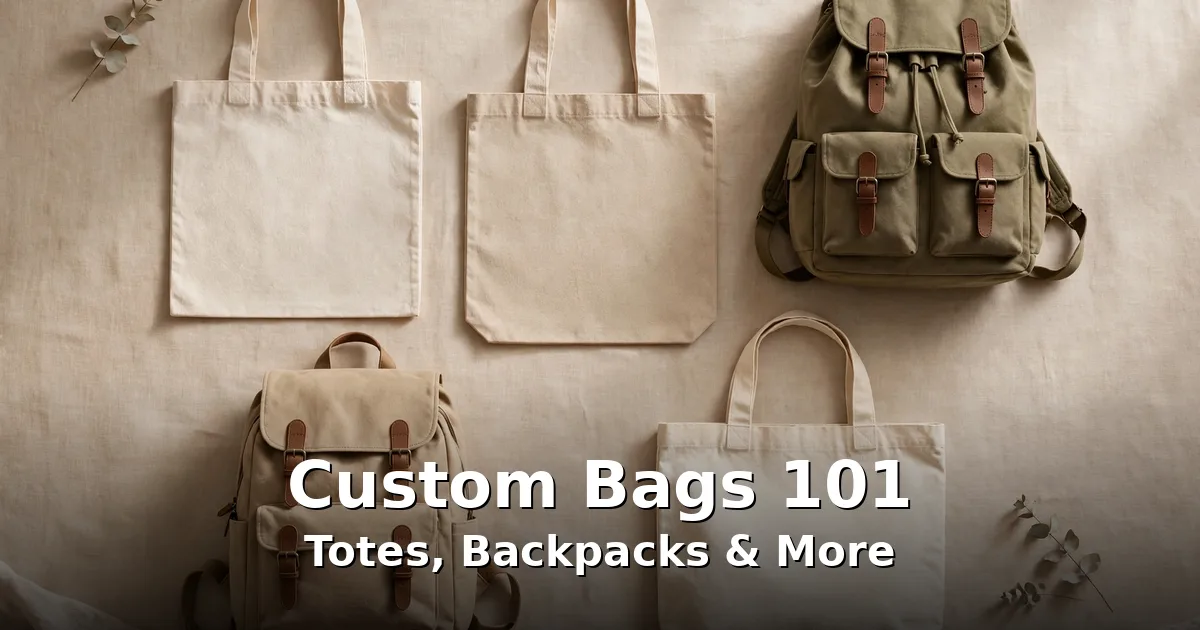
Custom bags work best when the bag, the artwork, and the use case are chosen together. A tote can be ideal for groceries, books, or event favors, while a backpack is usually more practical for a commute with a heavier load. This guide compares tote bags, backpacks, drawstring bags, and pouches by material, construction, print method, and use case, so you can choose a personalized bag that people will actually carry and keep.
Key takeaways
- Match the bag to the load: totes for light daily carry and shopping, backpacks for heavier commutes, drawstring bags for events, pouches for small items.
- Check the anatomy: strap drop, closure, gusset depth, and handle stitching matter more than the print.
- Material first, design second: canvas, nylon, leather, and recycled fabrics each print differently and wear differently.
- Design for the safe zone: keep artwork inside the usable print area, with contrast and simple shapes that read at a distance.
- Proof before production: confirm dimensions, decoration method, and personalization details in writing.
Table of contents
- Choose the bag type by use case
- The anatomy of a good tote bag
- Compare bag materials
- Design for the available print area
- Choose a printing method
- Custom bag designs from our collection
- Planning a group or corporate order
- Care and everyday use
- Frequently asked questions
Choose the bag type by use case
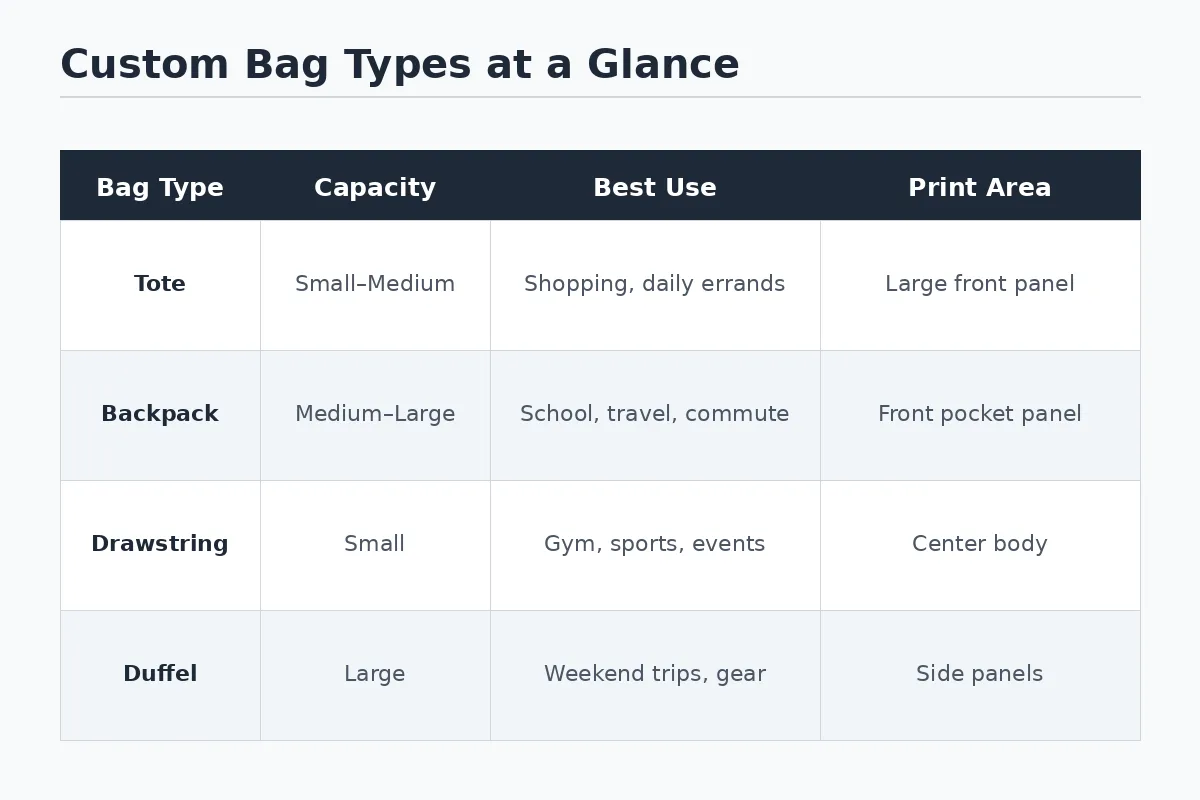
Start with what the recipient needs to carry, how the bag will be accessed, and whether weight needs to be distributed evenly. The same logo can look fine on several formats, but the functional choice determines whether the finished product becomes an everyday item or a one-time giveaway.
| Bag type | Best for | Design and function checks |
|---|---|---|
| Tote | Shopping, books, laptops in a sleeve, welcome kits, light daily carry | Check handle length (strap drop), open versus zipped top, gusset depth, and whether the front panel stays flat for printing. |
| Drawstring bag | Teams, clubs, races, and casual event distribution | Keep artwork bold and simple; lightweight construction suits light items and less sharp objects. |
| Backpack | Commuting, school, travel, and heavier loads that need support | Check padded straps, compartments, laptop sleeve, zipper placement, and the smaller usable print zones. |
| Zip pouch or small bag | Cosmetics, cables, stationery, and compact personalized gifts | Use a short mark or repeat pattern that will not be hidden by the zipper, gusset, or curved edges. |
| Travel tote | Airports and overnight trips | Look for a trolley sleeve that slides over a suitcase handle and a zip closure to keep contents secure. |
For a tote-versus-backpack decision, prioritize access and appearance for a light load, but prioritize compartments and two-shoulder support for frequent commuting. A gusset adds capacity but can reduce the flat front area available for a centered design. If you are considering the environmental angle of your choice, see our guide to sustainable tote bags.
The anatomy of a good tote bag
Two tote bags can look identical in a photo and behave completely differently in daily use. These are the details worth checking before you commit to a blank or place a custom order.
Strap drop
The strap drop is the vertical distance from the top of the handle to the top of the bag. If you wear a thick coat or blazer, a short handle will keep sliding off your shoulder. For comfortable over-the-shoulder carry in most seasons, a drop in the 9 to 11 inch range is a practical benchmark; shorter handles are better suited to hand carry.
Closure
The classic tote is open-top, which is great for quick access. For commuting, city living, or travel, a zipper or magnetic snap keeps contents from spilling if the bag tips over. An open tote with a small interior zip pocket is a good compromise.
Structure versus slouch
Structured bags hold their shape, protect contents, and look more professional — a real advantage if the tote carries a laptop or documents to work. Slouchy, unstructured bags offer more "throw-and-go" capacity and fold flat for storage, which is why they dominate grocery and beach duty. Neither is better in general; the use case decides.
Gussets and handle stitching
A bottom or side gusset lets the bag expand so it can hold three-dimensional items instead of flat envelopes. Where the handles meet the body, look for reinforced stitching — often an "X-box" pattern — since this is the most common failure point under heavy loads.
Compare bag materials
Material affects color, texture, weight, print quality, and care, so it should be part of the design decision rather than an afterthought. Ask the supplier about fabric weight, lining, water resistance, and finished dimensions rather than relying only on a product photo.
| Material | Durability | Maintenance | Best use case |
|---|---|---|---|
| Heavy canvas | High | Medium — spot clean; air dry to limit shrinkage | Errands, groceries, book bags, everyday custom totes |
| Light cotton | Moderate | Medium — hand wash cold | Event giveaways, lightweight shopping bags |
| Nylon | High | Low — wipeable, often water-resistant | Travel, gym, commutes in wet weather |
| Leather / vegan leather | High | Medium to high — condition or wipe per the care label | Professional settings, interviews, client meetings |
| Recycled polyester (rPET) | High | Low — wipe clean | Sport and outdoor bags, weather-resistant totes |
| Jute | Moderate | Medium — keep dry, brush clean | Farmer's markets, rustic-themed events |
Natural or undyed fabric can soften the appearance of bright colors, while dark fabric may require an underbase or a different decoration method. If sustainability claims matter to your audience, confirm the fiber content and look for documented certifications such as GOTS for organic cotton — our sustainable tote bag guide explains what those labels actually mean. For a design-specific project, see our overview of custom bags for style, branding, and functionality.
Design for the available print area
Keep the main message inside the manufacturer's safe print zone and leave space around seams, pockets, handles, and zippers. A short phrase or centered illustration usually reads better than a paragraph. For a group or business order, use one consistent logo or motif and vary only the name or role when personalization is needed.
Request the exact imprint dimensions for the selected bag before finalizing the file. Use a high-resolution raster file or a scalable vector file in the format the printer accepts, and preview the artwork on the actual bag color. Strong contrast and a limited palette are usually easier to read than fine lines or low-contrast detail on textured fabric.
Choose a printing method
Screen printing is efficient for larger orders with a limited color palette. Direct-to-garment or transfer methods can reproduce more detailed illustrations on suitable fabrics, although the supplier must confirm that the bag's material and coating are compatible. Embroidery creates a raised, durable mark for small logos, initials, and simple symbols, but it is not ideal for tiny text or a detailed photograph.
Ask for a digital proof and check the artwork on the actual bag color before approving production. A proof should show placement, approximate scale, colors, and personalization fields; it does not replace a physical sample when the order is high-volume, time-sensitive, or customer-facing.
Custom bag designs from our collection
Most custom-bag guides stop at blank bags. But a bag with an original design does double duty — the function plus artwork with actual personality. These are real designs from our collection, available on bag products:

"Boo-tiful" Skeleton Coffee Backpack
A skeleton-with-coffee Halloween graphic on a backpack — a seasonal design that suits students and commuters who want their daily carry to have some character. Available on Redbubble as a backpack.
View on Redbubble →
"Magic Code" Frog Zip Pouch
A frog-with-pumpkin graphic on a zip pouch — sized for cables, cosmetics, or stationery, and a good example of how a small repeat-friendly design suits compact bag formats. Available on Redbubble as a pouch.
View on Redbubble →Planning a group or corporate order
Confirm the quantity, bag dimensions, handle style, artwork, personalization data, packaging, and delivery deadline in writing. Ask whether there are minimum quantities, setup charges, color surcharges, or separate costs for individual names. Order a sample when the bag will be used for an event or sold to customers. If the design contains a date or a person's name, proofread every line before the order is finalized.
Care and everyday use
Follow the care label, avoid overloading the bag, and store it dry. Spot cleaning is often safer than treating a printed surface aggressively. For heavy canvas, spot cleaning with mild soap and water preserves structure; if the bag is unlined 100% cotton, hand washing in cold water and air drying is the gentler route. A bag organizer insert can turn a cavernous tote into a filed system and protect the items inside — including your phone, which is worth a look at our custom phone case guide if it rattles around loose in a large tote.
Frequently asked questions
What is the best custom bag for a giveaway?
A lightweight tote or drawstring bag is usually easy to distribute and decorate. Choose a sturdier canvas tote when recipients are expected to reuse it for shopping, books, or work.
What is the difference between a tote bag and a shoulder bag?
A tote is generally defined by two parallel handles and a large, open or simply closed top. A shoulder bag is often smaller, may have a single strap, and typically uses more structured closures like flaps.
Is a tote bag professional enough for an interview?
Yes, provided it is structured and made of a refined material such as leather or vegan leather. Skip slouchy canvas or loud prints for formal interviews and stick to neutrals like black, navy, or tan.
How do I clean a canvas tote bag?
Spot clean with mild soap and water to maintain the bag's structure. For unlined 100% cotton, hand wash in cold water and air dry — high dryer heat can shrink canvas noticeably.
How can I avoid a disappointing custom-bag order?
Confirm the material, finished dimensions, usable print area, decoration method, sample or proof process, care instructions, and delivery date in writing. Check every personalized name and date before production.
Browse the AIPrintVerse design collection for original artwork for custom bags and accessories.
Related guides
Continue with these related AIPrintVerse guides: