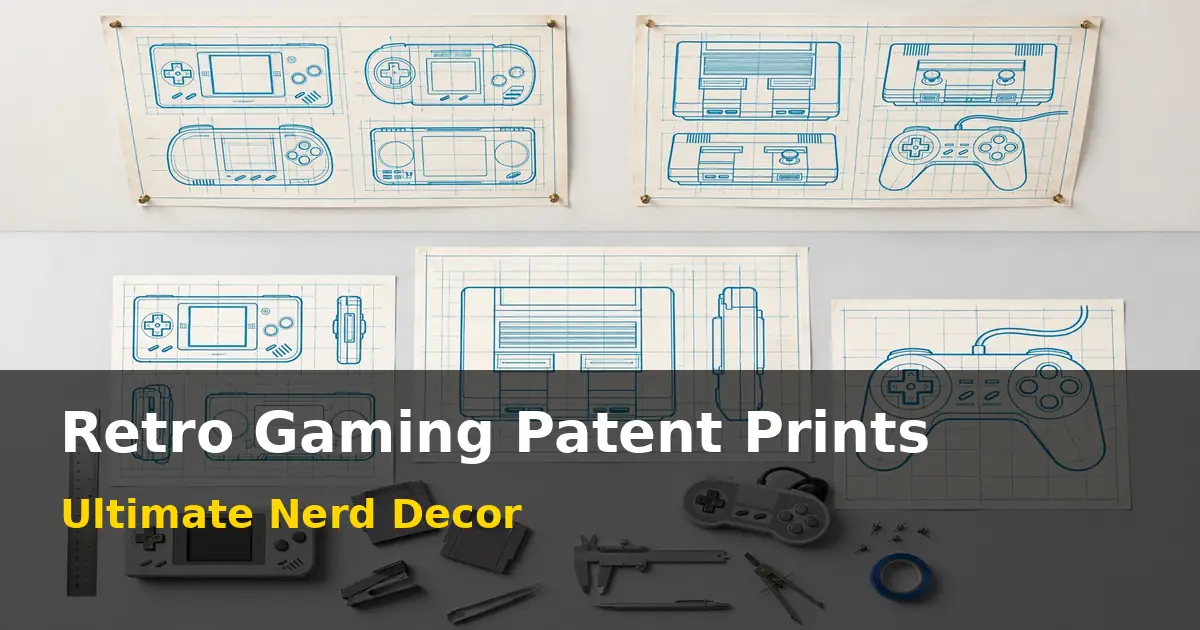
There is a particular romance to the technical drawings filed with the US patent office for a Nintendo Game Boy or an Atari 2600. They were never meant as art — they were legal diagrams protecting intellectual property. But stripped of plastic casing and branding, those precise lines read as industrial history: the skeletal geometry of the devices a generation grew up with. Printed well and framed right, retro gaming patent art prints signal your interests without turning the living room into a neon arcade.
The search results for this niche are almost entirely product pages. Nobody is explaining which background style fits which room, which consoles make the best sets, or how to tell a quality reproduction from a blurry upscaled scan. That is the gap this guide fills — an editorial buyer guide to patent art prints, from blueprint to chalkboard. Whether you are decorating a first apartment, a home office, or a dedicated gaming room, the same principles apply: pick one style, build a coherent set, frame it properly, and buy from sellers whose product photos prove the details are crisp.
Table of Contents
Key Takeaways
- Patent art bridges technical documentation and wall decor — grown-up nostalgia that works in shared living spaces.
- Four main styles: blueprint (minimalist offices), parchment (libraries), chalkboard (home theaters), minimalist white (safe everywhere).
- Hang sets of four to six consoles in a grid for a "collection" look; one print alone reads as a curiosity.
- Check that fine schematic details are crisp at print size, and favor archival inks in sunny rooms.
Why Patent Drawings Work as Decor
A bright Mario poster says "gaming room." A patent schematic of the Super Nintendo controller says "design history" — and guests who have never held a controller can still appreciate the clean geometry and meticulous labeling. The appeal is generational: the consoles of the 70s, 80s, and 90s were hand-drawn in an era before CAD made everything uniform, so the drawings have a warmth that modern patent filings lack. That hand-drawn quality is exactly why the retro era dominates this market.
There is also a preservation angle. As video games enter museum collections, owning the technical drawings feels like participating in that history — the moment a radical piece of industrial design was still just lines on paper.
Four Print Styles Compared
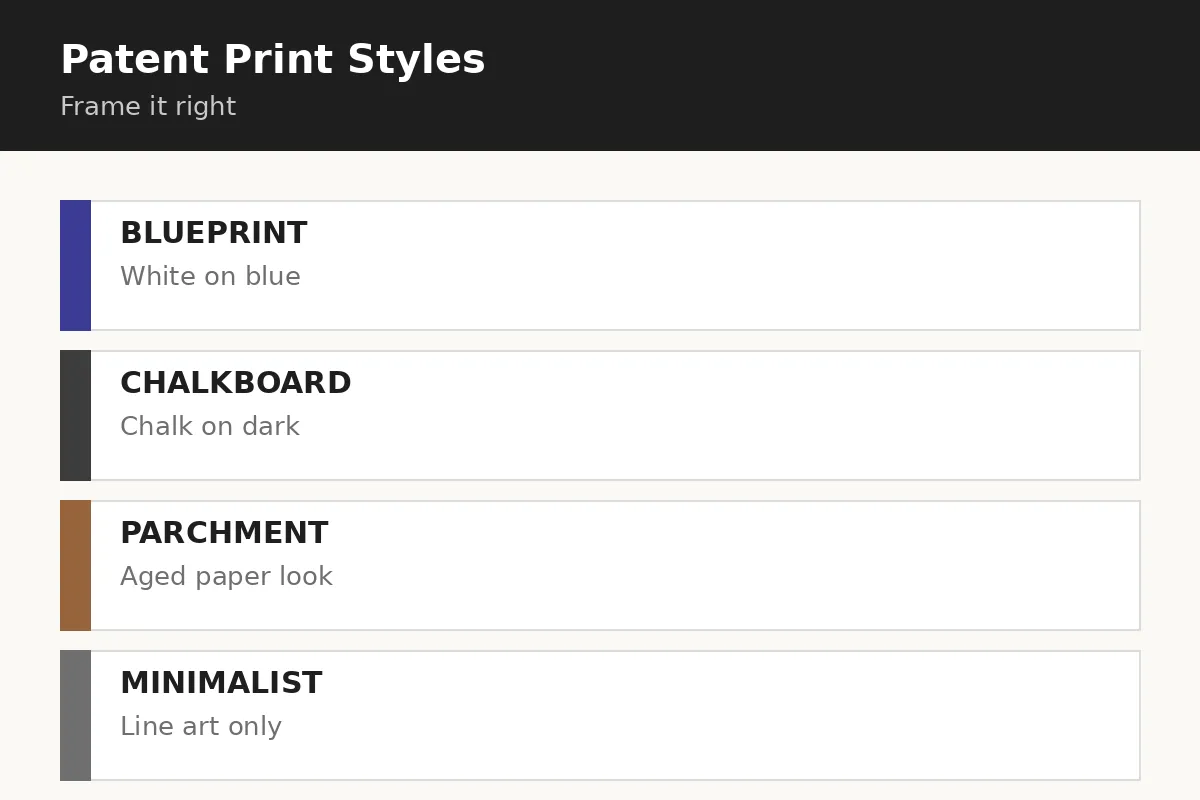
Blueprint: deep Prussian blue with white lines — the classic engineering look. Best in modern minimalist offices or rooms with white walls and metal accents. Vintage parchment: sepia tones and aged edges, as if pulled from a 1950s drawer. Fits libraries, studies, and rooms with heavy wood furniture. Chalkboard: dark charcoal with textured white lines — maximum contrast, popular for home theaters and gaming rooms. Industrial minimalist: black lines on stark white. The safest choice when you want the art to stay subtle.
Match the style to the room's existing palette rather than buying the style you like in isolation. A chalkboard print in a pale Scandinavian room fights the furniture; a parchment print in an all-black setup disappears.
Which Consoles to Hang
One print is a curiosity; four to six are a collection. Build an "evolution of the console" wall: the Atari 2600, NES, Sega Genesis, and original PlayStation make a natural timeline for most buyers. Hang them in a consistent grid — 2x2 or 3x2 — and keep the scale of the drawings consistent across prints. If the Game Boy drawing is cropped larger than the Xbox schematic, the visual balance breaks.
Controller patents are often better subjects than console patents: the SNES controller patent is a masterclass in industrial design, and its compact shape frames beautifully at 11x14 or 18x24 inches — the two sizes that keep small schematic text legible without overwhelming the wall.
Print Media and Framing
Heavyweight matte paper is the affordable default — no glare, easy to frame, though it can curl if left unframed. Gallery-wrapped canvas needs no frame but can look bulky for technical drawings. Metal prints are durable and modern but expensive and reflective. Archival giclée with pigment inks is the premium option: fade-resistant for decades, essential in sunlit rooms.
The frame matters as much as the print. A thin black metal frame or natural wood finish grounds the piece; a cheap plastic frame makes even the best reproduction look like a flea-market find. For a cohesive gallery wall, use identical frames across all prints.
Room-by-Room Placement Guide
Home office: blueprint-style prints above the desk reinforce a technical, focused mood — pair with black metal frames and keep the wall mostly bare so the schematics breathe. Living room: parchment or minimalist-white prints work best in shared spaces; they read as art history rather than fandom, which is exactly what earns them a spot outside the gaming room. Bedroom or dorm: chalkboard prints thrive here — the high contrast suits moodier lighting and pairs well with LED accent strips. Hallway: a timeline wall of four to six consoles turns a dead corridor into a conversation piece; keep frames identical and spacing even.
The golden rule: one room, one style. Mixing blueprint and parchment across the same wall breaks the "curated collection" illusion and reads as leftovers.
DIY: Printing Your Own Patent Art
If you are technically inclined, the most authentic route is free: the USPTO and Google Patents host the original filings as high-resolution TIFFs. Download the drawing sheets for your console, clean up the scans in an image editor (adjust levels, remove yellowing), and print at a local shop on heavyweight matte stock. The total cost is a fraction of boutique prints, and you control the exact crop and style. The tradeoff is time — expect an hour or two of cleanup per print — and you will need to add your own title block with the patent number and filing date if you want the finished look.
Framing Mistakes to Avoid
Mismatched frames across a gallery wall — the single fastest way to make a collection look accidental. Glare-heavy glass on chalkboard-style prints — use non-reflective glazing or go glassless in low-traffic rooms. Wrong scale: a tiny 8x10 lost on a vast empty wall, or an oversized 24x36 crowding a narrow hallway — mock up with painter's tape before you buy. Hanging too high: the center of the arrangement should sit at eye level, roughly 57 inches from the floor. Skipping the mat: a simple white or off-white mat gives technical drawings room to breathe and makes even budget prints look gallery-grade.
Building a Set: The Consoles That Belong Together
The most satisfying patent walls tell a story. The Nintendo arc: NES, SNES, Game Boy, N64 — four prints that trace one company's design evolution from chunky gray box to three-dimensional pioneer. The controller arc: Atari joystick, NES rectangle, SNES dogbone, PlayStation DualShock — a masterclass in how human hands reshaped hardware. The handheld arc: Game Boy, Game Gear, DS, PSP — the entire history of portable play on one wall. Pick one arc and commit: a mixed bag of unrelated patents reads as decoration, while a single arc reads as a curated exhibit. Keep backgrounds identical across the set — all blueprint or all parchment — and the story lands.
How to Spot a Quality Reproduction
Zoom into the listing's product photos: fine text and part numbers should be crisp, not blurred. Quality reproductions include the original patent number, filing date, and inventor names — that metadata is part of the authenticity. If you are technically inclined, the USPTO and Google Patents offer the original high-resolution filings for free; cleaning one up yourself is the most authentic route, though it takes real image-editing work. Our own collection does not currently carry patent-art prints, so the guidance above is written to help you buy well anywhere — browse our designs page for the retro artwork we do offer.
Frequently Asked Questions
Are patent art prints actual legal documents?
No. They are artistic reproductions of the technical drawings inside patent filings — accurate to the original diagrams, but made for decoration, not legal use.
What size works best for patent art prints?
11x14 inches or 18x24 inches. These sizes keep the small schematic details — part numbers, labels — legible without the print dominating the wall.
Which consoles make the best patent prints?
The hand-drawn filings of the 70s–90s: Atari 2600, NES, SNES, Game Boy, Sega Genesis, and the original PlayStation. Controller patents often frame better than full-console schematics.
Do the prints include the patent number and inventor?
Quality reproductions do — the original patent number, filing date, and inventor names are part of what makes the piece feel historically authentic.
Will patent prints fade in sunlight?
Standard prints will fade over time in direct sun. For bright rooms, choose archival giclée prints with pigment-based inks, which resist UV fading for decades.