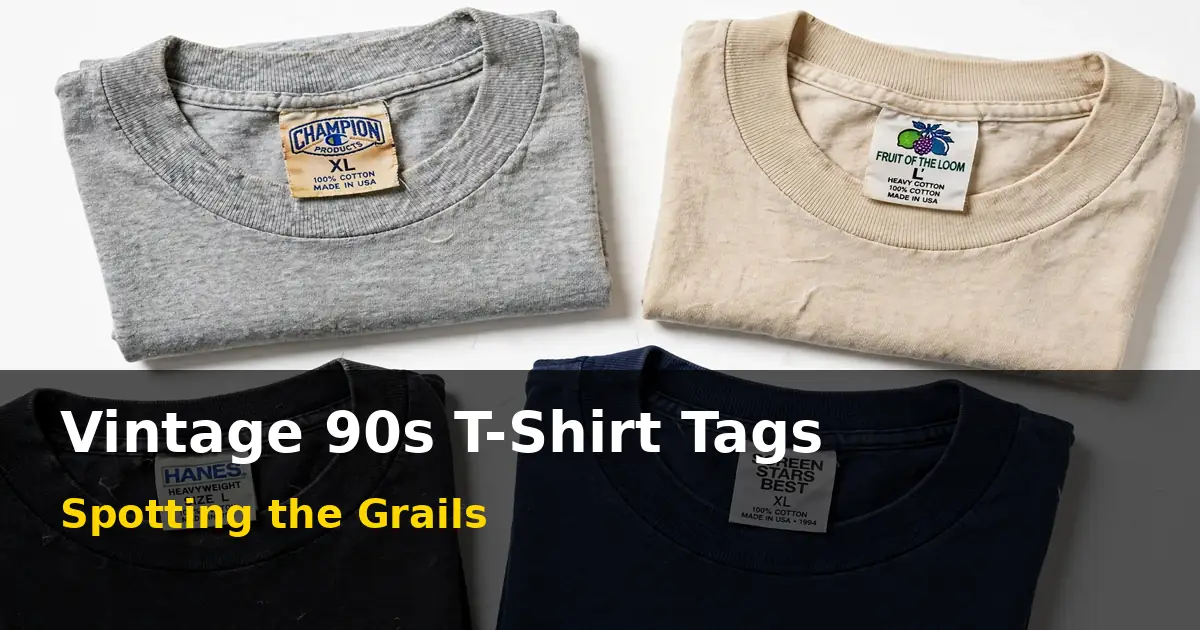
Walking through a thrift store and spotting a faded graphic is a rush, but the real moment of truth happens at the neckline. In the vintage world, the tag is essentially the birth certificate of the garment. If you are hunting for pieces from the 1990s — a decade defined by the explosion of streetwear, grunge, and blockbuster movie promos — understanding tag evolution is non-negotiable. This guide teaches you to read a 90s tag the way collectors do, so you can tell a genuine grail from a clever reprint in under a minute.
Table of Contents
- Why Tags Matter More Than Graphics
- The 60-Second Tag Read
- The Big Merchandisers: Giant, Brockum, Winterland, Blue Grape
- The Blank Staples: Fruit of the Loom, Hanes, Screen Stars, Jerzees
- Licensing and Copyright Dates
- Red Flags: How to Spot Modern Reprints
- What to Do When the Tag Is Missing
- Frequently Asked Questions
Why Tags Matter More Than Graphics
Graphics can be reprinted. Tags are much harder to fake convincingly. During the 90s, the T-shirt industry went through a massive shift: at the start of the decade, almost everything sold in the US was manufactured domestically. By 1999, trade agreements had moved the bulk of production to Mexico, Honduras, and El Salvador. That transition is written into the tags. A "Made in USA" tag on a 100% cotton blank is a strong signal of early-to-mid 90s production; a tag reading "Made in Mexico" or "Assembled in Honduras" points later.
The tag also tells you who actually made the shirt. Most 90s merchandise companies did not manufacture their own garments — they bought blanks from specialist mills and printed on them. Knowing whether a blank came from Giant, Screen Stars, or Hanes tells you what the shirt was originally made for (tour merch, promo, corporate giveaway) and what quality of garment you are holding.
The 60-Second Tag Read
When you pick up a shirt, read the tag in this order:
- Brand name. Giant, Brockum, Winterland, Blue Grape, Screen Stars, Hanes, Fruit of the Loom, Jerzees, All Sport — each has known production eras.
- Country of origin. USA, Mexico, Jamaica, El Salvador, Honduras are period-plausible for 90s US-market shirts. Vietnam, Bangladesh, or Cambodia on a supposedly 90s shirt is a major red flag.
- Fabric content. 100% cotton and 50/50 cotton-polyester blends dominate the 90s. Tri-blends and "ringspun" marketing language are modern.
- The RN or CA number. Registered Identification Numbers are assigned to manufacturers by the FTC. Looking up an RN number tells you the actual company behind the tag — a useful cross-check when a tag looks unfamiliar.
- Texture and wear. Original 90s tags are often woven, stiff, and papery, or wafer-thin with printed text. They age: fading, fraying, shrinking. A tag that looks brand-new on a "30-year-old" shirt deserves suspicion.
The Big Merchandisers: Giant, Brockum, Winterland, Blue Grape
These four companies produced the licensed merchandise that defines 90s collecting.
Giant
Giant is the name most associated with 90s rock and metal merch — Metallica, Red Hot Chili Peppers, Smashing Pumpkins. Early-90s Giant tags are typically blue and white with "Made in USA" printed on them. By the late 90s, Giant moved to a grey/silver tag with Mexican production. Be cautious of Giant tags that feel silky or satin-like; originals were usually woven cotton, and the satin versions are among the most replicated.
Brockum
Brockum was the king of the "World Tour" shirt, with its iconic run roughly 1990–1994. The "Brockum Worldwide" tag is typically a large rectangular white tag. One practical note: Brockum shirts tended to run small by modern standards — a 90s Large often fits like a modern Medium. A "Brockum" tag on a shirt that fits like an oversized modern 2XL is worth a second look at the stitching.
Winterland
Winterland handled merch for acts like Phish and various Bay Area bands, plus posthumous Hendrix licensing. Their 90s tags evolved from a simple blue-and-white logo to a more elaborate rock-and-roll design. Winterland pieces are known for quality screen printing that has aged with attractive cracking.
Blue Grape
Blue Grape licensed an enormous range of 90s music merch. Their tags are often found on grunge and alternative rock shirts. Because Blue Grape produced so much volume, their tags are common — but that also makes them a frequent target for fakers, so cross-check with stitching and print.
The Blank Staples: Fruit of the Loom, Hanes, Screen Stars, Jerzees
Not every 90s shirt was tour merch. Movie promos, tech-company swag, and local event tees were printed on blanks from these mills:
- Fruit of the Loom (FOTL): Look for the "Best" tag or "Heavy Cotton" tag. Early 90s versions have a small fruit logo; by the late 90s the logo grew larger and more colorful. "Made in USA" is usually on the back of the tag or just below the logo.
- Hanes: The "Beefy-T" is legendary — thick tags, often with a blue or red border, known for durability and a boxy fit. Hanes dominated the skate and surf scene.
- Screen Stars: The budget-friendly choice and the source of the beloved "paper-thin" vintage feel. The "Screen Stars Best" 50/50 blend tag is a 90s staple. Note the trademark detail: "TM" under "STARS" indicates pre-1983; the registered "R" indicates after 1983.
- Jerzees: Created by Russell Athletic in the early 80s for sportswear, Jerzees tags are common on 90s athletic and promo tees. Their tag designs changed frequently through the decade, which makes them useful for dating.
- All Sport: The "Pro Weight" tag signals a heavy, durable blank popular for skate and rap tees, with notably thick collars.
For a deeper dive on the companies behind these tags, see our guide to vintage 90s t-shirt brands.
Licensing and Copyright Dates
Here is where beginners get tripped up. A shirt with a graphic of Star Wars: A New Hope and a copyright date of 1977 is almost certainly not from 1977 — that date refers to the copyright of the artwork or intellectual property, not the manufacture of the garment. In the 90s, licensing info was typically printed in small text at the bottom of the graphic. A license reading "1994" or "1996 Polygram Merchandising" gives you a much better window — but you must cross-reference it with the tag. A 1992 copyright on a modern tear-away tag means a modern reprint using old art.
One detail worth checking: in the 90s, the copyright line was usually screen-printed with the rest of the shirt, so the ink should share the same texture and cracking as the main image. A copyright that looks too crisp next to a faded graphic is suspicious.
Red Flags: How to Spot Modern Reprints
The vintage market is flooded with "repro" shirts. Some are sold honestly as tributes; others are designed to deceive. Run through this checklist:
- The tear-away ghost: Most 90s tags were woven into the collar seam. A small remnant of a ripped-out white paper tag with a "vintage" tag sewn in its place is a classic fake tell.
- Wrong country of origin: A "1991" shirt on a "Made in Vietnam" tag is a modern reprint — that production pipeline did not exist at scale for the US market in 1991.
- Fluorescent white: Genuine 90s white shirts have usually mellowed to off-white or cream over 30 years. A blinding optic-white shirt with an "aged" tag was likely tea-stained or chemically treated.
- Modern print feel: Authentic 90s plastisol prints crack in a fine, organic pattern. Modern DTG (direct-to-garment) prints feel smooth and flat, like part of the fabric dye.
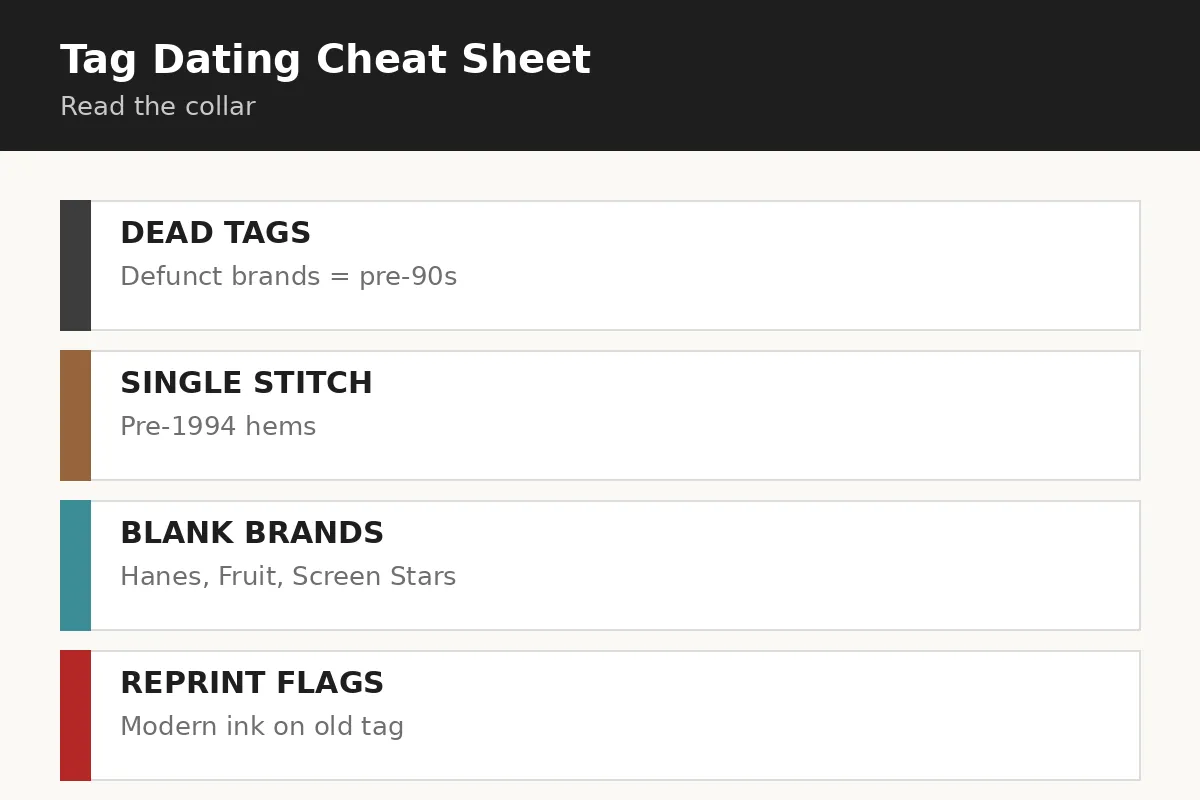
- Stitching mismatch: Single-stitch hems were standard until the mid-90s (see our single-stitch vs double-stitch guide). A shirt claiming to be from 1991 with chunky double stitching should set off alarms.
- Too-perfect aging: Uniform, symmetrical "distressing" is a factory effect. Real wear is random — heavier at the collar, pits, and hem.
What to Do When the Tag Is Missing
In the 90s, plenty of people cut itchy tags out. A missing tag — a "dead tag" — does not make a shirt worthless, but it removes your easiest dating tool. Fall back on construction: single-stitch hems, the hand of the fabric (thin, soft, broken-in cotton), the style of the print, and any copyright or licensing text on the graphic. Grade it accordingly — our vintage t-shirt grading guide covers how missing tags affect value — and be honest about the missing tag when selling.
Once you can read tags with confidence, the next skill is understanding what drives a shirt's worth beyond authenticity. Our guide to the most valuable vintage t-shirts breaks down the five value drivers collectors actually use.
Frequently Asked Questions
What does "single stitch" mean on a vintage tag guide?
Single stitch refers to one visible line of thread finishing the sleeve and bottom hems. It was the industry standard until the mid-90s, and it is one of the most reliable construction markers of a genuine 90s shirt.
Are all "Made in USA" tags from the 90s?
No. "Made in USA" tags span the 1970s through the late 1990s. To narrow a shirt to the 90s, combine the country of origin with the specific tag brand, the stitching, and the graphic style.
Can I trust the copyright date printed on the shirt?
Only as a reference for the artwork's age. Always verify the tag and stitching independently — a "1992" copyright on a modern Gildan-style tag is a reprint.
What is a "dead tag" shirt?
A shirt whose tag was cut out, common in the 90s when tags were itchy. You can still date it using stitching, fabric feel, and print licensing, but the missing tag reduces certainty and value.
Which 90s tag is the most faked?
Giant tags are among the most replicated because of their association with high-value rock and metal merch. Check the tag's weave texture, the stitching, and the print before trusting a Giant tag alone.