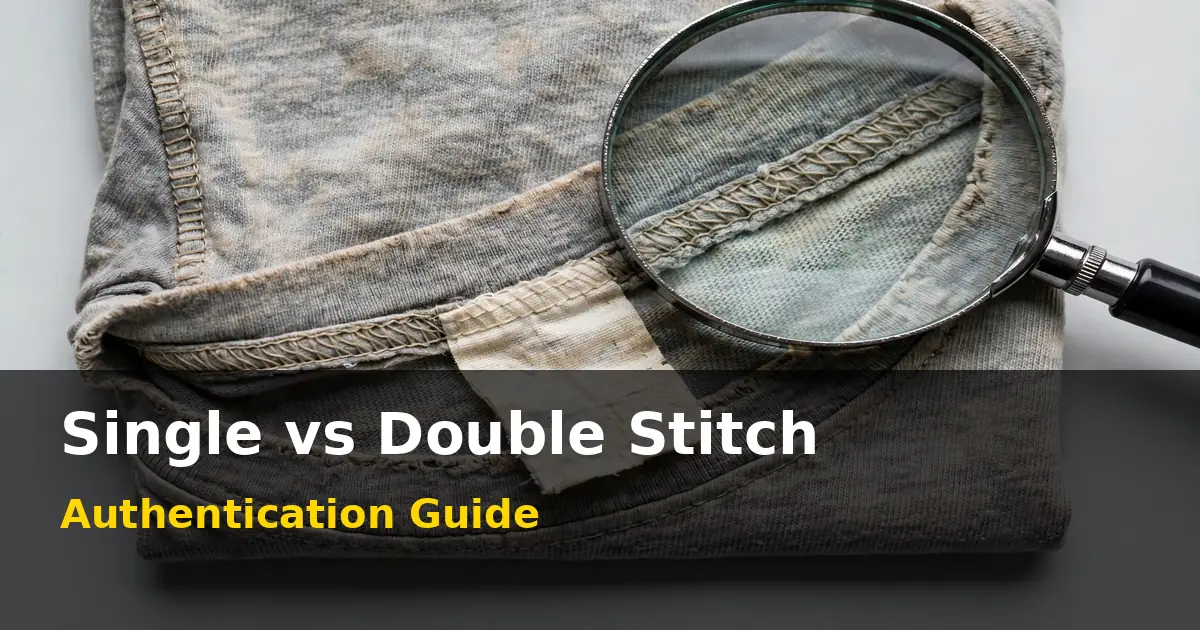
Walk through any thrift store and you'll see the phrase "SINGLE STITCH" shouted in listings like it's a gold bar. It isn't jargon — it's the fastest way to date a T-shirt. One row of thread on the hem means the shirt was almost certainly made before the mid-90s; two parallel rows mean it's modern. But here's what most guides won't tell you upfront: single stitching alone no longer proves a shirt is vintage. Reproduction brands know the trick too, and some fake it deliberately. This guide gives you the full picture — the stitch test, what it proves, where it lies, and the six other checks that separate a genuine vintage tee from a convincing copy.
Table of Contents
- Why Fakes Exist: Vintage vs Retro
- The 7-Point Authentication Checklist
- What Is a Single Stitch?
- What Is a Double Stitch?
- How to Date a Tee Using Stitching
- What Single Stitch Can't Prove: The Limits
- Bonus: The RN Number Lookup
- Red Flags in Listings
- Before You Buy: Condition and Fit
- Frequently Asked Questions
Why Fakes Exist: Vintage vs Retro
First, the vocabulary. Vintage means the shirt was actually made decades ago — typically 20+ years. Retro (or "vintage-inspired") means it was made recently to look old. Neither is bad; they just aren't the same thing, and they shouldn't cost the same. The problem is the middle ground: shirts deliberately built to pass as vintage, from fast-fashion "vintage wash" tees to high-end reproductions sewn on vintage-style machines.
Collectors describe the difference as patina vs precision. Genuine vintage has patina — uneven fading, softening, and wear that happened gradually and randomly over decades. Reproductions have precision — distressing applied in a pattern, fading that's uniform across the garment, aging that looks designed rather than earned. Once you learn to see that difference, most fakes reveal themselves in seconds.
The 7-Point Authentication Checklist
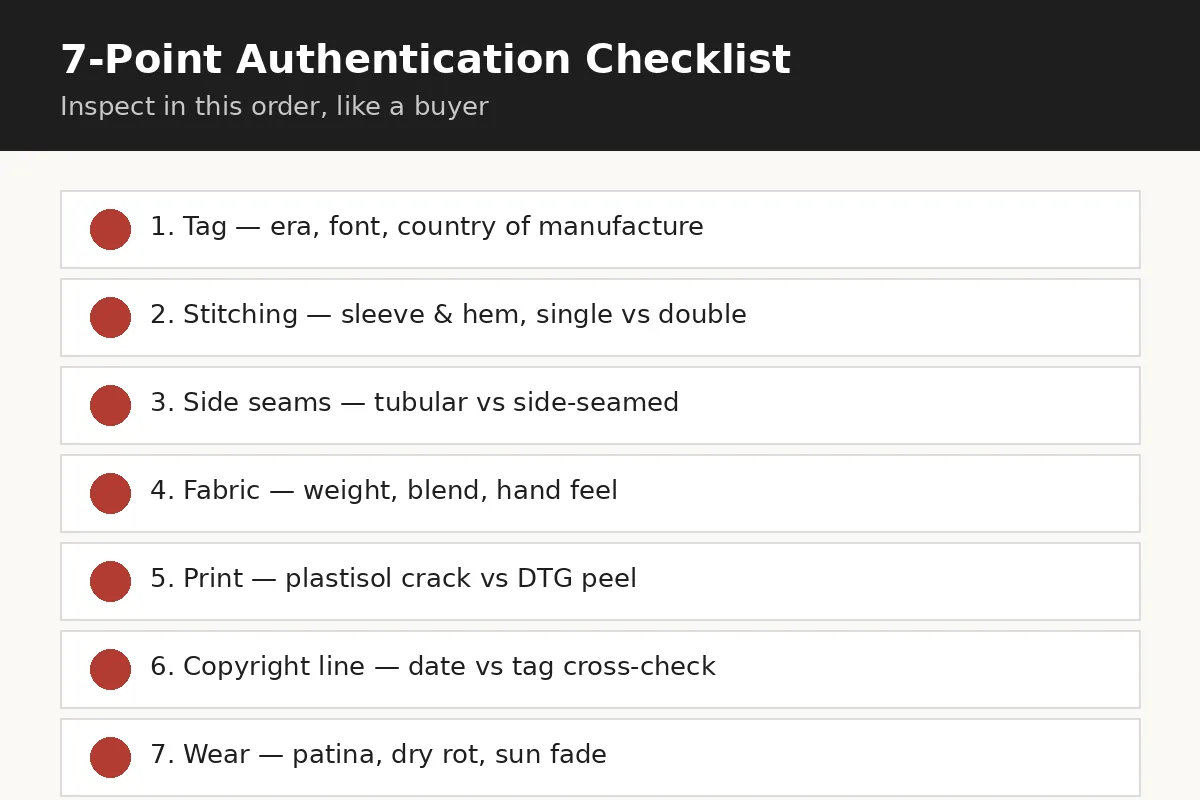
Run these in order when you're holding a shirt. Most fakes fail by step four, so you rarely need all seven.
- Read the tag. The tag is the garment's ID card. Look for the brand (Screen Stars, Hanes, Fruit of the Loom, Brockum, Giant, Winterland, Blue Grape), the country of manufacture, and the tag style. A printed-on neck label (tagless) almost always means post-2005. Paper-thin, brittle tags point to the 70s and early 80s.
- Check the hem stitching. Flip the sleeve cuff and the bottom hem. One line of thread = likely pre-1994. Two parallel lines = modern. (Full breakdown below.)
- Check the side seams. Authentic vintage tees from the 70s and 80s are often tubular knit — no side seams at all. Modern shirts almost always have them.
- Feel the fabric. True vintage cotton is usually light, thin, and soft from decades of washing. 70s–80s shirts are often 50/50 cotton-poly blends with a slightly sheer drape; 90s shirts trend heavier ("beefy" cotton). A stiff, thick shirt with a single stitch is suspicious.
- Inspect the print. Old plastisol screen prints develop fine, hairline cracking (craquelure) and fade gradually. Modern digital (DTG) prints peel in plasticky chunks or fade to nothing. Uniformly "distressed" graphics with identical wear everywhere are usually factory-aged.
- Read the copyright date — carefully. A "© 1988" on the print tells you when the design originated, not when the shirt was printed. Reprints of a 1988 design carry the same date. The copyright date is a clue, never proof.
- Study the wear pattern. Real aging is uneven: sun-fading lightens the shoulders more than the body, armpits thin first, collars soften. Factory distressing tends to be symmetrical and evenly distributed.
What Is a Single Stitch?
Flip up the sleeve cuff or the bottom hem of a shirt. A single stitch shows as one solitary line of thread on the outside, with an interlocking overlock pattern on the inside of the hem. Before the mid-90s, this was simply how shirts were made — the single-needle machine was the workhorse of the factories that dominated the market.
Where to look matters. Check the sleeve hems and the bottom hem — not the shoulder seams or collar. Those areas are constructed differently even on modern shirts, so they tell you nothing. On a genuine single-stitch hem, the stitching often looks slightly wavy or puckered rather than laser-straight, and the hem has a bit of "give" when you tug it — modern double-needle hems feel more rigid.
Technically it's the weaker construction: if a thread snaps, the hem can unravel. But it produces a cleaner, thinner drape with none of the bulk of a modern hem — which is part of why vintage tees hang the way they do.
What Is a Double Stitch?
A double stitch shows as two parallel lines of thread along the hems — the double-needle coverstitch that became the industry standard around 1994–1995. Manufacturers phased out single-needle machines because the double stitch is structurally more forgiving: if one thread breaks, the other usually holds, and it handles the heavier cottons that took over in the 90s. By 1996, single stitching was effectively dead in mass production.
How to Date a Tee Using Stitching
Stitching is the first line of defense. Here's the timeline:
- Pre-1990: almost exclusively single stitch. A double stitch on a shirt supposedly from 1982 is a near-certain reprint.
- 1990–1993: transition years. Mostly single stitch, with early double-needle experiments appearing.
- 1994–1996: the "great crossover" — you'll find both. Shirts from this window must be dated by the tag, not the hem. Some were even printed on leftover deadstock single-stitch blanks after double stitching became standard.
- 1997–present: standardized double stitch. Single stitching becomes a stylistic choice, not a manufacturing necessity.
One more dating tool: tag eras. The 70s and early 80s used thin, paper-like tags that fray and crumble; the 80s are the era of Screen Stars and the Champion "blue bar"; the 90s brought larger, colorful tags with "Made in USA" prominent. For a deeper dive on tags specifically, see our guide to identifying vintage 90s T-shirt tags.
What Single Stitch Can't Prove: The Limits
This is the section most guides bury. A single line of thread should never, on its own, make you pay vintage prices:
- Heritage reproductions. Japanese repro labels and heritage brands run vintage-style machines specifically to recreate the old look. These are new, single-stitched, and honestly sold — but they're not vintage.
- Fast-fashion fakes. Mall brands use single stitching plus artificial distressing to mimic the aesthetic. The giveaway is usually the side seams (modern shirts have them; 70s–80s vintage often doesn't) and a printed neck label.
- Modern brands using old-style seams. Some contemporary labels never switched their hem construction. A single-stitch-style hem on a shirt with a modern tag, modern cut, and modern fabric is just a design choice.
- Deadstock blanks. Genuine old blanks were sometimes printed years later. The shirt is old; the graphic isn't. The copyright-date trap applies here too.
The thread itself can talk: vintage thread tends to be matte cotton, while modern thread often looks slightly shiny and synthetic. It's a subtle tell, but authenticators use it.
Bonus: The RN Number Lookup
US-made garments often carry an RN number (Registered Identification Number) on the care tag. You can look it up in the FTC's RN database to see which company registered it. This tells you who made the shirt, not when — but it's a useful cross-check: if the RN traces to a company founded in 2010 and the seller claims the shirt is from 1985, the listing is lying. An RN that returns no result, or a company name that doesn't match the brand on the tag, is a red flag. Treat it as corroboration for the tag check, never as standalone proof.
Red Flags in Listings
Buying online? Watch for these:
- "Vintage style" in the title instead of "vintage" — the seller is telling you it's a repro. Believe them.
- One photo, no hem or tag shots. Legitimate vintage sellers photograph the stitching, the tag, and the print close-up. Vague listings deserve skepticism.
- "Made in China" tag + single stitch. Authentic single-stitch vintage was overwhelmingly made in the USA, Pakistan, or Honduras.
- Perfectly even distressing across the whole garment — factory aging, not decades of wear.
- Modern slim fit + "1980s" claim. Vintage cuts are boxy with shorter bodies; a long, slim silhouette contradicts the era.
For where to hunt safely, see where to find authentic vintage graphic tees online and our broader guide to finding, styling, and valuing vintage T-shirts.
Before You Buy: Condition and Fit
Authentication is only half the job — condition and fit decide whether a shirt is worth your money:
- Measurements, not sizes. Vintage sizing runs small and varies wildly by brand. Ask for pit-to-pit and length; a vintage "large" can fit like a modern medium.
- Print condition. Light, even cracking is normal and desirable. Large flaking areas or a thick, plasticky-feeling print can signal a modern reprint.
- Holes and stains. Pinholes at the collar and small marks are typical; armpit holes, large stains, and stretched collars reduce value. Decide your tolerance before you bid.
- Dry rot. On very old shirts, the fabric itself can be disintegrating — it tears with almost no force. If the cotton feels papery and fragile beyond normal thinness, walk away; it won't survive wearing or washing.
- Smell and storage. Musty or smoky shirts can be nearly impossible to fully deodorize. Ask how it was stored.
And if you love the look without the collector prices or the authentication anxiety, modern retro-style prints are the practical alternative — browse the AIPrintVerse designs collection for vintage-inspired graphic tees printed to order.
Frequently Asked Questions
Does single stitch always mean a shirt is vintage?
No. It's a strong indicator of a pre-1994 shirt, but heritage reproductions, fast-fashion fakes, and some modern brands use single stitching. Always cross-check the tag, side seams, and fabric.
Can a double stitch shirt still be vintage?
Yes. A shirt from 1997 or 1998 is pushing 30 years old and counts as vintage, but it will almost certainly be double-stitched. The stitch rule mainly dates 70s, 80s, and early-90s pieces.
What does "50/50" mean on a vintage tag?
A 50% cotton / 50% polyester blend — the dominant T-shirt fabric of the 70s and 80s. It's thin, soft, slightly sheer, and resists shrinking. Finding it on a shirt supports (but doesn't prove) a vintage date.
Is "retro" the same as "vintage"?
No. Vintage was made decades ago; retro was made recently to look old. Sellers who write "vintage style" are describing retro — price it accordingly.
Can I trust distressing as a sign of age?
Not on its own. Natural wear is uneven — sun-faded shoulders, thinning armpits, softened collars. Factory distressing tends to be symmetrical and uniform across the garment.
Does the copyright date prove when a shirt was made?
No — it dates the design, not the printing. A reprint of a 1988 graphic carries the same © 1988. Treat it as a clue, never as proof.