Custom apparel sits at the intersection of strategy and style. Whether you are ordering shirts for a startup rebrand, a family reunion, or your own streetwear line, the same five decisions determine the outcome: the purpose of the order, the garment, the print method, the artwork files, and the ordering workflow. Get those right and the result looks professional. Get one wrong and you learn an expensive lesson.
Most guides to custom apparel are written by print shops, and they all quietly steer you toward whatever method that shop sells. This one doesn't sell printing. It's an independent buyer's guide — the decisions in the order that actually matters, with the trade-offs stated plainly.
Table of Contents
Key Takeaways
- Start with the purpose — promo swag, retail merch, and uniforms each demand different quality and budget decisions.
- Fabric choice shapes the print result; match the method to the fabric, not just the design.
- Screen printing wins on volume, DTG wins on detail and small runs, embroidery wins on corporate durability.
- Vector files and 300 DPI artwork are non-negotiable for professional results.
- Always approve a digital proof — and order a sample before committing to a large run.
1. Define the Job First
Before touching a color swatch, define what the apparel is for. Three categories cover nearly every order, and each pulls your decisions in a different direction.
Promotional and Event Swag
Handouts for trade shows, fun runs, or conferences. Cost per unit matters most here, but there is a trap: if the shirt is so cheap it goes straight to the donation bin, your brand impression goes with it. Aim for the cheapest garment you would still wear yourself.
Retail and Merchandise
Shirts you sell. Perceived value is everything — customers can tell a boxy promo tee from a retail-fit garment instantly. Spend more on the blank here; the margin usually justifies it.
Uniforms and Corporate Wear
Durability and consistency rule. Embroidered polos or quality fleece hold up to weekly washing and look professional for years. Plan for reorders: pick garments from established blank lines that won't be discontinued next season.
2. Choose the Garment
The canvas dictates the art. You cannot print a photographic design on a heavy ribbed texture and expect clarity, and you cannot sublimate onto cotton. Start with fabric.
100% Cotton
The classic. Breathable, prints beautifully with screen printing and DTG. Ring-spun and combed cotton are the premium versions — softer and smoother, with fewer impurities that can interfere with fine detail.
Polyester and Performance Blends
Essential for athletic wear: moisture-wicking and colorfast. But polyester needs compatible methods — dye sublimation or DTF — because standard plastisol screen inks can suffer dye migration, where the fabric color bleeds into the print.
Tri-Blends
Cotton, polyester, and rayon. Very soft, with a vintage heathered look and a drape that lifestyle brands love. Slightly trickier to print on, so confirm the method with your printer first.
Fit and Weight
Check the garment's weight (GSM) and fit profile. A 180 GSM fashion-fit tee and a 220 GSM heavyweight boxy tee are different products with different audiences. If you are ordering for a group, unisex sizing simplifies the size curve; if fit matters, offer a fitted option in the same print.
3. Match the Print Method to the Order
This is the decision that determines cost, quality, and durability. Match the method to three things: quantity, design complexity, and fabric.
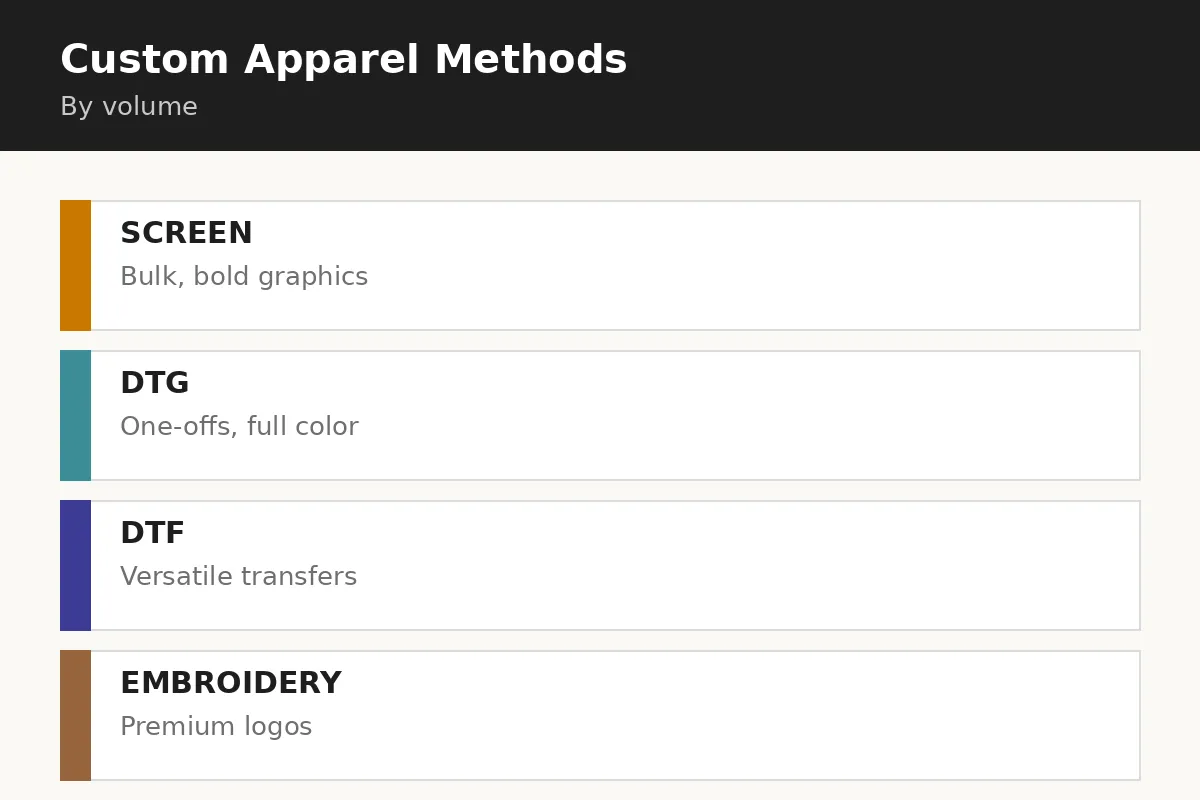
| Method | Best For | Strengths | Limitations |
|---|---|---|---|
| Screen printing | Large runs of the same design | Very durable, vibrant color, cheapest per unit at volume | Setup cost per color, poor for photos and gradients |
| DTG | Small batches, detailed full-color art | Unlimited colors, soft feel, no setup fees | Slower for bulk, needs high cotton content |
| DTF | Mixed fabrics, dark polyester | Works on almost any fabric, vivid on darks | Slightly heavier hand feel than DTG |
| Embroidery | Polos, hats, jackets, corporate wear | Professional texture, extremely durable | No gradients or tiny text, heavy on thin fabrics |
| Heat transfer vinyl | Names, numbers, simple bold graphics | Bright colors, special finishes like glitter | Can feel plasticky, limited detail |
A practical rule: if you need 24 or more of one design with a few colors, screen printing usually wins. Fewer than that, or a photographic design, points to DTG. Corporate polos point to embroidery. For a deeper dive on the digital option, see our DTG printing guide.
4. Prepare Print-Ready Files
Nothing delays an order like a low-resolution logo emailed as a phone screenshot. Speak the printer's language:
- Vector is king (.AI, .EPS, .SVG): vectors scale infinitely without losing sharpness — essential for screen printing and embroidery, where colors must be separated cleanly.
- Raster needs 300 DPI at print size (.PNG, .PSD): a photograph must be 300 dots per inch at the actual dimensions it will print. A small web image stretched across a chest will look blocky.
- Spot colors need Pantone codes: screens see RGB (light), printers mix ink. If brand accuracy matters, supply the Pantone (PMS) reference.
- Transparent backgrounds: for DTG and DTF, deliver artwork on transparency, not a white box — unless the white box is the design.
5. The Ordering Workflow
A smooth order follows the same steps whether you use a local shop or an online printer:
- Brief the printer: garment, quantities per size, print locations, deadline. Vague briefs get vague quotes.
- Approve the digital proof: check every word, color, placement, and dimension. Production starts only after your approval — errors you approve are yours.
- Order a sample: for any run that matters, one sample shirt is the cheapest insurance in the industry. Check the print, the fit, and the color in person.
- Plan the size curve: for group orders, don't guess — collect sizes in advance. A common split skews toward medium and large, but your group is your group.
- Build in lead time: standard production is often one to two weeks plus shipping. Rush fees are real; ordering early is free.
If you want to skip inventory entirely, print on demand prints one shirt at a time as orders come in — a different model with different trade-offs.
Why the Sample Matters More Than the Quote
Price quotes are estimates; a sample is evidence. A single sample shirt answers questions no quote can: does the ink color match your brand on this exact fabric? Does the print placement sit right on an extra-small and a 3XL? Does the garment's fit match its size chart? Printers expect sample requests on serious orders, and the good ones encourage them. When the sample arrives, wash it once before approving — that single wash reveals more about durability than any spec sheet. Photograph the approved sample next to its proof and keep both with your order records; on reorders, that photo is your quality reference.
For group and team orders, the sample also settles the most common dispute in custom apparel: sizing. Pass it around, let people try it on, and collect real size commitments instead of guesses. A fifteen-minute fitting session prevents the classic outcome of twenty mediums nobody wanted.
6. Common Mistakes to Avoid
- Choosing the garment on price alone. A shirt nobody wears is the most expensive shirt you can buy.
- Approving proofs in a hurry. Typos on 200 shirts are permanent.
- Ignoring the fabric-method match. Sublimation on cotton and plastisol on uncoated polyester are the two classic failures.
- Skipping the sample. Screens render colors differently than monitors; one sample answers every question.
- Forgetting reorders. If this design will be reprinted, save the exact garment SKU, ink colors, and file versions.
Prefer to make shirts yourself instead of ordering? Our home printing guide covers the DIY methods. And if sustainability matters to your brand, read our eco-friendly printing guide before choosing inks and fabrics. You can also browse finished designs for inspiration in our design collection.
Frequently Asked Questions
What is the cheapest way to make custom apparel?
For large quantities of a simple design, screen printing has the lowest per-unit cost. For one-offs or small batches, DTG or print-on-demand avoids setup fees entirely. The cheapest method depends on your quantity and design complexity, not on the method alone.
Screen printing vs DTG — which should I choose?
Choose screen printing for 24+ units of a design with few colors — it's more durable and cheaper at volume. Choose DTG for small runs, photographic designs, or unlimited colors with no setup cost. For dark polyester, consider DTF instead.
What file format do printers need?
Vector files (AI, EPS, SVG) are ideal because they scale without losing quality. For photographic designs, supply a raster file (PNG, PSD) at 300 DPI at the actual print size. Always include Pantone codes if exact brand colors matter.
How far in advance should I order custom shirts?
Allow at least two to three weeks for standard production plus shipping, more for embroidery or large runs. Ordering a sample first adds a few days but prevents expensive mistakes. Rush production is available from most shops at a premium.
Can I reorder the same design later?
Yes — keep the garment SKU, ink colors or Pantone codes, print dimensions, and your approved files. Printers can usually match a previous run exactly if you supply the same specifications, though dye lots and garment availability can vary.