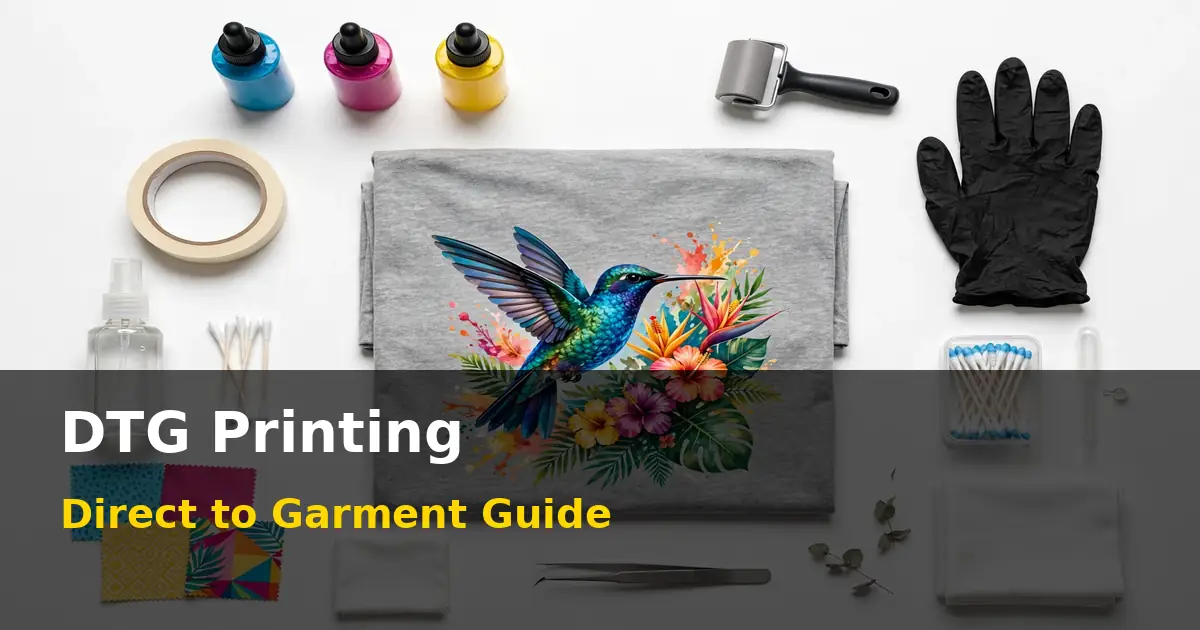
Direct-to-garment (DTG) printing is the reason a one-off shirt with a photographic design can exist at all. Think of it as an inkjet printer's big brother: instead of paper, a t-shirt sits flat on a platen while print heads spray water-based ink directly into the fabric fibers. No screens to burn, no minimum order, full color from the first shirt.
It is also the backbone of the print-on-demand economy. This guide explains how DTG actually works, where it beats the alternatives, and — just as important — where it doesn't.
Table of Contents
Key Takeaways
- DTG sprays water-based CMYK ink (plus a white underbase on darks) directly into cotton fibers.
- It needs high cotton content and proper pretreatment on dark garments — skip either and the print fails.
- DTG wins on detail and small runs; screen printing wins on large runs; DTF wins on polyester.
- There are no setup fees, so one shirt costs roughly the same to start as twenty.
- Properly cured DTG prints are soft, durable, and wash well with basic care.
1. What Is DTG Printing?
Direct-to-garment printing applies a design straight onto a textile with a specialized inkjet printer. The garment is loaded flat, the design is printed digitally, and heat cures the ink into the fibers. Because there is no physical setup per design — no screens, no films — the first shirt off the printer costs essentially the same to produce as the fiftieth.
That economics made DTG the default method for print-on-demand services: a customer orders one shirt, one shirt gets printed, and nobody holds inventory.
2. How It Works, Step by Step
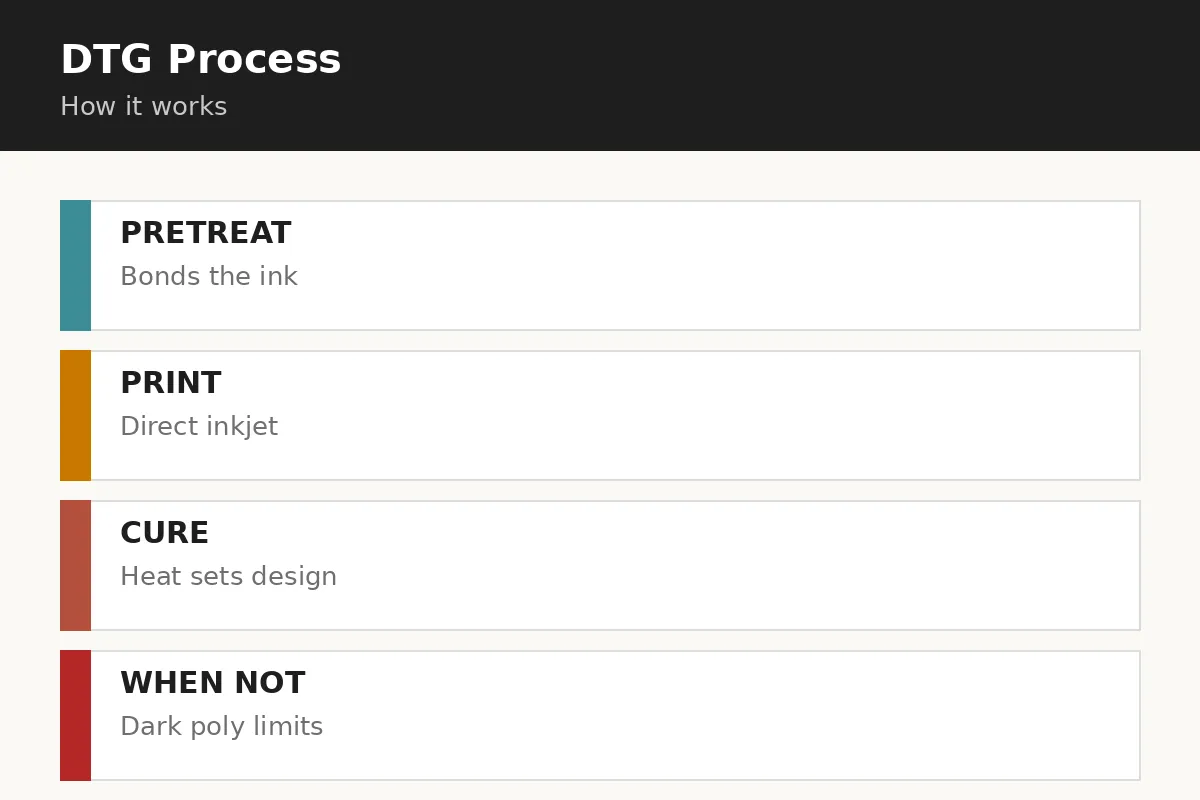
- Artwork preparation. The design is processed through RIP software (Raster Image Processor), which manages color profiles and calculates exactly how much ink — including white — each area needs.
- Pretreatment (dark garments). A primer solution is applied so ink bonds instead of sinking into the fibers. Light garments can often skip this.
- Loading. The shirt goes onto a flat platen. A single wrinkle here ruins the print, so garments are smoothed carefully.
- Printing. On dark shirts, a white ink underbase goes down first and is lightly cured; then CMYK layers build the full-color image on top. On white or light shirts, CMYK prints directly.
- Curing. Heat — usually a heat press with a protective sheet — sets the ink permanently into the fibers.
The whole cycle takes a few minutes per shirt, which is why DTG scales poorly to huge runs but beautifully to one-offs.
One more practical detail: DTG printers print within a defined platen area, so oversized all-over prints aren't possible — the design is limited to roughly a standard chest, back, or sleeve placement. If your artwork needs to wrap around seams or cover the whole garment, sublimation on polyester is the method built for that.
3. Pretreatment: The Make-or-Break Step
If you've ever seen a DTG print that looked dull, cracked after two washes, or had a visible rectangular "box" around the design, pretreatment was the culprit. It's a balancing act: too little and colors sink into the fabric and look muddy; too much and the ink sits on top and peels. Automated pretreatment machines beat hand sprayers for consistency, which is one reason prints from established POD providers tend to outlast hobbyist setups.
That faint vinegar smell on a fresh DTG shirt? That's the pretreatment solution. It's non-toxic and washes out completely on the first cycle.
4. DTG vs. Screen Printing, DTF, and Sublimation
| Method | Strengths | Weaknesses | Best For |
|---|---|---|---|
| DTG | Unlimited colors, soft feel, no minimums | Slow at volume, needs cotton | Small runs, photos, complex art |
| Screen printing | Most durable, cheapest at high volume | Setup cost per color, bad for gradients | 50+ units of one design |
| DTF | Works on any fabric, vivid on darks | Slightly heavier feel, extra steps | Polyester, hats, mixed-fabric orders |
| Sublimation | Permanent, zero feel | Polyester only, light garments only | All-over prints, sportswear |
The DTG vs. DTF question comes up constantly. DTG feels softer because ink absorbs into the fibers; DTF sits slightly on top due to its adhesive layer, with a faintly plasticky hand on heavy coverage. DTF wins on fabric versatility — it handles polyester, nylon, and dark garments without cotton. If softness on cotton matters most, pick DTG; if the garment is polyester or you need one method across mixed fabrics, pick DTF.
5. When to Choose DTG — and When Not To
Choose DTG when:
- You're printing fewer than a few dozen of a design.
- The artwork is photographic, gradient-heavy, or full-color.
- Each shirt is different (names, photos, one-offs).
- You're selling through print-on-demand with no inventory.
- The garment is cotton or a cotton-heavy blend.
Don't choose DTG when:
- You need hundreds of the same shirt — screen printing will be cheaper and faster.
- The garment is 100% polyester — use DTF or sublimation instead.
- You need neon or metallic effects — DTG's CMYK gamut can't produce them; screen printing with specialty inks or HTV can.
- Durability under industrial laundering matters most — screen print still leads over hundreds of wash cycles.
Common DTG Defects and What Causes Them
Knowing the failure modes helps you judge print quality — whether you're buying DTG shirts or running the printer yourself:
- Dull, washed-out colors on darks: under-pretreatment or too little white underbase. The ink sank into the fibers instead of sitting on the primer.
- Cracking or peeling: over-pretreatment or under-curing. The ink formed a film on top instead of bonding.
- Visible pretreatment box: excess pretreatment sprayed beyond the design area. It washes out, but it looks bad out of the bag.
- Fuzzy edges: garment fibers sticking up through the print — usually fixed by better platen technique or a lint roller before printing.
- Color shift: uncalibrated RIP or wrong color profile. Reds going orange is the classic symptom.
Every one of these is a process problem, not a DTG problem. A shop that pre-treats consistently, maintains its printers, and cures properly produces prints that last.
A Note on DTG Maintenance
DTG printers are famously maintenance-hungry, and that's worth knowing as a buyer too. The white ink contains titanium dioxide, which settles and clogs print heads if the machine sits idle. Shops that print daily have fewer problems than shops that print weekly — another reason established high-volume POD providers tend to deliver more consistent quality than a local shop that dusts off the DTG printer once a month. If you're evaluating a printer, asking how often their DTG machines run is a fair question.
6. File Prep for DTG
- Resolution: 300 DPI at the actual print dimensions. DTG rewards detail — give it detail to work with.
- Transparency: deliver art on a transparent background; stray white boxes print as white boxes.
- Color mode: work in RGB for the widest gamut; the RIP handles conversion.
- Dark garments: remember the white underbase exists — fine light details on dark shirts depend on it, so avoid hairline elements that the underbase can't support.
- Care: wash inside out in cold water, low dryer heat. Properly cured DTG holds up well within the normal life of the garment.
For the broader ordering picture, see our custom apparel guide and print-on-demand guide. For cleaner inks and fabrics, read our eco-friendly printing guide, or browse finished DTG-friendly designs in our design collection.
Frequently Asked Questions
Does DTG printing wash off?
No — when properly pretreated and heat-cured, DTG prints are durable and last through the normal life of the garment. Fading or peeling almost always traces back to skipped pretreatment or under-curing, not the method itself.
Can you DTG print on polyester?
Standard DTG inks need natural fibers like cotton to bond properly. On 100% polyester the ink can migrate or wash out. For polyester garments, DTF or sublimation are the reliable choices.
Why is DTG more expensive than screen printing for large orders?
DTG's per-shirt cost stays roughly flat because each garment is printed individually with digital ink. Screen printing has high setup costs but very low ink costs, so its per-unit price drops sharply as quantity rises. The crossover is typically in the dozens of units.
What is the vinegar smell on a new DTG shirt?
That's the pretreatment solution used on dark garments to help ink bond. It's non-toxic and disappears completely after the first wash — it's actually a sign the printer did the prep step properly.
DTG vs DTF — which is better?
DTG feels softer on cotton because ink absorbs into the fibers; DTF works on virtually any fabric including polyester and dark synthetics but has a slightly heavier hand feel. Choose DTG for cotton softness, DTF for fabric versatility.