Print on demand (POD) is a fulfillment model in which a supplier prints, packs, and ships a product only after a customer places an order. You never buy inventory up front, which makes it one of the lowest-risk ways to test a product idea. But "simple" is not "easy": you still choose the product, create or license the artwork, publish the listing, attract buyers, and handle customer issues. This guide walks through the process as a sequence of decisions, not promises.
Table of Contents
- What print on demand is—and what it is not
- Step 1: Pick and validate a narrow niche
- Step 2: Build a repeatable design system
- Designing with AI tools, honestly
- Step 3: Choose a fulfillment partner
- Step 4: Choose a sales channel
- Step 5: Price with a contribution formula
- Step 6: Order samples and run a small launch
- Step 7: Market the first collection
- Legal and IP essentials
- Frequently Asked Questions
Key Takeaways
- POD removes the need to buy stock before a customer orders, but it does not remove product, marketing, or customer-service work.
- A focused audience and a small first collection make demand easier to test than a general store.
- Compare suppliers on delivered cost, quality consistency, and integration—not catalog size alone.
- Run a contribution-margin calculation before publishing, then order samples and test checkout yourself.
What print on demand is—and what it is not
The workflow looks like this:
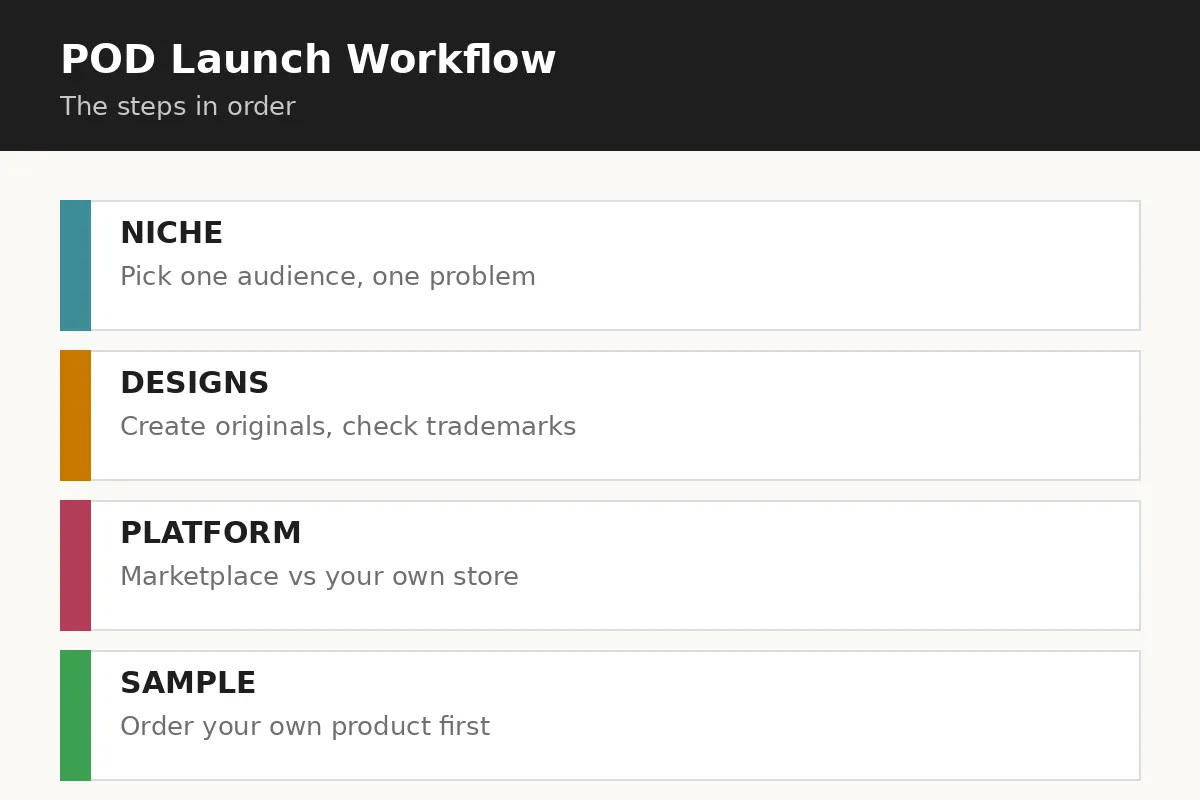
- You create a listing with your design on a supplier's blank product, in your store (Shopify, Etsy, WooCommerce) or on a marketplace.
- A customer orders and pays you the retail price.
- The order routes automatically to your POD supplier.
- The supplier prints, packs, and ships directly to the customer. You pay the supplier the base cost.
- You keep the difference after costs and fees.
There is no holding stock and no upfront capital tied up in inventory, which makes it easy to pivot when a trend fades. The trade-offs: per-unit costs are higher than bulk manufacturing, you have less control over production and delivery, and returns still land on your desk. Treat POD as a controlled testing and brand-building model, not as automatic passive income.
Step 1: Pick and validate a narrow niche
A niche is a defined audience with a shared interest, identity, problem, or buying occasion. "Everyone who likes funny shirts" is too broad to guide a product range or a marketing message; "first-time marathon runners who want understated training humor" gives you a clearer customer, vocabulary, and design brief.
A practical niche test
- Describe a specific person and occasion in one sentence: who buys, what for, and why the design is relevant.
- Look for evidence of demand in search results, reviews, forums, and trend data—buying intent, not just likes.
- Map the competition. Record ten comparable listings: prices, product types, style, and review complaints. Competition proves buyers exist; it does not prove your version is distinct.
- Find a defensible angle by audience, tone, fit, personalization, material, or occasion.
A useful three-pillar filter, borrowed from experienced sellers: passion (a community that identifies with the topic—hobbyists, professions, and fandoms buy identity, not just garments), visual potential (some aesthetics translate to fabric far better than others), and search volume (use Google Trends or an Etsy keyword tool to confirm people actually search for these terms before you invest in artwork).
Before designing, write a one-page customer brief: audience, the top three phrases they use, likely purchase occasion, preferred product, and the reason your store should exist. For the design side of that brief, see our guides to graphic design principles and designing a t-shirt from scratch.
Step 2: Build a repeatable design system
You do not need to be a professional illustrator, but you do need a consistent process. Text-led designs can work when the phrase is specific to the audience and the typography is legible at thumbnail size.
- Generate concepts in sets. Several variations around one audience and occasion, not one design scattered across unrelated niches.
- Check the thumbnail. View artwork at search-result size and remove detail that disappears or becomes unreadable.
- Prepare production files. Follow the supplier's requirements for format, transparent background, color profile, resolution (typically 300 DPI), and printable area—a blurry print is an instant refund request.
- Review rights before upload. Keep license records for fonts, stock assets, and commissioned work; skip characters, logos, lyrics, and celebrity references.
- Build a product family. Reuse a restrained palette, type system, or illustration language so the store feels intentional.
Designing with AI tools, honestly
Generative AI has lowered the cost of producing artwork, which is genuinely useful for rapid prototyping and testing niche aesthetics. It has not lowered the cost of judgment. Different tools suit different jobs: Midjourney for artistic quality and texture, DALL-E 3 for detailed instructions and text rendering, Leonardo.ai for a traditional interface with built-in upscaling, Ideogram for typography and lettering.
Two things matter more than which tool you pick: commercial licensing (use a paid tier that grants commercial rights, and read the terms—trial generations can carry restrictions you do not want on products you sell) and human modification (the U.S. Copyright Office's position is that AI images without significant human intervention cannot be copyrighted; adding typography, combining elements, and adjusting composition creates derivative work with stronger protection). Some marketplaces, including Etsy, ask sellers to disclose AI assistance—build transparency in from the start.
AI output is usually small (often around 1024 pixels). Upscale before printing: a large garment print wants several thousand pixels on the long edge, or the result will look soft.
Step 3: Choose a fulfillment partner
Start with one primary product and, at most, one complementary product. A focused collection is easier to photograph, price, explain, and support. Then compare fulfillment partners on the factors that actually determine your customer experience:
| Decision factor | What to check | Why it matters |
|---|---|---|
| Delivered cost | Product, print, shipping, fees, branding add-ons | Base price alone can make a weak product look profitable. |
| Production and delivery | Production time, coverage, tracking, holiday cutoffs | A clear delivery promise is part of the product. |
| Quality control | Print placement, color, fabric, packaging, replacement policy | One poor sample reveals risks mockups hide. |
| Operations | Store integration, order routing, support, branded packaging | You still own the customer relationship. |
Common options, described plainly: Printful runs its own production facilities—more consistent quality control, higher base costs. Printify is a network of print vendors—usually lower base costs, more variation between providers. Gelato runs a global network suited to international shipping. Redbubble and Spring (formerly TeeSpring) are marketplaces where you upload designs and skip the store entirely—less control, but the fastest way to start testing. None is "the best"; the right one is whichever meets your customer promise consistently at a cost your pricing can support.
Step 4: Choose a sales channel
Your first channel should match your current strength:
| Route | Best fit | Trade-off to plan for |
|---|---|---|
| Marketplace | Testing search demand with limited setup | Fees, competition, limited audience ownership |
| Independent store | Building a brand and an owned email list | You own traffic, analytics, policies, support |
| Both, later | Expanding after one channel works | More listings and edge cases to manage |
Pick one channel, publish a coherent collection, and learn which designs earn clicks, add-to-carts, and sales. Add a second channel only when you can keep product information, pricing, and support consistent.
Channel-specific deep dives on this site: Amazon Merch, Shopify print on demand, and WooCommerce print on demand.
Step 5: Price with a contribution formula
Start from the money left after variable costs, not from a competitor's sticker price:
Contribution before tax = retail price − product and print cost − shipping subsidy − platform and payment fees − ad allowance − refund/replacement reserve.
For example, if a product sells for $29, the product and print cost is $12, shipping support is $5, transaction fees are $2.50, and you reserve $1.50 for promotion or replacements, the contribution before tax is $8. That is an illustrative planning example, not a promised margin—recalculate it for every product, channel, destination, discount, and advertising plan.
Decide in advance whether shipping is charged separately or built into the price, and write down your minimum acceptable contribution and discount floor. If a product only works at a price your target customer will not pay, change the product, supplier, offer, or audience—do not rely on volume to fix the math.
Step 6: Order samples and run a small launch
A first launch should answer business questions: which audience responds, which design angle earns attention, and which product and price can be fulfilled reliably? A small collection makes those answers easier to see.
- Prepare five to ten related designs on one primary product and one optional companion product.
- Order and inspect samples—garment weight, print quality, artwork scale, color, packaging, tracking, and delivery time—before promoting anything.
- Publish complete listings with sizing, materials, care, production time, shipping expectations, returns, and clear mockups or sample photos.
- Test checkout end to end: tax settings, shipping charges, order routing, confirmation emails, and the delivery promise.
- Track a simple scorecard by product: impressions, clicks, add-to-carts, conversion, contribution per order, refunds, and customer questions.
- Improve one variable at a time so you can learn what caused a result.
Do not treat likes as proof of demand. A design that gets attention but no product-page visits may need a better call to action; a page that gets visits but no sales may have a price, fit, shipping, trust, or quality problem.
Step 7: Market the first collection
Start where the niche already spends attention—marketplace search, short-form video, Pinterest, creator partnerships, or email—and choose one primary traffic source.
- Use real product evidence. Sample photos, fit videos, close-ups, and packaging reduce the uncertainty that mockups create.
- Write in the buyer's language. Use the phrases your niche actually uses in titles, descriptions, and FAQs—without stuffing them unnaturally. On Etsy, long-tail tags (e.g., "retro golden retriever mom shirt" instead of "dog shirt") target higher-intent buyers.
- Build a follow-up path. With appropriate consent, use email or social retargeting to share new designs rather than sending constant discounts.
- Review the numbers weekly. Separate traffic problems from offer problems and fulfillment problems before spending more on ads.
Legal and IP essentials
Intellectual-property risk is a reason to stop a design before publication. Screen risky names and phrases in the USPTO trademark database, search the marketplace for existing uses, and investigate the owner and product category—a search is a screening step, not a legal clearance opinion. When a name or design is central to your business, ask a qualified professional in your jurisdiction.
Write store policies that match your supplier's actual process: explain production times separately from transit times, state how damaged items are handled, and keep records of invoices, fees, advertising, samples, and refunds. Registration and tax rules vary by location and destination—consult a professional when sales become regular or cross-border.
Frequently Asked Questions
How much money do I need to start a print-on-demand business?
You can test the model with a marketplace account and free design tools, but budget for at least one sample, listing or platform fees, a store subscription or domain if applicable, and initial promotion.
Is print on demand still worth trying in 2026?
It can be, as a focused product and marketing test. Generic designs face heavy competition; a defined audience, reliable samples, and sound unit economics matter more than a large catalog.
Should I order samples before selling?
Yes. A sample verifies print placement, color, fit, material, packaging, tracking, and delivery time—and gives you original product photos that mockups cannot.
Is AI-generated art legal to sell on products?
It can be, with a paid tier that grants commercial rights and artwork that avoids existing trademarks. Disclose AI assistance where required, and add meaningful human modification so the work is defensible as a derivative.