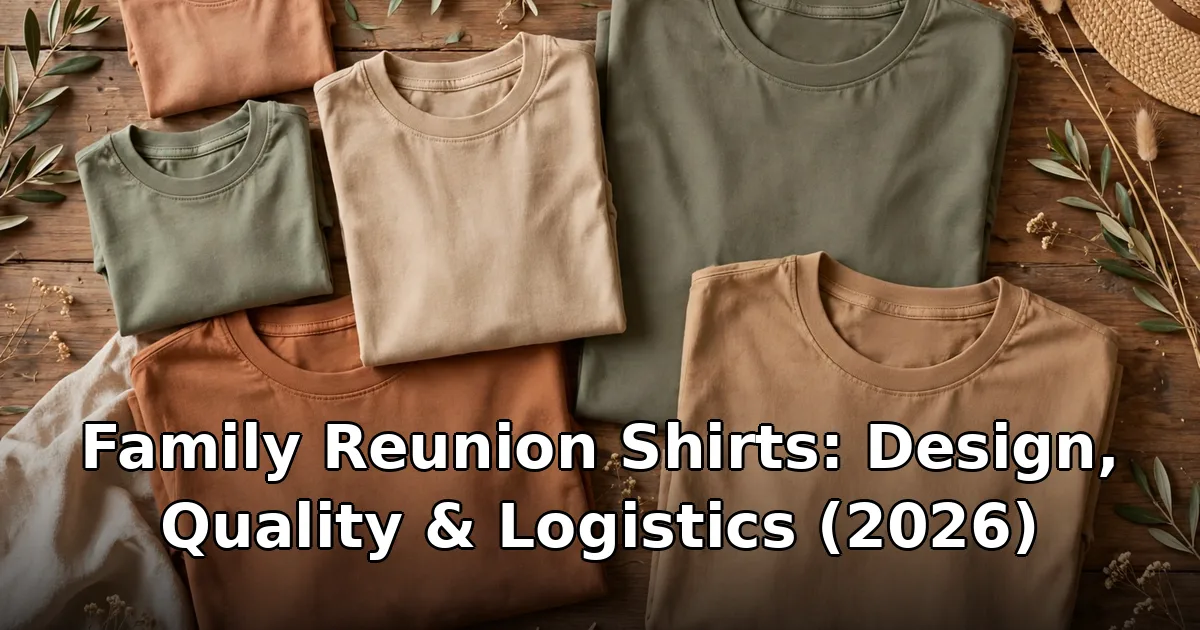
Walk into any state park or hotel lobby in July and you'll likely spot them: a sea of matching shirts in one bold color, emblazoned with a family name or a reunion year. Family reunion shirts are part practical tool, part souvenir — they help the group stay visible and give everyone something to take home. This guide covers the three things that determine whether yours succeed: design, quality, and logistics.
Table of Contents
Key Takeaways
- Ring-spun cotton is the comfort baseline; tri-blends handle hot outdoor reunions best.
- Screen printing suits large groups with simple artwork; DTG suits small groups and photo designs.
- Offer multiple fits — a single "unisex" cut rarely flatters everyone.
- Use an online ordering link so each household picks sizes and pays individually.
Why the Reunion Shirt Works
A shared shirt does two jobs at once. Socially, it signals belonging — distant cousins who haven't spoken in years get an instant conversation starter and a visible marker that they're part of the same team. Practically, one bright color makes a scattered group easy to spot across a park, resort, or crowded restaurant.
The shirts that get worn again after the event share one trait: they look like something someone would actually buy. Keep that as your design compass and the rest gets easier.
Fabric: Beyond the Budget Tee
It's tempting to order the cheapest heavy-cotton blank available. For an outdoor summer reunion, reconsider: a heavy 6 oz cotton shirt in humid heat feels miserable by noon, and scratchy fabric guarantees the shirt lives in a drawer afterward.
Ring-spun cotton is the minimum worth buying — the fibers are twisted and thinned during spinning, which makes it noticeably softer than basic carded cotton. Tri-blends (polyester/cotton/rayon) go further: they breathe well, drape nicely, and resist the boxy shrinkage cheap shirts develop after a few washes. If the reunion is in serious heat, lighter fabric weights (around 4 oz) are worth the small premium.
One fit note: offering a women's cut alongside the standard unisex blank meaningfully increases the odds people wear the shirt again. It's a small logistics addition with a big wearability payoff.
Printing Methods Compared
The right decoration method depends on headcount and artwork complexity:
| Method | Strengths | Limitations | Best For |
|---|---|---|---|
| Screen printing | Vibrant colors; cost-effective at 24+ pieces | Setup fees; limited color count | Large families (50+) with 1–3 color logos |
| Direct-to-garment (DTG) | No minimums; handles photos and fine detail | Higher per-unit cost; prints can fade faster | Small groups or photo-based designs — see our DTG guide |
| Sublimation | Zero-feel print that never cracks or peels | Only works on light, high-polyester fabrics | Athletic-style shirts for "family olympics" events |
| Heat-transfer vinyl | Easy individual names and numbers | Can feel plasticky; may peel over time | Adding names to the back for small groups |
Design Themes That Work
The strongest reunion designs look "retail-ready" rather than clip-art assembled. Current directions that hold up:
- Badge and national-park style: Vintage typography in a badge layout with the family name and year. Rugged, timeless, and it flatters every age group.
- Minimalist typography: Just the family name in a bold modern font across the chest. Teenagers will actually wear this to school.
- The lineage list: Surnames of the family branches on the back, showing how the branches merged into the current generation.
- Retro sunset: 70s/80s-style lettering with sunset gradients — a nostalgia hit for Gen X and grandparents that's ironically cool for Gen Z.
Design discipline matters: limit the artwork to two colors. It keeps screen-printing affordable and prevents the shirt from looking cluttered. If a relative is a graphic designer, let them lead; otherwise most printers offer templates far better than a hand-drawn sketch.
For more theme inspiration, see our 15 matching family shirt ideas.
Logistics: Sizing and Ordering Without Chaos
Collecting sizes and money from 40 people across six states is where most reunion plans break down. Two approaches solve it:
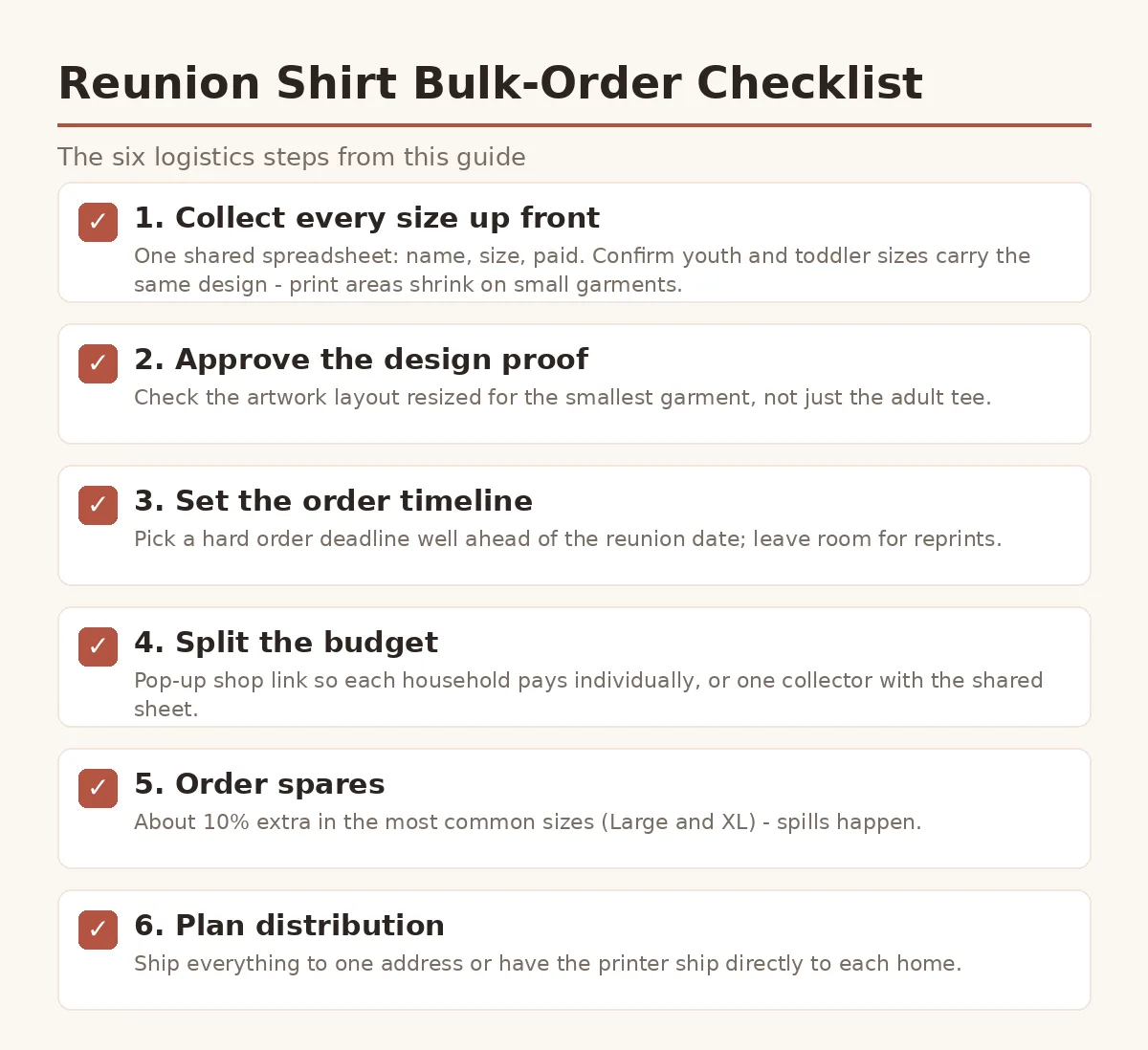
Online pop-up shops. Many custom apparel companies host a temporary ordering link for your group. Each household picks its own sizes, pays individually, and shirts ship to one address or directly to each home. This eliminates the dreaded "money collector" role entirely.
The manual route, done right. Use one shared spreadsheet (name, size, paid), set a hard order deadline two weeks before you think you need it, and order about 10% extra in the most common sizes (Large and XL). Someone always spills BBQ sauce, and a spare shirt makes you the hero of the reunion.
Whichever route you take, confirm with the printer that youth and toddler sizes carry the same design — print areas shrink on small garments, which sometimes requires a resized layout.
Sustainable Options
Organic cotton and recycled-polyester (rPET) blanks are widely available from most custom printers now. They cost more than standard blanks, but for families trying to reduce fast-fashion waste — especially for a nature-themed reunion — the trade-off is worth discussing with the group. Another simple sustainability win: skip year-specific designs so the shirts stay wearable (and giftable) for years. Our eco-friendly printing guide covers the print methods in more depth.
Reunion-Day Checklist
A short run-sheet for the morning of the event:
- Spare shirts: Bring the extras in Large and XL, plus a stain-removal pen. Someone always needs one.
- Group photo window: Schedule the big photo early, before heat, food, and activities take their toll on the shirts.
- Name tags (optional): For large reunions, peel-and-stick tags with first names plus family branch ("Lisa — Miller side") help distant relatives actually talk to each other.
- A "shirt captain": One person holds the spares and handles last-minute swaps so the organizer isn't doing it mid-barbecue.
Frequently Asked Questions
How far in advance should I order family reunion shirts?
Start 6–8 weeks before the event: two weeks for design, two for collecting sizes and payments, and two for production and shipping — plus a buffer week for delays.
What is the best color for family reunion shirts?
Bright colors like royal blue or kelly green maximize visibility in crowds. Heather grey and navy get worn most often after the event. Avoid white for outdoor meal-heavy reunions.
Do I need different shirts for kids and adults?
Same design, but make sure your printer offers it in youth and toddler sizes. Print areas are much smaller on a 2T shirt than an adult 3XL, which can require a resized layout for screen printing.
Screen printing or DTG for a reunion?
Screen printing for 24+ shirts with simple artwork — it's the most cost-effective per unit. DTG for smaller groups, photo designs, or when everyone wants something slightly different.
Should I include the year on the design?
Yes — the year turns the shirt into a collectible that distinguishes each reunion in the wardrobe. If you want maximum re-wearability, keep the year small, e.g. on a sleeve.