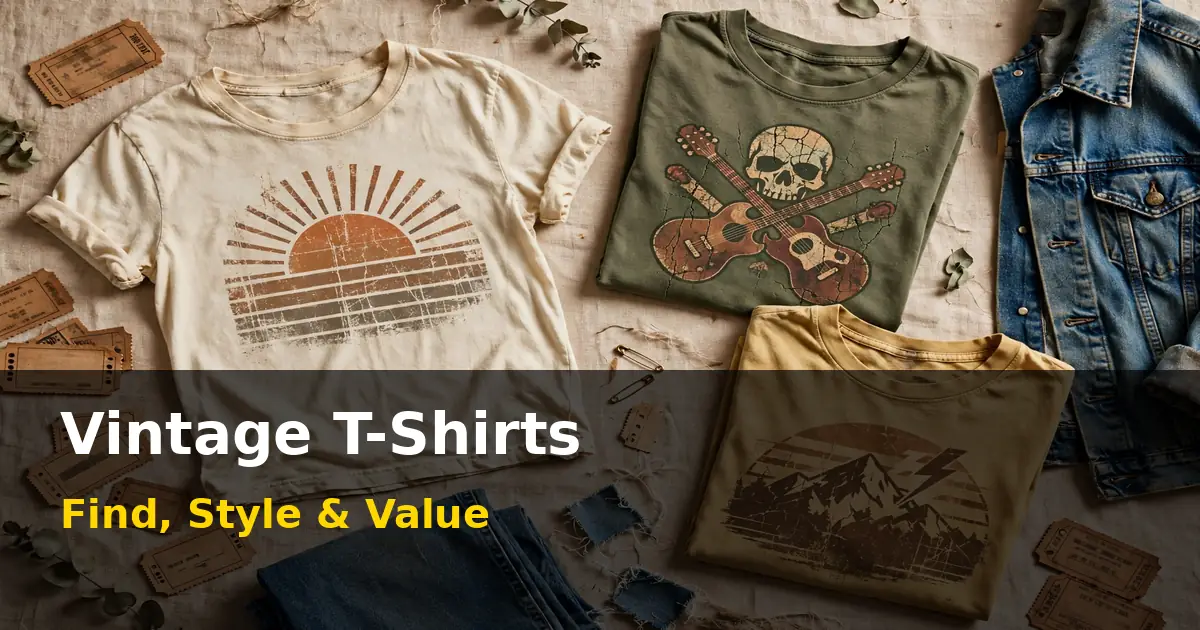
There is a specific kind of rush that only happens in a thrift store. Your fingers graze a fabric that feels impossibly soft — paper-thin, perfectly faded, carrying a graphic from a tour that happened before you were born. That is the pull of the vintage t-shirt: part fashion, part archaeology, part treasure hunt.
But the vintage tee market has a learning curve, and the internet is full of confident-sounding advice that falls apart in the wild — including price tables presented as fact in a market where values shift constantly. This guide is the hub for our whole vintage series: what "vintage" actually means, how to find authentic pieces, how to authenticate them, what drives their value (not fixed prices), how to keep them alive, and how to wear them. Each section below links to a dedicated deep-dive.
Table of Contents
- Why Vintage Tees Endure
- Real Vintage vs. Vintage-Inspired: Know the Difference
- Finding Authentic Vintage Tees
- Authenticating: The Stitch, the Tag, the Print
- What Drives a Vintage Tee's Value
- Caring for Vintage Cotton
- Styling Vintage Tees
- Vintage-Inspired Designs From Our Collection
- Frequently Asked Questions
Why Vintage Tees Endure
A vintage t-shirt is one of the few garments that gets more interesting the more it is worn. The fading softens the graphic, the collar relaxes, and the shirt becomes a record of everywhere it has been. Three forces keep demand strong:

- Scarcity is built in. Nobody is printing more 1987 tour tees. Every year, more are lost to stains, dry rot, and donation bins, while the pool of interested buyers keeps growing.
- The construction was different. Pre-mid-90s tees were often cut with tubular bodies (no side seams), single-stitch hems, and softer 50/50 cotton-poly blends — details that read instantly as "old" to anyone who handles a lot of shirts.
- They are wearable culture. A band tee, a defunct brand logo, a cartoon promo — each one is a timestamp. People wear them the way others hang posters.
That same popularity is why the market is flooded with reproductions. Which brings us to the most important distinction in this guide.
Real Vintage vs. Vintage-Inspired: Know the Difference
Real vintage means the shirt was actually manufactured decades ago — generally 20+ years old, with the stitching, tags, and print aging to prove it. Vintage-inspired means a new shirt designed to look old: distressed graphics, retro typography, faded color palettes, printed last month.
Neither is "better" — they serve different purposes. A real vintage tee is a collectible with a finite supply; a vintage-inspired tee is a wearable design you can actually find in your size, in new condition, without paying collector prices or worrying about dry rot. Honest sellers label which one they are selling. Be wary of any listing that uses words like "vintage style" in the title but "vintage" alone in the description — that ambiguity is usually deliberate.
The rest of this guide covers real vintage. If you decide the vintage-inspired route is more practical for you, skip to the collection section below — every design there is honestly labeled as vintage-inspired, never as true vintage.
Finding Authentic Vintage Tees
The hunt is half the hobby. Thrift stores and charity shops are the classic starting point: high effort, occasionally high reward, and the only place where a five-dollar rack can still hide something special. Estate sales and flea markets tend to be better curated — you pay more because the seller already did the digging. Online, the established resale marketplaces (eBay, Depop, Grailed, Etsy) offer the widest selection, but they also host the most reproductions, so every online purchase should be authenticated on arrival.
Sourcing well is a skill with its own techniques — from reading seller photos to searching misspelled listings. Our dedicated guide covers it in full: The Hunt for History: Where to Find Authentic Vintage Graphic Tees Online.
Authenticating: The Stitch, the Tag, the Print
Authentication is a three-legged stool — stitching, tag, and print — and you need all three legs before you trust a piece. The sleeve hem is the fastest check: a single row of stitching (single stitch) was the industry standard through the 70s, 80s, and early 90s, while two parallel rows (double stitch) took over in the mid-to-late 90s. The tag is the shirt's birth certificate — Screen Stars, Hanes Beefy-T, Giant, and Brockum tags each point to specific eras, and a tag printed directly on the fabric (tagless) is a modern construction. The print itself should show natural aging: slight cracking and fading consistent with decades of washing, not the uniform "distress" of a factory-aged reprint.
Two practical checks most beginners skip: cross-reference the copyright date printed under the graphic with the tag era (a "© 1989" print on a tagless modern blank is a reproduction), and test deadstock black tees from the 90s for dry rot — gently stretch the fabric, and if it tears like paper, the fibers are gone and the shirt is unwearable. The full authentication method, with photos of what to look for, is here: Single Stitch vs Double Stitch: The Ultimate Guide to Vintage Tee Authentication.
What Drives a Vintage Tee's Value
You will find plenty of price tables online claiming a 1980s tee is "worth" a specific dollar range. Treat those as fiction: vintage tee prices are set by individual sales between buyers and sellers, and they move with trends, celebrity sightings, and reissue news. What you can learn are the drivers — the factors that consistently push a shirt's market price up or down:
- Rarity of the graphic. Tour-specific dates, limited event prints, and short-lived brands beat endlessly reprinted designs.
- Cultural weight. Band tees from landmark tours, iconic pop-culture moments, and historically significant graphics command premiums because demand extends beyond fashion into fandom.
- Era and construction. 70s and 80s single-stitch pieces in good condition are scarcer than 2000s double-stitch, and the market prices that in.
- Condition. Some fading is expected and even desirable; holes, heavy stains, and dry rot are not. Deadstock (unworn) commands a premium only if the fibers survived storage.
- Size. Larger sizes are rarer in true vintage (bodies were cut smaller decades ago) and often price higher.
The honest way to value a specific shirt is to look at completed sales of the same or comparable pieces on resale marketplaces — not asking prices, which are wishes. Our collector-focused guide goes deeper into the grail market: The Holy Grail of Cotton: Most Valuable Vintage T-Shirts to Collect in 2026.
Caring for Vintage Cotton
Decades-old cotton is fragile, and one hot dryer cycle can do what twenty years of wear did not. The rules are simple and non-negotiable: wash cold, inside out, with a gentle detergent; never use high heat; hang dry or lay flat. Keep vintage tees out of prolonged direct sunlight in storage, and never store them damp — mildew is irreversible. For stained grails, resist aggressive treatments; a gentle soak beats scrubbing, and some stains are simply part of the shirt's history.
The complete preservation routine — including how to handle cracking prints and store a collection — is here: The Definitive Guide to Washing Vintage T-Shirts: How to Preserve Grails Without Ruining the Print.
Styling Vintage Tees
The classic mistake is treating a vintage tee like gym clothes. The fix is contrast: pair the softness of a worn-in tee with something structured. An oversized 90s tee with tailored trousers and a blazer; a fitted 80s single-stitch with high-waisted denim and a belt; a faded band tee under a leather jacket. One relaxed piece per outfit is the rule — head-to-toe slouch reads accidental, while one slouchy piece against sharp tailoring reads intentional.
Fit matters more than people expect: true vintage runs small and boxy by modern standards, so try before you commit when buying in person, and check pit-to-pit measurements when buying online. The full styling playbook: The Art of the Archive: A Masterclass in Styling Vintage T-Shirts.
Vintage-Inspired Designs From Our Collection
Not everyone wants to hunt thrift racks or gamble on authentication — and that is fine. These are real vintage-inspired designs from our collection: new garments with retro aesthetics, honestly labeled as what they are. Each is available on Redbubble on multiple products; pick your garment on the product page.

"Vintage Goose" 90s Retro Folk-Art Design
A vintage-inspired 90s design with country farmhouse folk-art charm — the retro goose aesthetic without the thrift-store gamble. Available on Redbubble on hoodies, tees, and other products; pick your garment on the product page.
View on Redbubble →
"1985 Retro Birthday" Vintage-Style Design
A vintage-inspired 1985 design in the classic birth-year tee tradition — the look of a decades-old milestone shirt, printed new. Available on Redbubble on sweatshirts, tees, and other products; pick your garment on the product page.
View on Redbubble →
"Mystical Sun and Moon" Vintage Bohemian Design
A vintage-inspired bohemian design with celestial sun-and-moon artwork — the 70s mystic aesthetic, brand new. Available on Redbubble on tees, stickers, and other products; pick your product on the product page.
View on Redbubble →Looking for more? Browse our full designs collection — the vintage-inspired pieces are mixed in with everything else.
Frequently Asked Questions
How old does a t-shirt have to be to count as vintage?
The commonly used threshold is 20+ years old. A shirt from the early 2000s now qualifies by age, though collectors tend to reserve the most enthusiasm — and the highest prices — for pieces from the 70s through the 90s.
Is single stitching a guarantee that a shirt is vintage?
No — it is a strong indicator, not a guarantee. Single stitching was standard through the early 90s, but modern reproductions can copy it. Always cross-reference with the tag and the copyright date under the graphic.
Why do some vintage tees cost so much?
Rarity, cultural significance, era, condition, and size all push prices up, and the supply is finite — nobody is making more of them. But prices are set sale by sale; check completed sales of comparable pieces rather than trusting fixed price tables.
Can I wear a valuable vintage tee, or should I keep it stored?
That is a personal call. Wearing adds fading and wear that collectors price in; storing preserves condition but you never enjoy it. Many collectors wear their mid-tier pieces and archive only the true grails.
Are vintage-inspired tees "fake vintage"?
Only if they are sold as real vintage. A honestly labeled vintage-inspired tee is just a new shirt with a retro design — there is nothing deceptive about it. The problem is sellers who blur the line.
What is the biggest beginner mistake?
Buying on excitement without authenticating. Slow down, check the stitch, the tag, and the copyright date together, and compare against completed sales before paying a premium.