Amazon Merch on Demand is one of the most talked-about print-on-demand platforms for a simple reason: it puts your designs in front of Amazon's enormous built-in audience while Amazon handles printing, shipping and customer service. But it is also one of the hardest platforms to join, with an invite-only application and a tier system that limits how many designs new sellers can publish. This guide explains how the platform actually works, what the application and tier system involve, how to research niches and upload designs, how to stay clear of trademark trouble, and how sellers realistically scale — without hype or invented earnings claims.
Table of Contents
Key Takeaways
- Amazon Merch on Demand lets you sell printed apparel and more with no inventory — Amazon prints, ships via Prime, and handles support.
- Joining requires an application that Amazon reviews manually; approval is not guaranteed and waiting times vary.
- New accounts start with a small design allowance and earn more slots by selling — growth is paced by design.
- Copyright and trademark compliance is the single most important account-safety habit on the platform.
What Is Amazon Merch on Demand?
Amazon Merch on Demand (formerly called Merch by Amazon) is Amazon's print-on-demand service for creators. You upload artwork, choose which products it appears on, and set your selling price. When a customer places an order, Amazon prints the product, ships it — often with Prime delivery — and handles any customer service. You earn a royalty on each sale.
There are no inventory costs and no monthly fees for the basic program. That makes the barrier to entry cheap in money terms — but not in effort. Because you are selling inside Amazon's marketplace, you are competing with thousands of other listings, and Amazon's search rewards listings with relevant keywords and consistent sales. Think of the platform as a giant search engine that happens to sell shirts, not as a passive income machine that runs itself.
It is worth setting expectations early: the era when a generic slogan shirt could generate easy monthly income is long gone. Today's successful sellers treat it like a small business — research niches, design deliberately, optimize listings, and protect their accounts.
The Application: Getting Accepted
Unlike most print-on-demand marketplaces, you cannot simply sign up for Merch on Demand. You request an invitation and complete an application that Amazon reviews manually. Wait times vary widely — some applicants hear back in days, others wait weeks or months — and rejections are common.
Several habits genuinely improve your odds:
- Write the application like a business plan, not a form. Explain specifically what you plan to sell — original, niche-focused apparel designs — in complete sentences.
- Use an established Amazon account. An account with normal purchase history looks more legitimate than a brand-new one created yesterday.
- Show you exist elsewhere. Links to a portfolio, an Etsy shop, or a design social account demonstrate you are a real creator.
- If rejected, improve before reapplying. A rewritten, more detailed application beats rapid-fire resubmissions.
Approval is a black box — Amazon does not publish its criteria. A thoughtful application clearly outperforms a lazy one, but there is no guaranteed formula.
The Tier System Explained
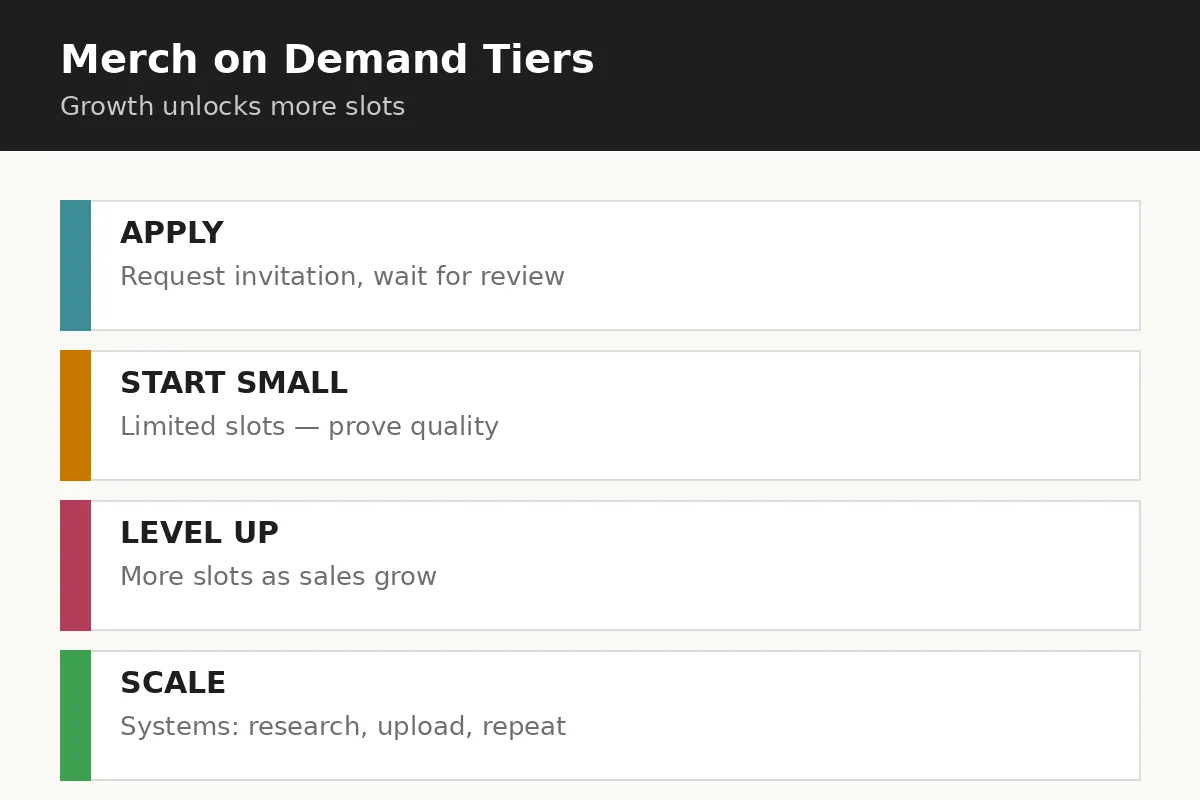
New sellers typically start with a small number of design slots — historically as few as ten live designs at a time. This is the "tier" system: as your designs sell and you fill your slots, Amazon promotes your account to higher tiers with progressively larger design allowances.
Early on, every slot is precious. Sellers usually focus on a handful of carefully researched designs rather than uploading everything at once. As sales accumulate, the constraint loosens and the work shifts from "which design deserves a slot" to managing a growing catalog — researching niches, refreshing seasonal listings, and retiring underperformers.
The practical takeaway: don't measure your first month by profit. Measure it by whether your designs are getting impressions and converting. Slot growth follows sales, and sales follow discoverability — which is why niche research and keywords matter so much.
Niche Research and Design Strategy
On Amazon, a search engine does your merchandising. The most important skill is finding phrases people actually search for but that aren't already saturated with listings. Good starting points:
- Amazon's own search bar. Type a niche word and read the autocomplete suggestions — those are real searches.
- Bestseller lists. Browse apparel bestseller rankings to see which niches (hobbies, professions, occasions) have demand.
- Specificity beats breadth. A shirt for a specific hobby-and-profession combination faces far less competition than a generic "dog lover" shirt.
- Text-based designs dominate. Identity-expressing slogans and typography consistently outperform complex illustrations in this marketplace.
One widely used approach is cross-niching: combining two interests in one design (fishing plus a tabletop game, nursing plus a hobby). A buyer who sees both of their identities on one shirt feels understood — and high-intent buyers convert better.
Color choice matters too. Dark garments — especially black — are perennial bestsellers in the t-shirt space, so designs should be conceived to look strong on dark fabric from the start.
Upload Best Practices
Getting the technical details right avoids rejections and rework:
- Use high-resolution transparent PNGs. Artwork should be crisp at print size — blurry or pixelated uploads get rejected or print badly.
- Follow Amazon's template dimensions. Amazon publishes art templates for each product; designing inside them prevents cropping surprises.
- Write the brand, title and bullets for searchers. Use a unique brand name per niche, put your main keyword naturally in the title, and use bullet points to describe the occasion and audience ("a funny gift for electricians who fish").
- Avoid keyword stuffing. Readable, buyer-focused titles outperform gibberish keyword piles.
- Proof before publishing. Check spelling, centering and color contrast on a mockup — a typo on a live listing wastes a slot and your credibility.
Trademark Caution: Protect Your Account
Intellectual-property enforcement is the single biggest account risk on Merch on Demand. Amazon can and does terminate accounts for infringement, including accounts with large catalogs and steady revenue.
The essentials:
- Learn the trademark/copyright distinction. You cannot use brand names (trademarks) or reproduce protected characters and artwork (copyright) — and many everyday phrases ("mama bear", "boy mom") are registered trademarks for apparel.
- Check phrases before uploading. The USPTO's trademark search database is free and public; checking a phrase there takes minutes and can save your account.
- Prefer original phrasing. Evergreen niches with your own wording are far safer than riding the edge of someone else's slogan.
- Steer clear of current events and celebrities. Names, likenesses and event branding are infringement minefields.
When in doubt, leave it out. One risky design is never worth the account it sits in.
Scaling: From First Sales to a Catalog
Scaling on Merch on Demand is a systems problem, not a talent problem. The pattern that works:
- Treat it as research first. Publish, watch which niches get impressions and clicks, then double down on what the data supports.
- Build a design pipeline. Whether you design yourself, use AI tools (with commercial rights and proper upscaling), or hire designers, the bottleneck is always output quality at volume.
- Balance evergreen and seasonal. Seasonal designs (holidays, events) create spikes; evergreen niches (professions, hobbies) sell year-round. A catalog weighted toward evergreen smooths out January.
- Consider Amazon ads for proven winners. A small daily budget behind a design that already converts can defend its search position — but only advertise listings with proven conversion.
- Retire dead weight. As tiers grow, slots become less scarce, but regularly auditing and removing zero-impression designs keeps your catalog healthy.
Growth compounds: more sales unlock more slots, more slots mean more niches covered, and more coverage means more data to refine your strategy.
For a broader view of how print-on-demand businesses fit together, see our print-on-demand business guide and our TeePublic review for a contrasting marketplace model.
Frequently Asked Questions
How long does Amazon Merch on Demand approval take?
It varies widely — some applicants are approved in days, others wait weeks or months, and some are rejected. Amazon does not publish its review criteria. A detailed, professional application with links to existing creative work improves your chances.
Is Amazon Merch on Demand free to join?
Yes — there are no monthly fees or listing costs in the standard program. Amazon takes its share from each sale and you keep the remaining royalty, which you influence by setting your price.
How do the design tiers work?
New accounts start with a small number of live design slots. As your designs generate sales and you fill your available slots, Amazon promotes your account to higher tiers with larger allowances. Growth is paced: early slots are precious, later tiers reward catalog volume.
Do I need to be a professional designer?
No. Many sellers use typography-based designs, licensed assets, AI-generated artwork (with proper rights and upscaling), or hired designers. What matters more than drawing skill is niche research and listing optimization.
What is the biggest risk to a Merch on Demand account?
Intellectual-property violations. Trademark or copyright infringement can lead to account termination regardless of your sales history. Always verify that phrases and imagery are clear before uploading, and keep records of your licenses and design sources.