If you're searching for a TeeSpring review in 2026, you need to hear the uncomfortable part first: multiple third-party sources report that Spring, Inc. — the company TeeSpring became in 2021 — closed its doors on September 15, 2026. Wikipedia lists the company as dissolved on that date, and independent reviews from this year describe a platform in collapse, with sellers reporting unpaid earnings. This is not a normal platform review. It's a post-mortem: what Spring was, what went wrong, and — most usefully — where to take your designs instead.
Table of Contents
Key Takeaways
- TeeSpring rebranded as Spring in 2021, pivoting from t-shirt campaigns to creator storefronts with YouTube, Twitch, and TikTok integrations.
- Wikipedia lists Spring, Inc. as dissolved on September 15, 2026, and 2026 seller reviews report payout delays — do not open a new store there.
- Its parent company, Amaze, now points creators toward Amaze Commerce.
- Redbubble, TeePublic, Printful, and Printify are the practical alternatives, depending on whether you want a marketplace or your own store.
What Was Spring (TeeSpring)?
Founded in 2011 in Providence, Rhode Island, TeeSpring invented the modern print-on-demand campaign model: you designed a shirt, set a sales goal, and the shirts were only printed if the campaign "tipped." By 2014 it had raised tens of millions in venture capital, and its name became shorthand for the viral Facebook t-shirt era.
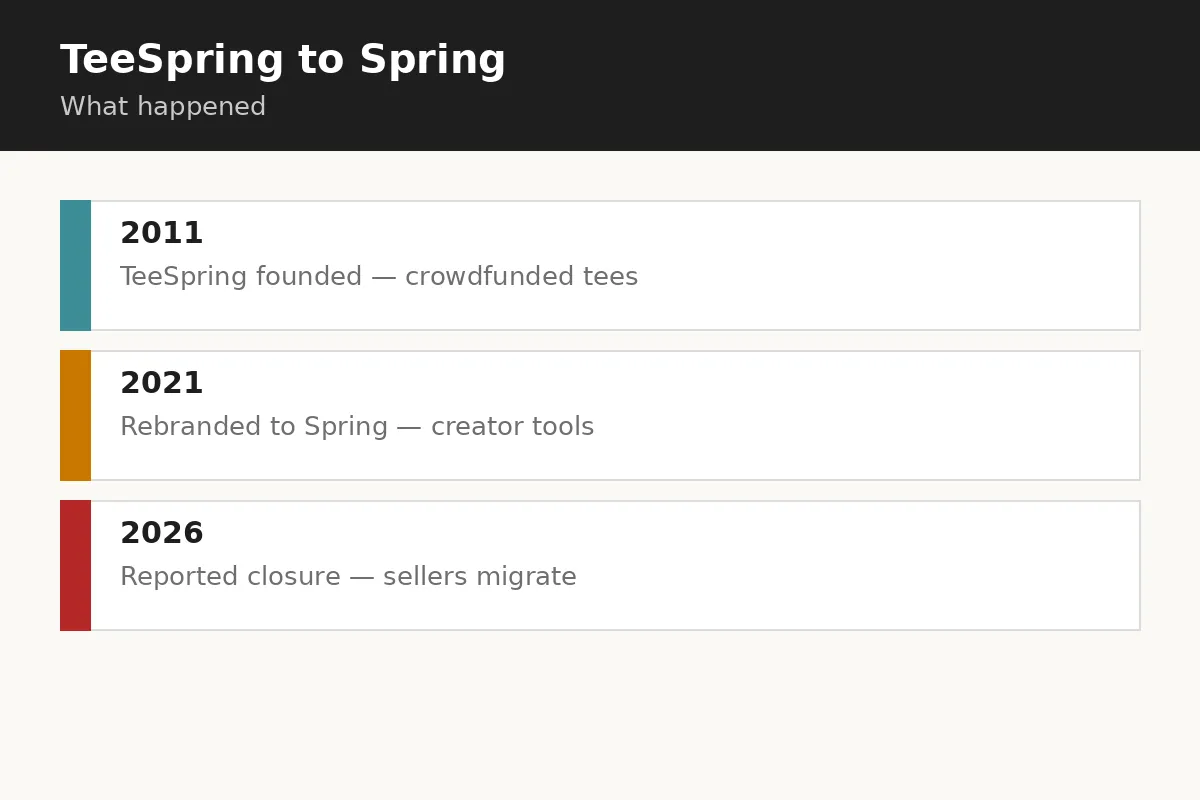
In 2021 the company rebranded as Spring — a deliberate move away from being "the t-shirt company." The new identity was built around the creator economy: free storefronts for creators, direct integrations with YouTube's merch shelf, Twitch, TikTok, and Instagram, and a catalog that expanded beyond apparel into accessories and digital products. For a stretch of years, Spring was genuinely ahead of its time on the social-commerce front. Nobody else let a streamer sell merch under a live broadcast quite as smoothly.
How Selling on Spring Worked
Spring ran on a simple base-cost model, and understanding it matters because it explains both the appeal and the fragility. You uploaded a design through Spring's web-based Launcher, chose products from the catalog, set your own retail price, and kept the difference between your price and Spring's base cost. No monthly fees, no inventory, no upfront spend. Spring handled printing, shipping, and customer service.
The catch — the one that applied to every free platform — was traffic. Spring was not a marketplace with built-in shoppers the way Redbubble is. It was a storefront: you brought the audience, usually from YouTube or TikTok, and Spring converted that attention into merch sales. Sellers who already had followings could do well. Sellers without one were shouting into a void, and a "Boosted Network" that promised to place proven designs on Amazon and eBay only activated for sellers who had already demonstrated sales — a genuine catch-22 for beginners.
What Happened in 2026: The Reported Closure
Here is what the public record currently says. Wikipedia's Teespring entry lists Spring, Inc. as dissolved on September 15, 2026. Independent 2026 reviews describe the same trajectory from the seller side: payout delays stretching for months, unresponsive support, and a platform that — in the words of one long-form seller account — had become "a shell of its former self." Trendlytic's October 2026 comparison notes that Amaze, the parent company, now redirects creators toward Amaze Commerce rather than Spring.
A note on honesty: these are third-party reports, not a press release we can link to. Platforms in decline rarely announce their own funerals. But when the public company record says "dissolved," sellers say "unpaid," and the parent company points new creators elsewhere, the pattern is consistent enough to act on. Do not open a new Spring store in 2026, and do not send traffic to an old one.
What It Did Well — and Where It Failed
Credit where it's due. Spring's strengths were real, which is why its collapse stings for the sellers who built on it:
What It Did Well
- Zero financial risk to start. No subscription, no inventory. If a design flopped, you lost time, not money.
- Creator integrations were genuinely ahead of their time. YouTube merch shelf, Twitch, and TikTok pipelines let creators sell where their audience already was.
- Done-for-you fulfillment. Spring handled printing, shipping, returns, and the dreaded "where is my package" emails.
Where It Failed
- Payment reliability broke down. The single most important job of a POD platform is paying its sellers. By 2026, seller reports say that part failed.
- You brought the traffic. Unlike marketplaces, Spring had no built-in shoppers. No audience meant no sales, and the Boosted Network gatekept the one discovery channel it had.
- Limited branding and customization. No custom neck labels, limited design tools, and a catalog that capped out around 50 product options — thin compared to Printful or Printify.
- Support went dark. Multiple seller accounts from 2025–2026 describe unresponsive support and hidden contact channels — the classic warning signs.
Who Spring Was Best For
In its working years, Spring's ideal seller was a creator with an existing audience: a YouTuber, Twitch streamer, or TikToker who wanted a free, fast merch shelf without building a store. It was never the right pick for a brand builder who wanted custom packaging, owned customer data, and real margins — that seller always belonged on Printful-plus-Shopify. And it was never the right pick for an artist who wanted to upload designs and let a marketplace bring the buyers — that artist belonged on Redbubble or TeePublic. Spring lived in the middle, and the middle turned out to be the least defensible ground.
If You Had a Spring Store: What to Do
If you still have a Spring storefront linked anywhere, treat it as dead infrastructure and act accordingly:
- Remove the links. Take Spring store links out of your YouTube descriptions, TikTok bio, and anywhere else they appear. Dead links cost you trust.
- Attempt to withdraw any balance through whatever payout channel you used (Payoneer or PayPal), and document everything in case of disputes.
- Re-upload your designs elsewhere. You retained ownership of your artwork — Spring was a fulfillment partner, not a rights holder. Your designs are portable.
- Diversify going forward. Never again keep all your merch revenue on a single free platform. The sellers who survived Spring's collapse best were the ones already selling in two places.
Alternatives for Displaced Spring Sellers
The right replacement depends on what job you were hiring Spring to do. This is a feature-based comparison, not a ranking — the best platform is the one that matches your situation.
- TeePublic — for artists who want upload-and-earn. A real marketplace with its own shoppers. Lower margins than running your own store, but zero marketing required if your designs rank. Several former Spring sellers report landing here.
- Redbubble — for artists who want the biggest marketplace. Huge built-in traffic, enormous product catalog, and no need to drive your own visitors. Trade-off: you don't own the customer relationship.
- Printful — for creators building a real brand. Plugs into Shopify or Etsy, prints most products in-house for consistent quality, and supports real branding (labels, packaging). Trade-off: higher base costs and you run your own store and traffic.
- Printify — for margin-focused sellers. A network of print providers competing on base cost, which keeps prices low. Trade-off: quality varies between providers, so you have to vet and test.
- Amaze Commerce — for former Spring loyalists. Amaze's own successor platform for creators. If you liked Spring's creator-first model, this is where the parent company is sending people.
For a broader walkthrough of how these models work, see our print-on-demand starter guide.
Frequently Asked Questions
Is TeeSpring still operating in 2026?
According to Wikipedia's company record, Spring, Inc. (TeeSpring's name since 2021) was dissolved on September 15, 2026, and independent seller reviews from 2026 describe payout failures. Its parent company Amaze now directs creators to Amaze Commerce instead.
Why did TeeSpring rebrand to Spring?
The 2021 rebrand signaled a shift from being "just a t-shirt company" to a broader creator-commerce platform, with storefronts, social-media integrations (YouTube, Twitch, TikTok), and a wider product catalog including digital products.
Was Spring free to use?
Yes. Spring charged no monthly fees and required no inventory. It made money through the base cost of each product, and sellers kept the margin between the base cost and their chosen retail price.
What is the best TeeSpring alternative now?
It depends on your model. Artists who want a marketplace with built-in traffic should look at Redbubble or TeePublic. Creators building their own branded store should consider Printful or Printify paired with Shopify or Etsy. Amaze Commerce is the parent company's own successor platform.
Do I still own my designs from my Spring store?
Yes. Sellers retained full ownership of their artwork; Spring acted as a fulfillment partner. Your designs are portable and can be re-uploaded to other print-on-demand platforms.