Printify and Printful are the two names every print-on-demand seller meets first. Both let you sell custom t-shirts, hoodies, mugs, and more without holding inventory — but they are built on fundamentally different models, and that structural difference matters more than any feature list. This comparison sticks to what is verifiable about each platform: how fulfillment works, where quality control sits, what branding options exist, and how shipping and integrations differ. No invented pricing tables, no fake ratings — just the trade-offs, so you can match a platform to your business.
Table of Contents
- The Core Difference: One Company vs. a Marketplace
- A Note on the 2024 Merger
- Product Catalog and Provider Choice
- Quality Control: Where Consistency Comes From
- Pricing Structure: Free Tiers and Paid Plans
- Shipping: Predictability vs. Flexibility
- Branding and White-Label Options
- Integrations and Ease of Use
- Matching a Platform to Your Business
- Frequently Asked Questions
Key Takeaways
- Printful fulfills orders in its own facilities; Printify routes orders through a network of third-party print providers.
- That single difference drives everything else: quality consistency, catalog breadth, shipping behavior, and branding options.
- Both offer free entry tiers with paid plans that unlock discounts and features — check current pricing on each platform's own pricing page before deciding.
- Many sellers use both: one for value lines, one for premium branded products.
The Core Difference: One Company vs. a Marketplace
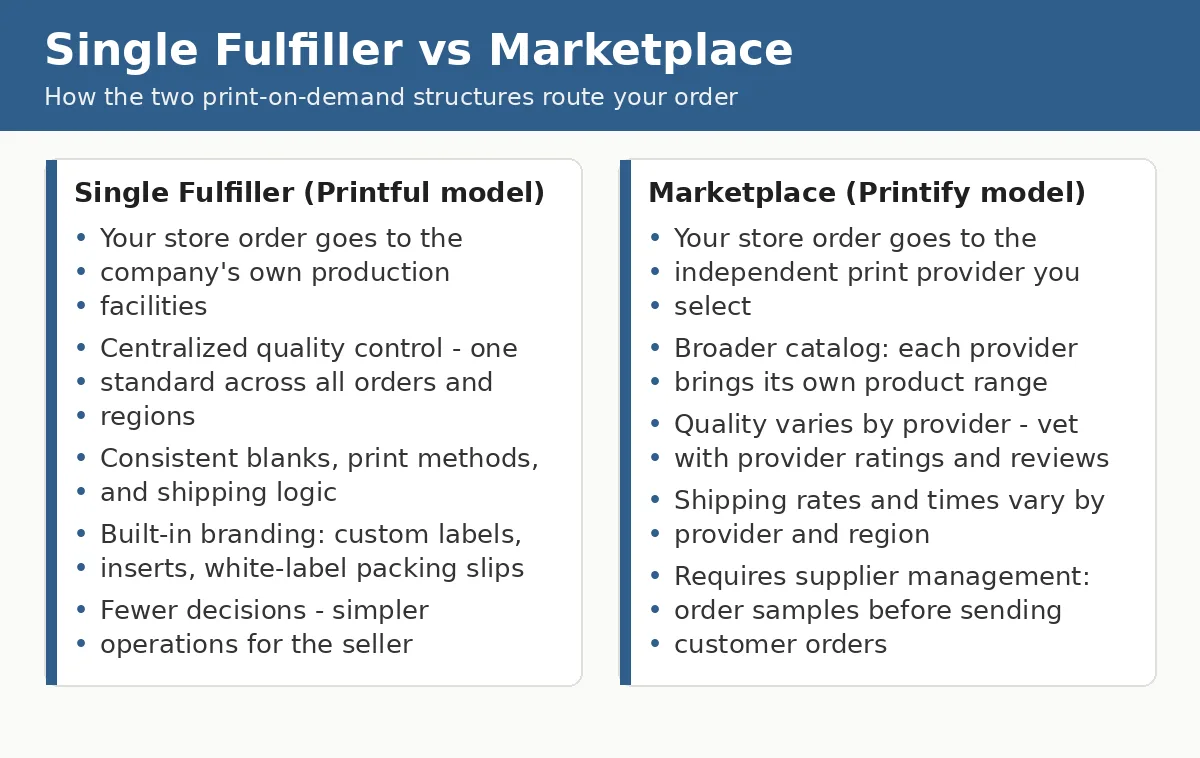
Printful is a single fulfillment company. It prints, packs, and ships your orders in its own production facilities. One company, one quality standard, one shipping logic. Printify is a marketplace: it connects your store to a network of independent print providers, and you choose which provider fulfills each product. Dozens of providers compete inside the platform, which gives you choice — and responsibility for choosing well.
Everything else in this comparison flows from that structural split. If you want to understand the print technology both rely on, start with our DTG printing guide — most apparel on both platforms is printed direct-to-garment.
A Note on the 2024 Merger
In late 2024, Printful and Printify announced a merger, bringing the two largest POD platforms under shared ownership. As of 2026, they continue to operate as separate platforms with separate provider networks, pricing, and branding. For sellers, the practical takeaway is modest: the competitive pressure that once pushed the two apart now lives under one roof, so it is worth keeping an eye on a third independent option as well. Nothing about day-to-day fulfillment has merged — a Printful order still goes through Printful's facilities, and a Printify order still goes through the provider you selected.
Product Catalog and Provider Choice
Printify's catalog is the broader of the two, because each provider brings its own product range — apparel, accessories, home goods, and niche items across many suppliers. The trade-off: the "same" product from two providers can differ in blank brand, print method, and quality, so you are effectively curating your own supply chain. Printful's catalog is a curated, single-source list. Fewer options, but every item is the same blank, printed the same way, in every facility.
For sellers testing many product ideas quickly, Printify's breadth is an advantage — you can trial unusual products without committing. For sellers building a tight, coherent line (say, a streetwear label on specific heavyweight blanks), Printful's consistency removes a variable. If you are still mapping out the business itself, our print-on-demand flagship guide covers the full setup, and the Shopify POD guide covers the storefront side.
Quality Control: Where Consistency Comes From
This is the sharpest real-world difference. With Printful, quality control is centralized: the same company that takes your order prints it, under one set of standards, with one support team accountable for the result. Orders look the same whether they ship from a US or EU facility, and if something goes wrong there is one throat to choke.
With Printify, quality varies by provider. Top-rated providers produce work equal to anything in the industry; weaker ones do not. Printify surfaces provider ratings and reviews, and experienced sellers standardize on two or three vetted providers per region. The practical discipline: always order samples from any provider before sending them customer orders, and re-sample periodically — providers change blanks and equipment. This vetting work is the real cost of Printify's flexibility; it is learnable, but it is work.
Pricing Structure: Free Tiers and Paid Plans
Both platforms are free to start: no setup fees, no order minimums, you pay when orders happen. Both also sell paid subscription tiers that unlock lower per-item costs and extra features. The honest way to compare them is structural rather than numerical, because exact prices and plan names change:
- Printful: higher base per-item costs on average, reflecting in-house production and included quality control. Paid tiers reduce costs once volume justifies them.
- Printify: lower per-item costs on average, because providers compete on price inside the marketplace. The paid tier amplifies those savings and is where margin-focused sellers usually land.
Do not decide on a screenshot of someone's pricing table — open both platforms' current pricing pages, price your actual best-selling product from each, and compare your real margin. Anything else is someone else's math.
Shipping: Predictability vs. Flexibility
Printful's shipping is centralized and predictable: standard rates per product and region, with production and transit times you can quote to customers confidently. Printify's shipping varies by provider — each sets its own rates and production times, and providers cluster in different regions. That variability is a feature if you route US orders to a US provider and EU orders to an EU provider (faster delivery, lower cost per region); it is a headache if you let orders scatter across providers without a routing strategy.
Either way, publish honest delivery estimates in your store and pad them slightly. POD production plus shipping is slower than Amazon Prime, and managing that expectation is a customer-service decision, not a platform feature.
Branding and White-Label Options
Printful is the stronger branding platform: custom neck labels, branded packaging inserts, and white-label packing slips are built into its offering (some as paid add-ons). For a premium brand where the unboxing matters, this is a genuine differentiator. Printify's branding options are thinner and provider-dependent — some providers offer custom labels, many do not, and packaging is generally plain and unbranded.
If your brand strategy leans on packaging as marketing, that alone can settle the decision. If you sell primarily on marketplaces where packaging is invisible to the buying decision, it matters much less.
Integrations and Ease of Use
Both integrate with the major sales channels — Shopify, Etsy, WooCommerce, and others — with automatic order syncing and tracking. Printful's integration list is slightly broader and its mockup generator is widely regarded as best-in-class, which speeds up product creation. Printify counters with a straightforward product-creation flow and its own mockup tools, plus a few marketplace connections Printful lacks.
On ease of use, the difference is philosophical: Printful is simpler because there are fewer decisions (one catalog, one fulfillment path). Printify asks more of you upfront — choosing providers, comparing blanks — but rewards that effort with lower costs and more options. Beginners who want the shortest path to a first sale usually find Printful simpler; sellers comfortable with supplier management usually find Printify's flexibility worth it.
Matching a Platform to Your Business
Rather than a single winner, here is how the trade-offs map to seller profiles:
- Choose Printful if you are building a premium brand where every order must look identical; branded packaging and inserts are core to your unboxing; you sell at price points with room for higher base costs; or you want the simplest operations with no provider management.
- Choose Printify if you compete on price or operate on thin margins; you want to test a wide range of products before committing; you are comfortable vetting providers and standardizing on a few good ones; or you sell on price-sensitive marketplaces where unit economics dominate.
- Consider both if your catalog has tiers: many established sellers run value products through Printify providers and premium branded lines through Printful.
Whichever you pick, the design fundamentals do not change: high-resolution files, honest mockups, and print-aware artwork. Our t-shirt design guide and AI design guide cover that side of the business.
Frequently Asked Questions
What is the main difference between Printify and Printful?
Printful is a single fulfillment company that prints in its own facilities; Printify is a marketplace connecting you to a network of independent print providers. That structural difference drives their catalog breadth, quality consistency, shipping behavior, and branding options.
Is Printify or Printful better for beginners?
Printful is simpler for beginners: one catalog, one fulfillment path, and centralized quality control mean fewer decisions. Printify offers lower costs and more choice but requires vetting providers — manageable, but real work. Both are free to start, so testing both with sample orders is the most reliable way to decide.
Did Printful and Printify merge?
Yes — the two companies announced a merger in late 2024 and operate under shared ownership as of 2026. They still run as separate platforms with separate fulfillment networks, pricing, and branding, so the day-to-day comparison in this article still applies.
Can I use Printify and Printful at the same time?
Yes, and many sellers do. A common setup is running value-tier products through vetted Printify providers for margin, while premium branded lines go through Printful for consistency and packaging. Both integrate with the same sales channels, so they can serve different products in one store.
Which has better print quality, Printify or Printful?
Printful's quality is more consistent because it is centralized in its own facilities. Printify's quality varies by provider — the best providers match or exceed Printful, while weaker ones do not. On Printify, always order samples from a provider before sending them customer orders.