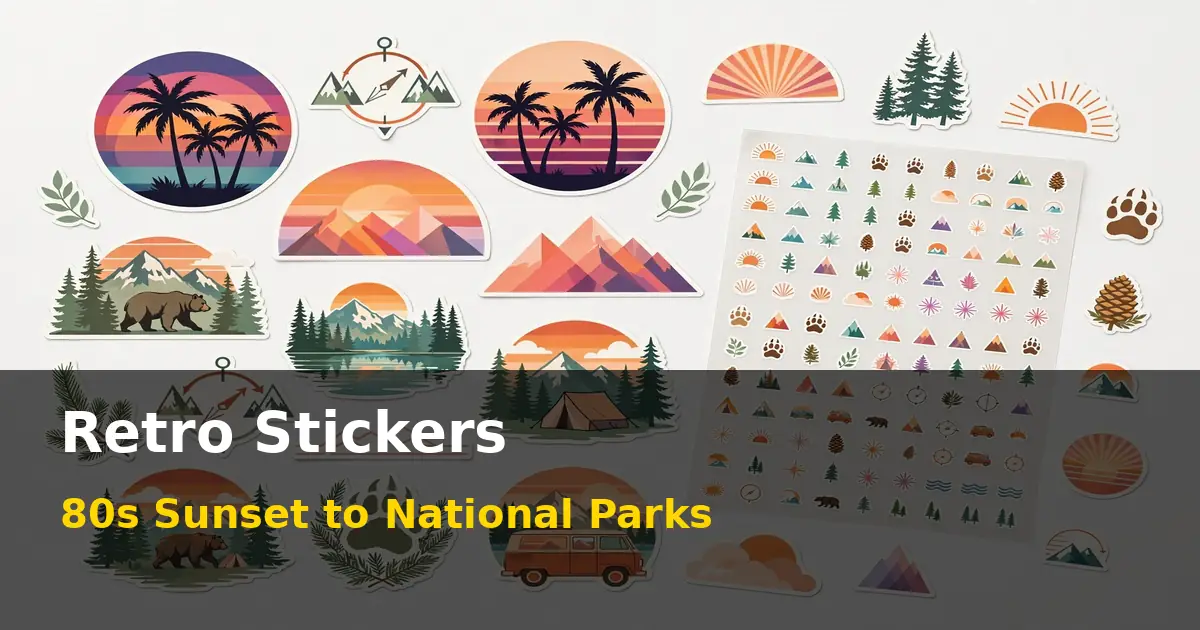
Walk into any specialty coffee shop and you will see them: a neon-striped sun sliced by horizontal scanlines on one laptop, a 1930s-style mountain badge on the next, and bold varsity block letters on a water bottle nearby. Retro stickers are not one trend — they are three distinct design movements sharing the same 3-inch vinyl canvas. This guide breaks down the 80s synthwave sunset, the national park badge, and the collegiate Americana lanes, then shows you how to buy well and stick them where they last.
The search results for retro stickers are almost entirely marketplace listings. Nobody is explaining which lane fits you, which finish survives on a water bottle, or how to spot a design that will peel by spring. That is the gap this guide fills: an editorial buying guide for all three retro sticker lanes, with real designs from our own collection.
Table of Contents
Key Takeaways
- Retro stickers fall into three lanes: 80s synthwave, national park badges, and collegiate Americana — each with its own visual rules.
- Die-cut vinyl with UV laminate is the workhorse finish; matte reads vintage, holographic reads synthwave.
- Match the lane to the surface: sunset stickers pop on dark laptops, park badges suit earthy gear, varsity letters suit tech and journals.
- Heat the adhesive before removal and the sticker comes off clean; residue yields to rubbing alcohol.
The Three Lanes of Retro Stickers
Lane 1 — the 80s synthwave sunset. The sliced neon sun, the perspective grid floor, the Miami Vice palette of hot pink, cyan, and orange. It signals retro-gaming, synth music, and a lo-fi digital lifestyle. Its DNA is early computer graphics: the stepped gradients of a Commodore-era screen, the scanlines of a CRT monitor.
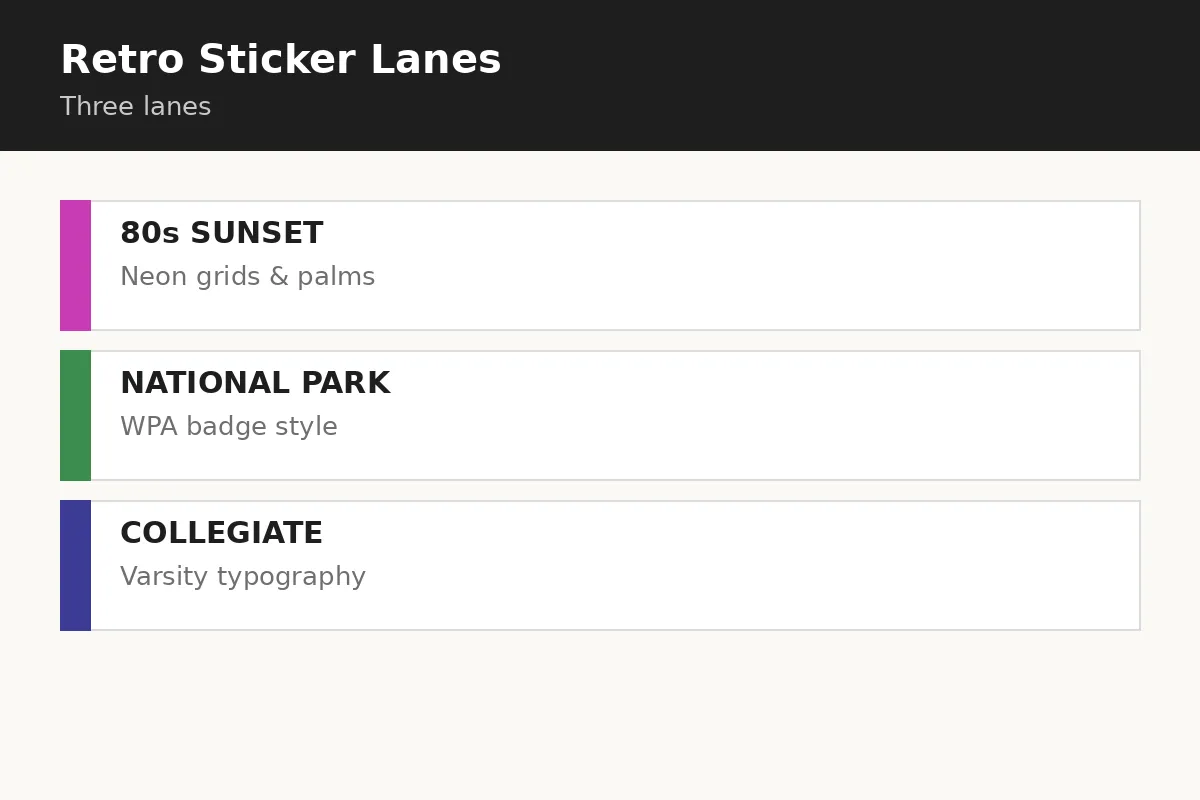
Lane 2 — the national park badge. Limited palettes of ochre, forest green, and burnt orange; geometric mountains; woodblock typography. Its lineage runs through the WPA Federal Art Project posters of the 1930s, which used bold flat shapes to promote the national parks. Today the style has become a travel resume — a badge of places visited, or places aspired to.
Lane 3 — collegiate Americana. Heavy varsity block letters with 45-degree angled corners, slab serifs in the Ivy style, distressed textures that mimic decades of screen-print wash. It projects heritage, permanence, and quiet confidence — the visual language of a 1950s letterman jacket translated to a laptop lid.
The lanes mix well in a sticker-bomb collage, but they rarely mix well as a single design. A sunset with a varsity font feels confused; a park badge with holographic finish loses its vintage soul. Pick your lane first, then shop inside it.
Anatomy of Each Lane
What makes a synthwave sunset authentic: the sun should never be a solid circle — horizontal slices widening toward the bottom, a perspective grid leading to the horizon, and a stepped (not smooth) gradient that nods to limited 80s color depth. Palms or mountains are optional garnish.
What makes a park badge authentic: four to six flat colors, geometric simplification (triangles for mountains, chevron pines), heavy woodblock or Futura-style typography, and a subtle halftone grain. The best ones feel like they could have hung in a 1930s train station.
What makes collegiate type authentic: the 45-degree angled corner of the varsity block (a legacy of cutting felt by hand), tight letter spacing that mimics sewn patches, a white contour cut of 2–3mm around the letters for legibility on dark surfaces, and classic color pairings — forest green and cream, navy and gold, burgundy and white.
Sticker Finishes: A Buying Guide
The finish changes the era a design reads as. Die-cut vinyl with UV laminate is the default workhorse: waterproof, dishwasher-safe, and rated for years of outdoor exposure. Matte laminate softens colors and reads vintage — ideal for park badges and collegiate designs. Holographic vinyl is pure synthwave; use it for 80s designs, but know it can look busy on detailed art. Glossy UV-coated vinyl is the most vibrant and weather-resistant, though glare can wash it out in sunlight. Transparent vinyl looks like glass art on car windows but needs a white-ink underlay to stay vivid.
Check two things before buying: that the sticker is vinyl-based (not paper) if it will touch water, and that the adhesive is high-tack if the surface is powder-coated, like many insulated water bottles.
Real Designs From Our Collection
These are real designs from our own collection — each one an example of its lane done right:

"Forbidden Forest National Park" Sticker
A vintage hiking-badge design in the national park lane — earthy palette, bold badge typography. The sticker listing lives on our Redbubble page; pick stickers (or any garment) there.

"We Ride at Dawn" Frog & Goose Sticker
A chaotic-meme take on retro design — bold type, vintage illustration energy. Works in a sticker-bomb collage or on its own. Available as a sticker on our Redbubble page.

"Retro Elk" Americana Sticker
A vintage fall hunter scene in the Americana lane — forest tones, nostalgic badge layout. On our Redbubble page, pick the sticker or browse the other garments carrying this artwork.
Where to Stick Them
Laptops: sunset stickers and varsity letters pop against dark lids; park badges read best on silver or matte surfaces. Cluster three to five in varying sizes rather than placing one lonely sticker. Water bottles: powder-coated bottles demand high-tack vinyl; this is where the national park "travel resume" lives. Cars and windows: transparent vinyl or die-cut vinyl with UV laminate; clean the glass with isopropyl alcohol first. Journals and planners: collegiate stickers pair naturally with the dark-academia aesthetic — matte finish keeps the vintage illusion intact.
Building a Collection That Reads as Curated
A random assortment of stickers reads as clutter; a curated set reads as a personality. The trick is a loose color thread: if most of your stickers share two or three colors — say, burnt orange and cream, or neon pink and black — even wildly different designs hang together. Vary the sizes: one large anchor sticker (3–4 inches), a few mediums (2–3 inches), and smalls to fill gaps. Leave breathing room between stickers on a laptop lid; on a water bottle, wrap them in a band around the middle rather than scattering them everywhere.
Collect by story, not by impulse. A bottle that documents a road trip — one park badge per stop — is more interesting than five sunsets bought on the same afternoon. And retire stickers that no longer fit: a clean peel with heat keeps the collection evolving instead of fossilizing.
Quick Buyer's Checklist
Before you add to cart, run through this: Material — vinyl, not paper, for anything that touches water. Finish — matte for vintage lanes, holographic for synthwave. Adhesive — high-tack for powder-coated bottles. Size — measure the surface, not your optimism; a 4-inch sticker overwhelms a phone case. Artwork quality — zoom the listing photos; blurry edges at screen size become blurry edges at print size. UV resistance — stated explicitly for car and outdoor use. Miss any one of these and the sticker fails early, no matter how good the design is.
Application and Removal
Apply to a clean, dry surface at room temperature. Smooth from the center outward to avoid air bubbles; a credit card edge works as a squeegee. For removal, heat the sticker gently with a hair dryer, peel slowly from one corner, and wipe any residue with rubbing alcohol or a citrus-based cleaner. Vinyl on glass and metal comes off cleanly; on painted surfaces, test a corner first.
Frequently Asked Questions
What are the three main retro sticker styles?
The three dominant lanes are the 80s synthwave sunset (neon, scanlines, grids), the national park badge (earthy palette, WPA-style illustration), and collegiate Americana (varsity block lettering, distressed textures). Each has its own visual rules and best-use surfaces.
Are retro stickers waterproof?
Vinyl-based stickers with a UV laminate are waterproof and dishwasher-safe, suitable for water bottles and cars. Paper-based stickers are not — check the material before applying one to anything that gets wet.
Which finish looks most vintage?
Matte laminate. It softens colors and gives a paper-like feel while keeping the waterproof benefits of vinyl. Holographic and glossy finishes read modern or synthwave, not vintage.
How do I remove a sticker without residue?
Warm the adhesive with a hair dryer, peel slowly from one corner, and clean any remaining residue with rubbing alcohol or a citrus-based adhesive remover.
Can I mix retro sticker styles on one surface?
Yes — sticker-bomb collages thrive on mixing lanes. The trick is varying sizes and keeping a loose color thread so the cluster reads as curated rather than random.