Buying a vintage t-shirt online is a different skill from buying anything else. The item is one of one, the seller's photos are your only inspection, and a modern reprint can be made to look convincingly "thrashed" in a factory. The good news: once you know the four types of marketplaces, the red flags that mark a scam, and how to read a listing like a collector, you can shop with confidence. This guide consolidates everything — where to look, what to check, and what to do when the real thing is out of budget.
Table of Contents
The Four Marketplace Types, Compared
Every place you can buy a vintage tee online falls into one of four buckets. Each has a different risk/reward profile, and most collectors use a mix of all four.
1. Peer-to-peer marketplaces (eBay, Depop, Poshmark, Mercari)
This is the digital flea market — the largest inventory and the best chance of an underpriced find, because many sellers are clearing closets, not running businesses. eBay's saved searches and filters are the most powerful tools in vintage hunting: set an alert for a specific tag or tour and you'll hear about new listings before the flippers do. The trade-off is that you're doing your own authentication, and these platforms are flooded with modern reproductions. Best for: bargain hunters who've learned the authentication basics. Watch out for: vague descriptions, stock photos, and sellers who can't provide a tag photo on request.
2. Curated vintage shops (Grailed, WyCo Vintage, Ragstock, Round Two)
Curated shops do the digging and authenticating for you — items are inspected, measured, and usually checked for issues like dry rot before listing. You pay a premium for that expertise, but the risk of buying a fake drops to near zero. Grailed's community skews toward streetwear and hype vintage; shops like WyCo and Ragstock carry broader inventories across decades. Best for: buyers who value certainty over deals, and anyone purchasing their first expensive piece. Watch out for: the markup — you're paying for the shop's eye, rent, and time.
3. General marketplaces (Etsy)
Etsy hosts serious vintage dealers who run their shops like boutiques, and its sellers tend to provide the most detailed measurements of any platform — crucial, since vintage sizing is erratic. The catch is search: Etsy's algorithm mixes true vintage with "vintage-inspired" handmade items, so filter carefully and read whether a listing says "vintage" or "vintage style." Best for: 70s and 80s pieces from professional sellers. Watch out for: repro shops using the word "vintage" loosely.
4. Community and direct sellers (Instagram dealers, forums, flea markets)
Archival dealers on Instagram source from estate sales and rag houses, and repeat customers can even request specific pieces. Flea markets (Rose Bowl, Brooklyn Flea and their equivalents) are where online inventory originates — getting there early is the original "saved search." The downside is structural: Instagram has no built-in buyer protection, and flea markets are cash-and-carry. Best for: experienced collectors building relationships. Watch out for: zero recourse if something goes wrong; always use a payment method with protection.
Scam Red Flags: Walk Away When You See These
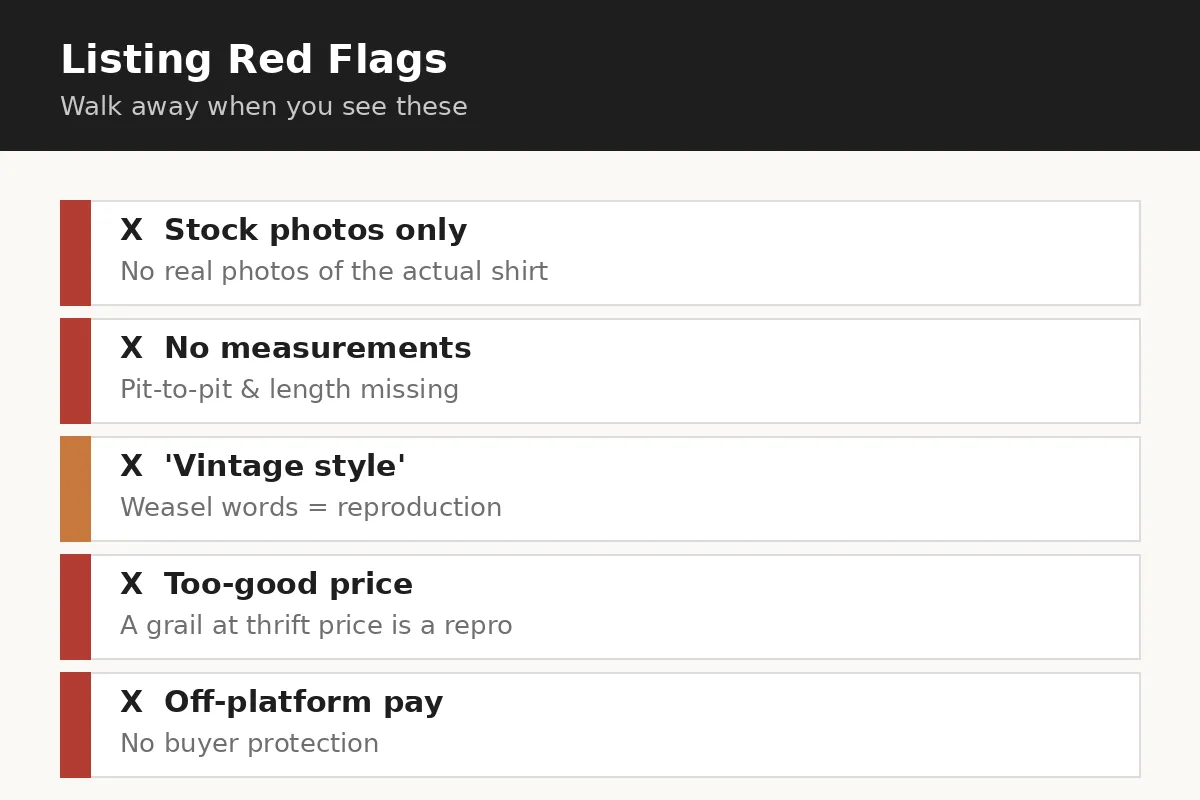
Most vintage scams follow the same playbook. If a listing shows two or more of these signs, move on no matter how good the shirt looks:
- Stock photos or a single blurry image. A legitimate seller photographs the actual shirt — front, back, tag, and stitching. A listing with one dark photo (or a manufacturer's mockup) is hiding something.
- No measurements, only a tag size. A 90s "Large" can be wider and shorter than a modern Medium. Refusing to provide pit-to-pit and length measurements is either laziness or deception; either way, don't buy.
- A price far below market for a "grail." Nobody accidentally lists a genuinely rare tour shirt for the price of a sandwich. Too-good-to-be-true pricing on hyped items means reproduction.
- The word "vintage" doing all the work. Phrases like "vintage style," "vintage-inspired," or "retro look" in the fine print mean it's a modern shirt. True vintage sellers say the era outright.
- Pressure to pay off-platform. Any seller steering you away from the marketplace's checkout to a direct transfer is removing your buyer protection. Legitimate dealers don't need to do this.
- Tag and stitching don't match the claimed era. A shirt "from 1988" with double-stitched hems and a modern heat-pressed neck label is a reprint — this is the single most common tell. For a deeper breakdown, see our single-stitch vs double-stitch authentication guide.
How to Read a Listing Like a Collector
Before you bid or hit buy, run through this checklist. It takes two minutes and filters out the vast majority of bad purchases:
- Measurements first. Ask for pit-to-pit (armpit to armpit, laid flat) and length (top of shoulder to hem) in inches. Compare against a shirt you own that fits well. Never trust the tag size alone.
- Demand the tag photo. Learn the hallmark manufacturers — Screen Stars, Brockum, Giant, Winterland, Hanes Beefy-T — and what their tags looked like by decade. A modern tag on an "80s" shirt ends the conversation.
- Check the stitching. Single-stitch hems (one visible line of thread on sleeves and bottom hem) indicate early-90s or earlier construction; double-stitching became standard around the mid-90s. Mismatched stitching and claimed era is a red flag.
- Read the print. Genuine vintage plastisol prints crack in a "shattered glass" pattern and feel slightly raised; modern water-based or heat-transfer prints fade evenly or feel like a sticker sitting on the fabric. Look for the tiny copyright line under licensed graphics — counterfeiters often omit it or get the font wrong.
- Ask about dry rot. Black shirts from the late 80s and early 90s can suffer fiber breakdown from sulfur-based dyes — a shirt that looks perfect can tear like paper. Ask the seller whether the fabric has been tug-tested, especially on black blanks.
- Scan for condition honesty. Good sellers photograph flaws: pinholes, stains, collar wear. A listing that claims "perfect vintage condition" with no flaw photos deserves skepticism — thirty-year-old cotton is never perfect.
Want the full picture on what makes a vintage tee valuable once you've verified it's real? Read our guide to finding, styling, and valuing vintage t-shirts.
Negotiating, Offers, and Returns
Vintage pricing is a negotiation, not a price tag — except at curated shops, where the authentication premium is the point.
- Make offers, politely. On eBay, Depop, and Poshmark, offering 10–20% below asking is normal etiquette. Reference sold listings (not asking prices) for comparable pieces when justifying your number.
- Use saved searches. eBay alerts for specific tags, tours, or graphics notify you the moment something lists — speed matters, because underpriced pieces sell within hours.
- Bundle to save on shipping. Many P2P sellers will combine shipping or discount multi-item purchases if you ask before paying.
- Check return policies before buying. Curated shops usually accept returns; P2P sellers often list "final sale," especially on low-priced items. If a seller won't accept returns and won't provide measurements, that's two red flags — skip it.
- Pay through the platform. Marketplace buyer protection only applies to on-platform transactions. On Instagram, use a payment method that allows disputes — never a direct transfer to a stranger.
The Vintage-Inspired Alternative
Sometimes the math doesn't work: the authentic piece is out of budget, the size you need doesn't exist, or you'd rather wear a shirt daily than preserve a collectible. Vintage-inspired designs — new artwork with retro typography, distressed textures, and era-correct graphics — give you the look without the hunt, the dry rot risk, or the collector pricing. Here are two genuinely vintage-styled designs from our own collection:

"Vintage Goose" 90s Retro Folk Art
A 90s-style farmhouse graphic with the distressed, lived-in feel collectors chase — without the fragility of a thirty-year-old blank. Available on Redbubble on sweatshirts, tees, and other products; pick your garment on the product page.
View on Redbubble →
"Retro Elk" Vintage Fall Scene
A 90s-style wilderness graphic in the Americana-nostalgia tradition — the kind of design that looks pulled from a 1994 hunting lodge. Available on Redbubble on sweatshirts, tees, and other products; pick your garment on the product page.
View on Redbubble →Looking for more vintage-styled artwork? Browse the full designs collection — new pieces are added regularly.
Frequently Asked Questions
What does "single stitch" actually mean?
Single stitch refers to the sewing technique used on hems and sleeves primarily before the mid-90s — one visible line of thread instead of two parallel lines. It's the quickest visual indicator that a shirt is true vintage rather than a modern reprint.
Is it safe to buy vintage t-shirts on Instagram?
It can be, but it's the riskiest channel because there's no built-in buyer protection. Only buy from established dealers with verifiable references and reviews, and always pay with a method that allows disputes — never a direct transfer to someone you don't know.
How do I know if a vintage shirt will fit me?
Never trust the tag size — a 90s Large is often cut wider and shorter than a modern Large, and decades of washing cause shrinkage. Always get pit-to-pit (width) and shoulder-to-hem (length) measurements and compare them to a shirt you own that fits well.
What is dry rot and how can I avoid it?
Dry rot is the chemical breakdown of cotton fibers, most common in black shirts from the late 80s and early 90s. The fabric becomes brittle and tears with almost no effort. Before buying, ask the seller whether the fabric has been tug-tested — reputable dealers check for this.
How should I wash a vintage t-shirt?
Cold water, gentle cycle, inside out — and never a dryer. Heat destroys old fibers and flakes vintage prints. For thin or valuable pieces, hand washing and air drying is the safest approach.