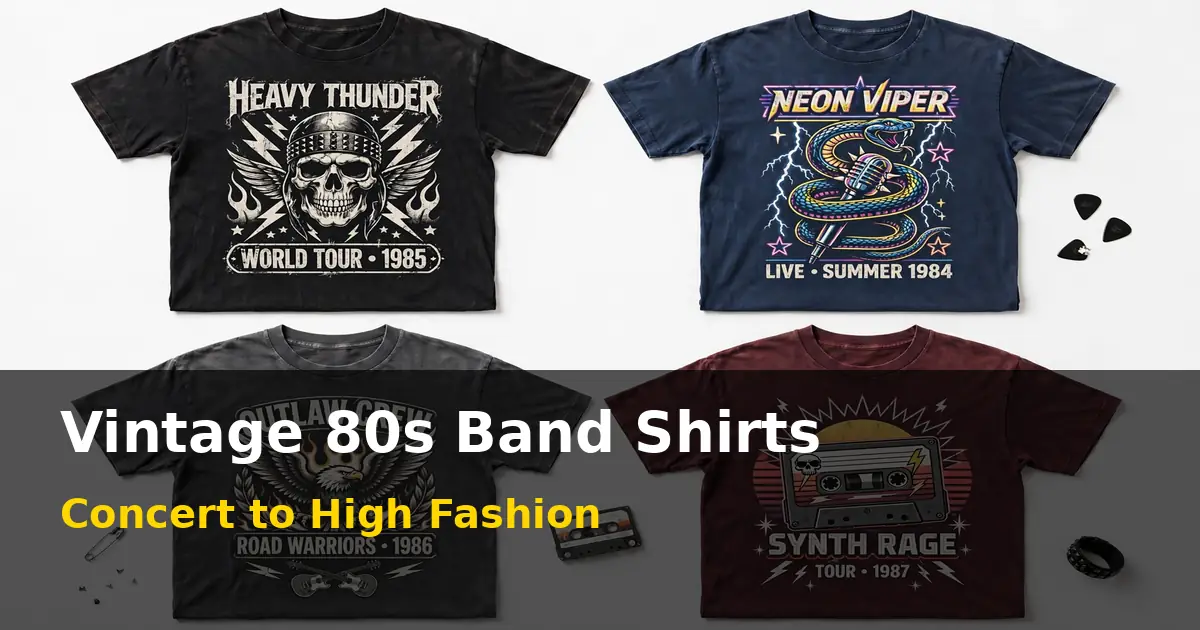
For those who lived through the 1980s, a band shirt was not just a garment — it was a tribal marker. In an era before social media, wearing a 1984 tour shirt broadcast your identity, your politics, and your musical allegiance to the world. Today those same shirts have moved from $10 souvenirs to serious collector pieces. This guide covers how to authenticate genuine 80s band shirts, which genres collectors chase, how originals compare to modern reissues, and how to keep 40-year-old cotton alive.
Table of Contents
The Cultural Weight of the 80s Band Tee
The 80s represent a sweet spot in textile history. Manufacturing moved away from the heavy, boxy 100% cotton of the 70s toward soft, breathable 50/50 cotton-polyester blends. These shirts drape differently — they feel like a second skin. If you have ever handled a genuine mid-80s metal tour shirt, you know the feeling: light, airy, carrying the ghosts of a thousand mosh pits. Modern manufacturing cannot quite replicate that broken-in 50/50 hand, which is one reason originals keep their premium.
Authentication: Avoiding the Repro Trap
You are at a flea market. You see a Joy Division Unknown Pleasures shirt priced at real money. Genuine 1980s artifact or clever counterfeit aged with tea and sandpaper? To a pro, it is all in the details:
1. The Single-Stitch Rule
The golden rule of vintage hunting. Look at the sleeve hem and the bottom hem: authentic 80s shirts almost always use single-stitch construction — one visible line of thread. Modern shirts (post-1994, generally) use double-stitch. A shirt claiming to be from 1985 with double stitching is a modern reprint. See our single-stitch vs double-stitch guide for the full breakdown.
2. The Tag
The tag is the shirt's proof of life. In the 80s, the dominant blanks were Screen Stars (especially the "Best" and white-label variants), Spring Ford, and Hanes (the Beefy-T). A "Made in Pakistan" or "Made in China" tag on an 80s band shirt is a massive red flag — authentic 80s merch was almost exclusively Made in the USA. Our tag identification guide covers how to read these labels.
3. Screen Print Cracking
80s printers used thick plastisol inks that sat on top of the fabric. Over 40 years, that ink dries out and develops a characteristic organic, spider-web cracking that follows the stretch of the fabric. Modern "distressed" prints usually look too uniform by comparison.
4. Copyright and Licensing
Most officially licensed 80s concert tees carry a copyright date printed just below the graphic. It should align with the tour or album year. A copyright date alone does not prove age — cross-check it with the tag and stitching — but a mismatch (say, a 2005 date on an "80s" shirt) ends the discussion immediately.
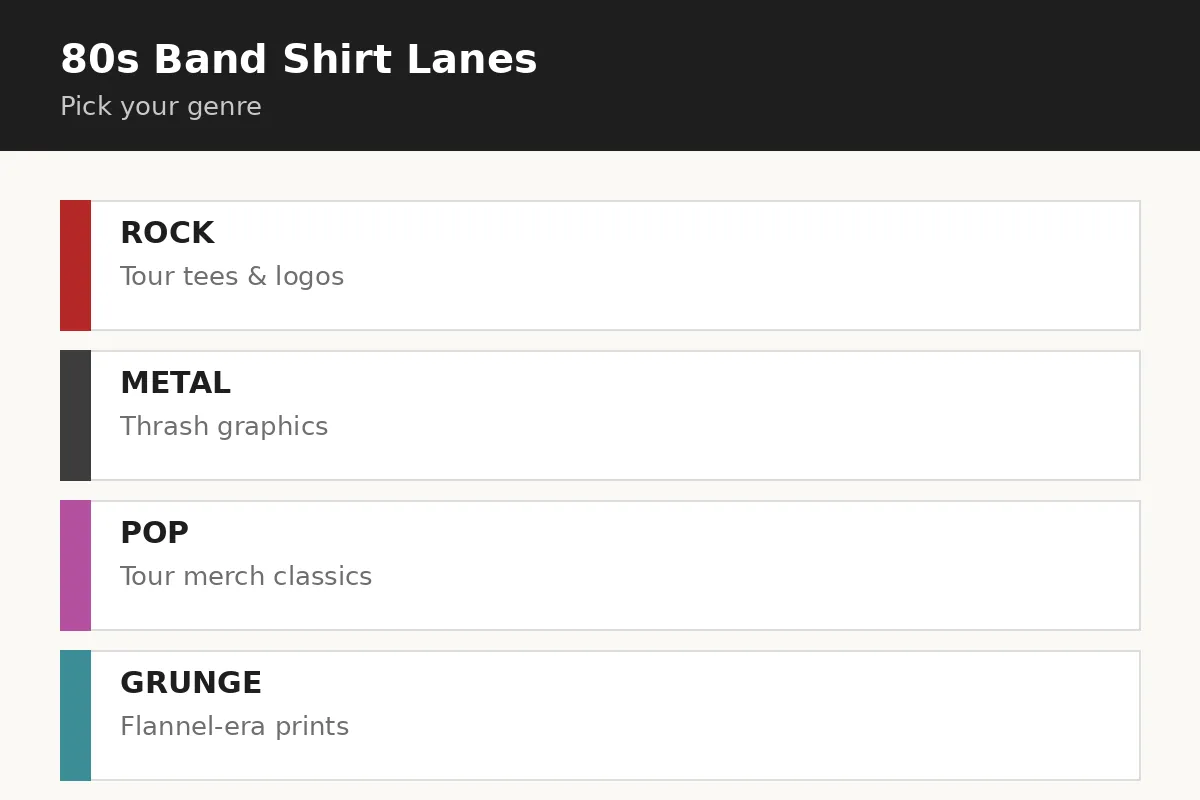
The Genre Lanes: Metal, New Wave, Punk
The 80s market is stratified by genre — and curiously, the more underground a band was in 1985, the more valuable the shirt tends to be today:
- Heavy Metal: The undisputed kings of the vintage market. Intricate artwork — Iron Maiden's Eddie, Metallica's Pushead-era designs — makes for graphics that still look stunning four decades on. Tour shirts with back prints listing dates are the most collected format.
- New Wave and Goth: The Cure, Depeche Mode, The Smiths. These shirts often feature minimalist designs on higher-quality cotton, and they cross over heavily into the high-fashion world — the aesthetic favored by designers working in the slim, dark silhouette.
- Hardcore Punk: Black Flag, Bad Brains, Minor Threat. Often printed in tiny batches on whatever cheap blanks were available, which makes them incredibly rare. A genuine early-80s hardcore shirt is the unicorn tier of the hobby.
Do not overlook parking-lot shirts — the unofficial bootlegs sold outside venues. Collectors often prize them for bizarre, unsanctioned artwork that is even rarer than the official merch. And keep an eye on staff and crew shirts: printed for venue employees and never sold to the public, they combine tiny production runs with genuine wear history, and they remain underappreciated relative to headliner tour merch.
Original vs. Modern Reissue
Why pay collector prices for an old shirt when a licensed reprint costs a fraction? An honest comparison:
- Fabric feel: Authentic 80s vintage is paper-thin, soft, and breathable. Modern licensed reprints tend to be heavier, stiffer cotton. High-end boutique repros get closer with pre-washed "vintage feel" blanks, but rarely match the real thing.
- Stitching: Originals are single-stitch; mass-market reprints are double-stitch. Some boutique repros replicate single-stitch — which is exactly why you never authenticate on one signal alone.
- Value trajectory: Authentic pieces have a collector market with recorded sales; reprints have essentially no resale value. Buy the original for the collection, the reprint for the gym.
- The look: For pure style with no hunt involved, a well-made reissue does the job. Be honest with yourself about which buyer you are.
Wearing the 80s Look Without the Hunt
If you want the 80s aesthetic without the authentication homework or collector prices, modern retro-styled designs deliver the vibe on new garments. These are new designs with a vintage look — not authentic vintage pieces:

Mystical Sun & Moon Vintage Bohemian Tee
A vintage-bohemian sun-and-moon graphic in the psychedelic tradition that ran through 80s metal and rock art. Available on Redbubble; pick your garment on the product page.
View on Redbubble →
"Vintage Goose" Retro Design
A throwback folk-art graphic with a retro look that pairs well with the 80s casual uniform of tees and denim. Available on Redbubble; pick your garment on the product page.
View on Redbubble →Where to Hunt 80s Band Shirts
Knowing what to look for is half the battle; knowing where to look is the other half:
- Flea markets and swap meets: The classic hunting ground. Arrive early, bring cash, and check the tag before you negotiate — sellers respect buyers who know what they are looking at.
- Estate sales: Some of the best 80s pieces surface here, often from original owners who bought the shirt at the show. Ask whether the seller attended the tour; provenance details like ticket stubs add confidence.
- Record fairs and music conventions: Dealers here tend to know their inventory, so prices run higher — but authentication is usually already done for you.
- Thrift stores: The lowest prices and the lowest hit rate. The trick is volume and speed: learn to spot single-stitch hems and 50/50 fabric by touch without stopping to inspect every shirt.
- Curated online sellers: Higher prices, but reputable sellers photograph tags, stitching, and flaws. For your first few purchases, paying the "knowledge premium" is cheaper than buying a fake.
Wherever you hunt, run the same authentication routine every time: tag, stitching, print, copyright. Consistency is what keeps you from buying a story instead of a shirt.
Preservation and Care for 40-Year-Old Cotton
A genuine 80s shirt is a museum piece that happens to be wearable. Treat it like one:
- Hand wash only in cold water with a gentle, pH-neutral detergent.
- Never use warm or hot water — it can cause ink bleeding and further shrinkage.
- The towel roll: do not wring. Lay flat on a clean towel, roll it up, and press to remove water.
- Air dry flat on a rack. Never hang a wet vintage tee — the water's weight stretches the neck and shoulders.
- Keep it out of the dryer entirely. High heat shatters old screen prints and melts the fragile polyester fibers in 50/50 blends.
For how condition affects what a shirt is worth, see our vintage t-shirt grading guide.
For the broader framework of what makes any vintage shirt collectible, see our guide to the most valuable vintage t-shirts, and browse the design collection for retro-styled pieces.
Frequently Asked Questions
How can I tell if a shirt is from the 80s or 90s?
80s shirts are almost always single-stitched with a slimmer, longer fit and often 50/50 blends. 90s shirts moved toward heavyweight 100% cotton, double-stitching, and a boxier, oversized fit.
What does 50/50 mean on a vintage tag?
50% cotton and 50% polyester — the standard 1980s blank composition, notably from Screen Stars. It is thinner, softer, and more shrink-resistant than 100% cotton.
Are parking-lot bootleg shirts valuable?
Often yes. Unofficial shirts sold outside 80s venues were printed in tiny runs with unique artwork, making them rarer than the official merch — and collectors prize that rarity.
Why are 80s band shirts so expensive?
Supply and demand. Most were worn to destruction decades ago, so surviving high-quality examples are genuinely rare — and current fashion favors the distressed 80s silhouette.
Should I buy an original or a reissue?
Buy the original if you are collecting or investing; buy the reissue if you just want the look for everyday wear. A reissue has the style at a fraction of the price but essentially no resale value.